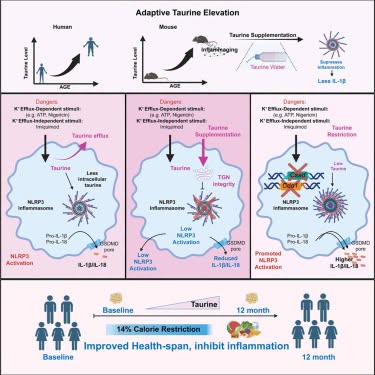
This 2023 Columbia University study used a taurine dose of 500-1000mg/kg in mice.
After appropriate allometric scaling, this converts to a dose of about 2.8-5.7g for a 70kg human.
This 2.8-5.7g dose range would be appropriate doses to test in human clinical trials to try to replicate the findings in mice.
Because mice have much faster metabolism than humans, you cannot simply use the same dose/kg in humans. You must apply an allometric scaling factor to adjust for the difference in metabolism. The FDA provides guidelines on how to do that for clinical trials (see comments).
Here is the math according to the FDA guidelines for allometrically scaling mouse doses to humans:
Divide 500-1000mg/kg by 12.3 to allometrically scale. This gives you a dose range of 40.7-81.3mg/kg for humans. Multiply that by 70kg to get 2.8-5.7g.
This 2.8-5.7g dose range is in line with taurine doses used in previous human studies, although on the high end. And it is in the range of what people actually take (e.g. athletes) when they supplement with taurine, although again on the high end.
Please note that this allometric scaling only gives you a very crude estimate of what might work in humans. It is only a starting point that needs to be refined by appropriately testing dose ranges in human clinical trials. This analysis is only meant to give you a rough feeling of what doses might work in humans. Emphasis on might.