Patients with kidney disfunction need to be careful with metformin.
(Paradoxically, metformin may actually protect the kidneys of healthy people. But once kidney function becomes impaired for other reasons, this is no longer true.)
Louis notes patients with kidney dysfunction need care with metformin; paradoxically it may protect healthy kidneys, but that no longer holds once function is impaired. Based on a shared review.
Patients with kidney disfunction need to be careful with metformin.
(Paradoxically, metformin may actually protect the kidneys of healthy people. But once kidney function becomes impaired for other reasons, this is no longer true.)
Is the "Gold Standard" Diabetes Drug Hitting Your Kidneys Harder Than We Thought?
For decades, metformin has reigned as the undisputed "first-line" treatment for Type 2 Diabetes. Praised by clinicians for its low cost, cardiovascular benefits, and general safety, it is the metabolic cornerstone for millions of patients worldwide. However, as a health journalist tracking the intersection of clinical research and patient safety, I’ve found that even the most trusted "gold standards" deserve a second look. Emerging research now points toward a challenging paradox: while metformin is hailed as a protector, new evidence suggests it may actually be accelerating organ decline in a specific, vulnerable population—those with moderate chronic kidney disease (CKD).
- The Crux of the Metformin Paradox: A Chasm in Outcomes
The primary finding of a recent retrospective cohort study conducted at Kaohsiung Medical University Hospital is nothing short of striking. By tracking the "eGFR slope"—the rate at which kidney filtration function changes over time—researchers exposed a massive chasm between patients who stayed on the drug and those who walked away.
The data reveals two very different trajectories:
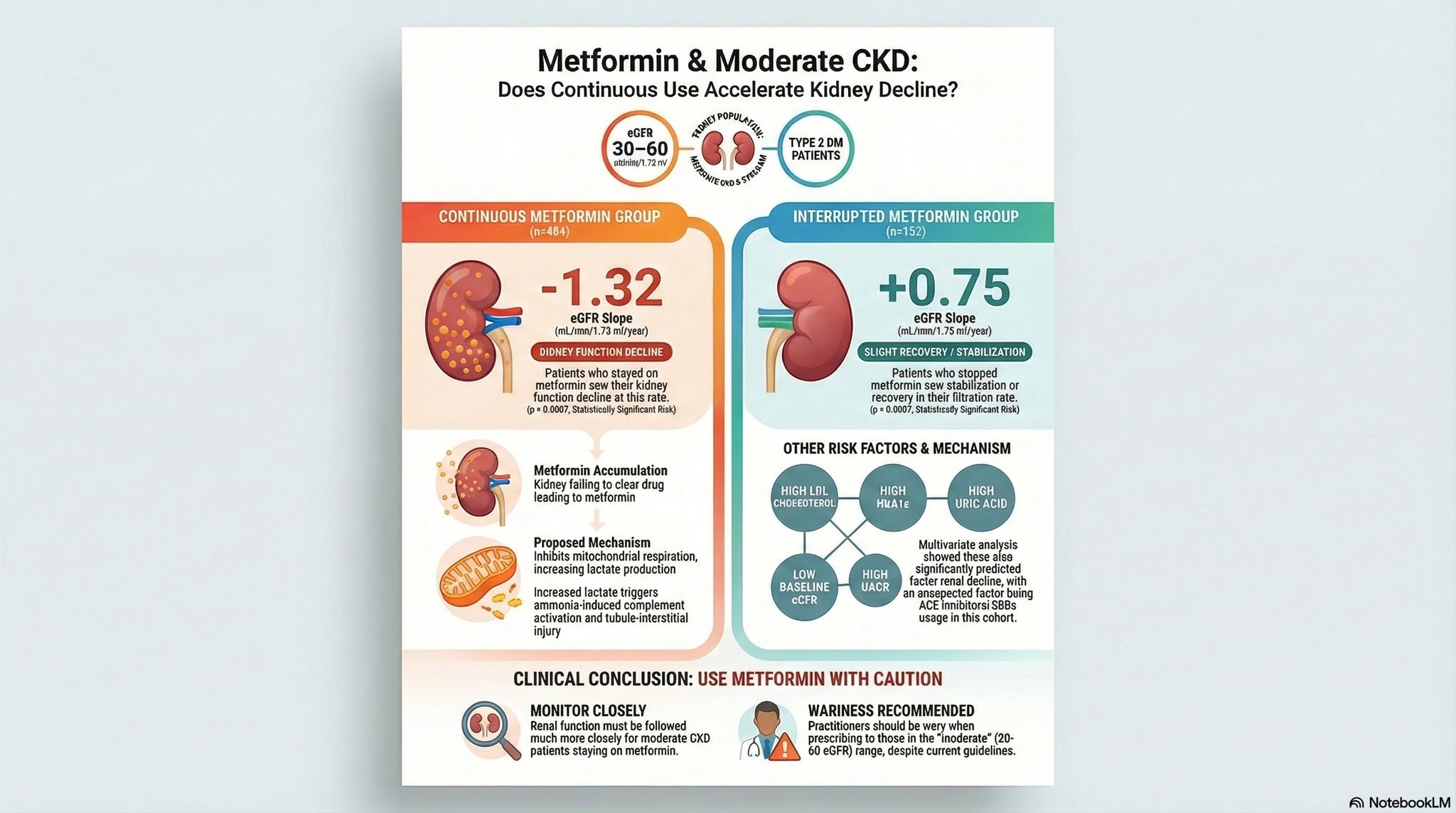
- Metformin Continuation: Patients saw a significant decline in function, with a slope of –1.32 mL/min/1.73 m²/year.
- Metformin Interruption: Patients who stopped the drug for at least 100 days saw their decline not only slow, but essentially halt, achieving a positive slope of 0.75 mL/min/1.73 m²/year.
This is the heart of the paradox. In this cohort, stopping the drug appeared to stabilize renal function, while continuing it was a primary risk factor for further damage. As the study bluntly concludes:
"Metformin may have an adverse effect on renal function in patients with type 2 DM and moderate CKD."
- Is the FDA "Safe Zone" Too Broad?
In 2016, the FDA revised its safety guidelines, shifting the contraindication for metformin from serum creatinine levels to eGFR. This move effectively expanded the "safe zone," approving metformin for patients with moderate CKD (specifically those in the eGFR 30–59 ml/min/1.73 m² range).
However, the reality of how the body processes this drug suggests that even this "approved" range might be a danger zone for some. Metformin is unique because it is excreted unchanged by the kidneys. This creates a lethal feedback loop: as kidney function begins to slip—even slightly—metformin accumulates in the system. This accumulation can further damage the kidneys, making them even less efficient at clearing the drug, eventually spiraling toward toxicity.
- The Invisible Mechanism: From Mitochondria to Acidosis
To understand why this happens, we have to look at the cellular level. Metformin works, in part, by inhibiting mitochondrial respiration. While this helps manage glucose, it also encourages the production of lactate. Usually, the liver (60%) and kidneys (30%) clear this lactate. But when the kidneys are compromised, they lose the ability to metabolize this excess, leading to the invisible threat of metabolic acidosis.
This isn't just a chemical imbalance; it’s a physical assault on the organ. This acidosis triggers "tubule-interstitial injury," which directly mediates the decline in eGFR. Recent analysis also suggests that metformin may interfere with oxidative stress responses and epigenetic modifications, specifically DNA methylation, potentially rewriting the cellular health of the kidney under the pressure of high glucose. The risk is well-documented in clinical history:
"Metformin users with a renal function of eGFR <60 mL/min/1.73 m2 had a higher risk of lactic acidosis or elevated lactate concentrations." (Cited from a previous clinical study in Diabetes Care)
- The "Multiplier" Risk Factors: When Metformin Meets Vulnerability
The study highlights that metformin doesn't act in a vacuum. Its impact is worsened by specific "multipliers" that accelerate renal decay. According to the research, patients are at much higher risk of a steep eGFR decline if they also present with:
- High serum LDL-C (Bad Cholesterol): High lipids accelerate atherosclerosis in the renal microcirculation, essentially "clogging" the kidney's delicate filters.
- High UACR (Urinary Albumin Creatinine Ratio): A high UACR at baseline is a hallmark of existing damage that makes the kidney less resilient.
- High HbA1c: Persistent hyperglycemia acts as a predictive factor for the progression of diabetic kidney disease.
- Low baseline eGFR and high uric acid levels.
Perhaps most surprising was the correlation regarding blood pressure medications. ACE inhibitors (ACEIs) and Angiotensin Receptor Blockers (ARBs), which are traditionally considered "renoprotective" (kidney-protecting), were associated with a decline in eGFR within this specific metformin-using group. While the researchers noted this might be due to selection bias (meaning the sickest patients were the ones prescribed these drugs), it nonetheless serves as a warning that standard protective measures may not be enough when metformin is in the mix.
- A Call for Clinical Caution
While the medical community shouldn't abandon a drug that has helped millions, this research—despite the limitations inherent in its retrospective nature—demands a shift in clinical caution. For patients sitting in the "middle ground" of moderate CKD (eGFR 30–60), the "set it and forget it" approach to metformin is no longer viable.
The takeaway for clinicians and patients is clear: renal function in this moderate range must be monitored with much greater frequency than current standards dictate. We are learning that the "gold standard" can lose its luster when applied to the wrong patient.
In our quest for the perfect first-line treatment, are we overlooking the nuanced needs of patients whose kidneys are already under stress? The evidence suggests that for the moderate CKD population, it may be time to ask if the drug intended to help is the very thing standing in the way of their recovery.