High iron levels have been repeatedly linked with aging and cardiovascular disease.
This new 40-month study in monkeys adds substantially to the evidence.
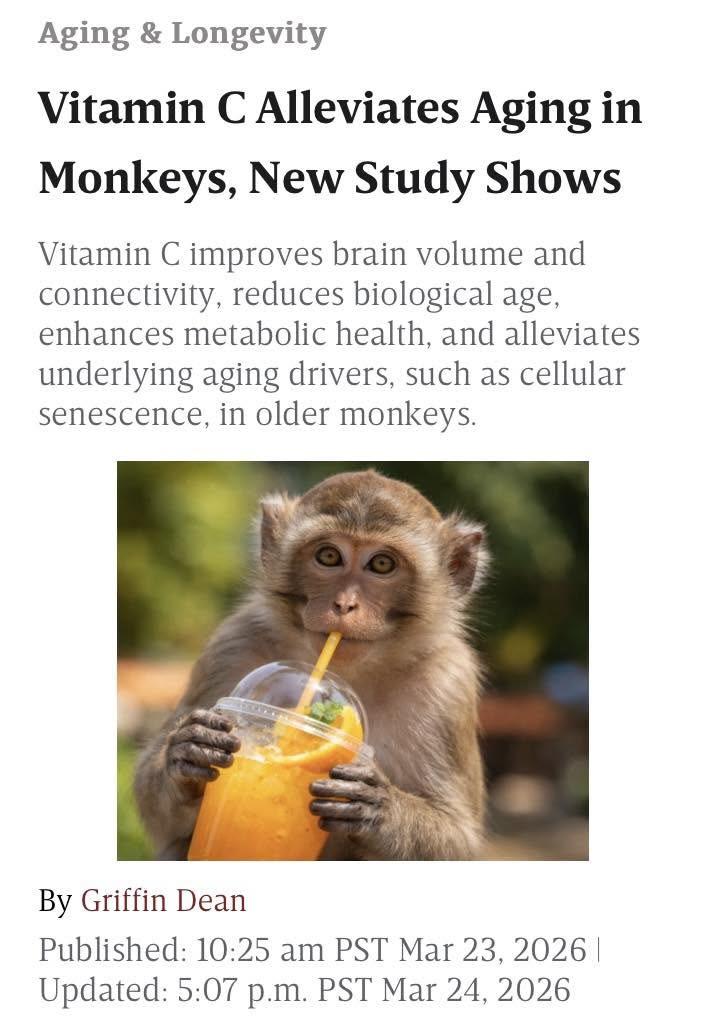
Vitamin C might offer some protection.
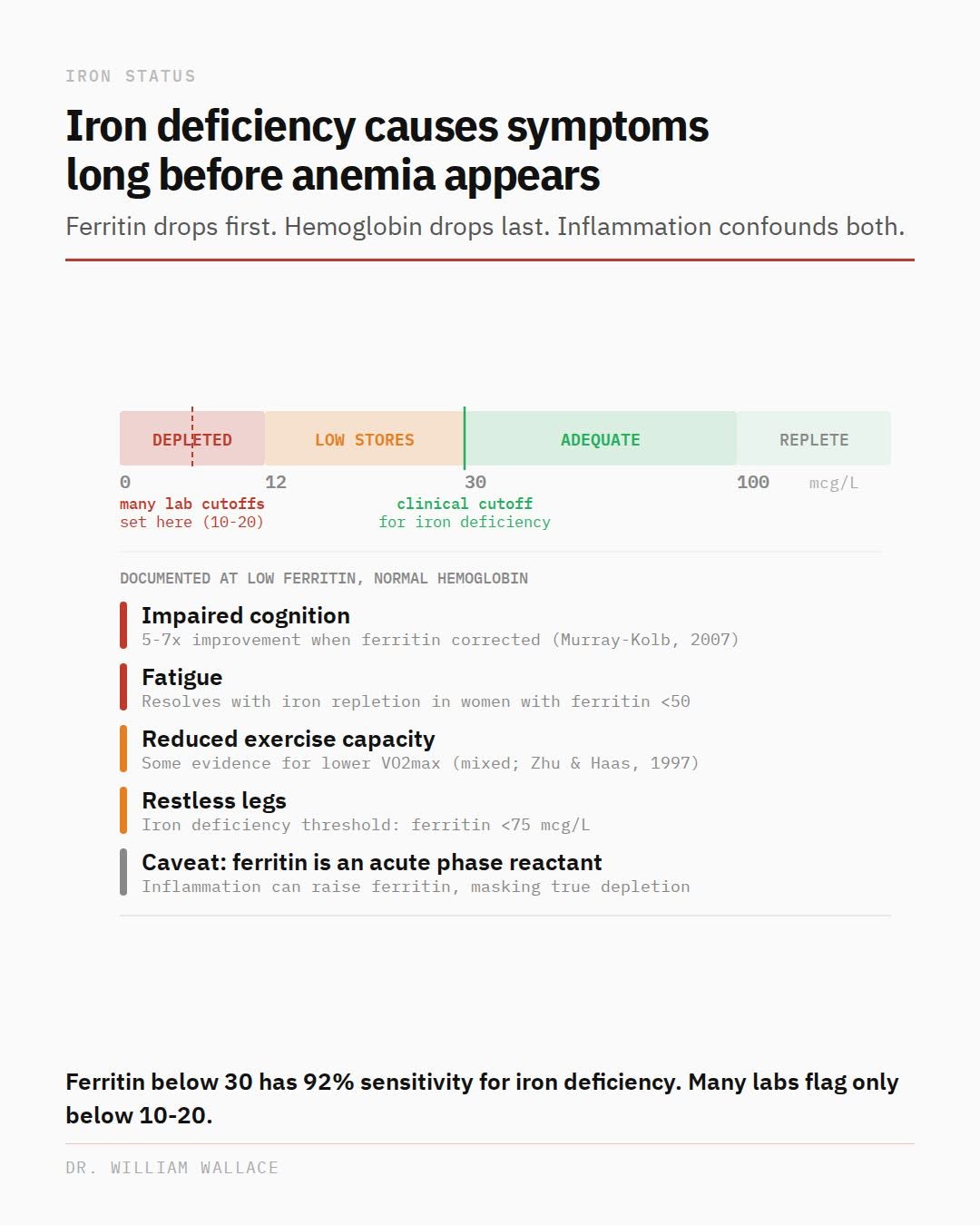
I’ve argued in the past that keeping your ferritin levels towards the lower end of the normal range is probably wise, if your goal is to slow aging and CVD: ↪ Should you take iron for low-normal ferritin? Probably not without symptoms or a cause. (This is assuming you have no signs or symptoms of iron deficiency or anemia, and have no clinical need for extra iron such as pregnancy or heavy menstrual bleeding.)
Link to journal paper:
“Vitamin C inhibits ACSL4 to alleviate ferro-aging in primates” (Cell Metabolism, Apr 2026)
Paper · Cell MetabolismCell Metabolism articlecell.com
Quoted from the journal paper:
“Aging is associated with oxidative stress, but specific druggable pathways remain elusive. Here, we define a conserved iron-lipid axis driving primate aging, termed “ferro-aging.” Multi-tissue profiling in humans and non-human primates reveals age-progressive iron accumulation, fueling chronic lipid peroxidation orchestrated by acyl-coenzyme A (CoA) synthetase long-chain family member 4 (ACSL4). Distinct from acute ferroptosis, this ACSL4-mediated process promotes cellular senescence and systemic functional decline. The therapeutic inhibition of hepatic ACSL4 via gene editing alleviates aging phenotypes in mice.
Through functional screening and target engagement studies, we identify vitamin C (VC) as a direct inhibitor of ACSL4. Long-term VC administration in aged monkeys for over 40 months potently reduces ferro-aging signatures across tissues, attenuates multi-organ pathology, and improves neurological and metabolic functions. Multi-omic aging clocks indicate the VC-mediated reversal of biological age.
Our work establishes ferro-aging as a core, targetable mechanism of primate aging and positions VC as a translatable geroprotective strategy through ACSL4 inhibition.”
Note that the mTOR-inhibiting drug rapamycin reduces iron accumulation via the hormone hepcidin. This is true of mTOR inhibition, in general. It causes ferritin levels to drop. See this reference:
“Iron: an underrated factor in aging” (Aging, Oct 2021)
aging-us.comLink to aging-us.comaging-us.com
facebook.com/share/p/1ZYW8eejj6
Quoted from that reference: “In turn, mTOR also exerts control over iron metabolism, and the inhibition of mTOR activity by rapamycin leads to inhibition of iron accumulation via the iron-regulating hormone hepcidin [10]. Transplant patients taking sirolimus (rapamycin) often develop a microcytic anemia, which has been linked to sirolimus-induced iron deficiency [11]."
As the post below mentions, the new study in monkeys identifies hepcidin dysregulation with age as contributing to tissue iron retention. This is a regulatory failure that appears to be part of aging itself, not simply a consequence of eating too much iron. Rapamycin (and mTOR inhibition, in general) directly addresses this.
This might be an under-appreciated mechanism by which rapamycin works to extend lifespan in animals. It might also be an under-appreciated way in which natural methods to inhibit mTOR (such as calorie restriction and fasting) extend lifespan in animals.
#ironHD #ferritinHD #vitamincHD #agingHD #longevityHD #cvdHD #monkeysHD #redmeatHD #acsl4HD #hepcidinHD #ferroagingHD #ferroptosisHD #peroxidationHD #fentonreactionHD
NEW STUDY ON AGING AND WHAT IT MIGHT MEAN FOR YOUR DIET
An interesting paper just dropped in Cell Metabolism that I think deserves your attention, with some very important context.
Researchers identified what they're calling "ferro-aging", a chronic, age-related process where iron gradually accumulates across multiple organs (liver, heart, lung, brain, muscle), driving lipid peroxidation via an enzyme called ACSL4, which promotes cellular senescence and organ decline. This is distinct from ferroptosis, which is acute cell death. Think of ferro-aging as a slow smoldering oxidative process that accelerates biological aging across tissues.
The mechanistic work is compelling. ACSL4 appears to act as a central switch, overexpressing it alone in young cells was sufficient to accelerate senescence, and knocking it down in senescent cells reversed it. And CRISPR knockout of ACSL4 in aged mice improved cognitive and motor function systemically. Solid potential causal evidence, not just correlation.
The headline finding is that Vitamin C was identified as a direct ACSL4 inhibitor, not just a generic antioxidant as it's typically categorized, but specifically binding to and suppressing the enzyme driving this process. In aged monkeys given oral Vitamin C (30mg/kg bodyweight) for 40 months, aging clocks showed biological age reversal of roughly 4-7 years across multiple organs, with improvements in brain structure, metabolic markers, insulin sensitivity, triglycerides, HDL, and visceral fat.
That's a pretty remarkable finding if it holds up.
NOW FOR THE NUANCE, BECAUSE THERE'S PLENTY OF IT....
Whether oral Vitamin C achieves the tissue concentrations needed for meaningful ACSL4 inhibition in humans remains an open question, especially because absorption rates drop significantly the more you take in. So this should not simply be interpreted as telling everyone to run out and start megadosing.
The dietary question no one discussing this study is talking about directly....
The paper identifies hepcidin dysregulation with age as contributing to tissue iron retention. this is a regulatory failure that appears to be part of aging itself, not simply a consequence of eating too much iron. Some people are already using this to imply dietary iron is therefore irrelevant to ferro-aging, ie "don't worry, you can keep eating your steak". That's a complete overreach for what we know.
Here's what the paper actually says about this subtopic:
NOTHING.
It doesn't study dietary iron's role in ferro-aging at all. That question is completely open.
What we know from existing literature is relevant though. Heme iron, the form found in red meat, enters intestinal cells via a transporter called HCP1 that largely bypasses the regulated absorption system. Non-heme iron, found in plant foods, is far more tightly regulated by that system. And critically, the hepcidin axis this paper identifies as becoming dysregulated with age is load-sensitive, meaning chronic high heme iron intake and the age-related failure of iron regulation may interact in ways we don't yet fully understand, but certainly possibly in a very negative way.
The honest scientific position to take here is that whether high habitual heme iron consumption accelerates ferro-aging or not is an important and still open question this paper didn't address. Anyone telling you it's definitely fine is going beyond the evidence.
What about Vitamin C and plant-based diets specifically?
This is an interesting wrinkle. Whole food plant-based diets are already associated with lower ferritin and lower tissue iron stores compared to omnivorous diets, largely because non-heme iron is more tightly regulated and plant foods contain phytates that further limit absorption (though not enough to cause deficiency if eating a high quality diet). If ferro-aging is partly driven by chronic iron accumulation, this may represent an underappreciated protective mechanism of WFPB eating that deserves more research attention.
Plus, people eating whole food plant-based diets typically have substantially higher Vitamin C intake than omnivores, often well above the RDA, simply from fruit and vegetable consumption. Whether typical WFPB Vitamin C intake is sufficient to meaningfully inhibit ACSL4 and stop or slow this process is still unknown. The monkey study here used 30mg/kg/day, which in humans would be several hundred milligrams of supplemental C on top of typical dietary intake. However it is also very interesting to consider the fact that vitamin C in foods is significantly better absorbed than purified vitamin C so eating a high vitamin C diet technically doesn't cross over directly here and it may not be necessary to consume that much. Also, chronically low Vitamin C status, which is more common in heavily meat-centered diets with low produce intake, may be relevant here also. I am especially concerned here about carnivore diet eaters simultaneously eating tons of high heme iron red meat and at most just the tiny amounts of vitamin C necessary to just stave of acute scurvy.
Not a good combo according to this research!!
Does all this mean WFPB eaters are protected from ferro-aging? We don't know. Does it mean carnivore dieters should be concerned? We don't know that either with certainty, but it sure makes me nervous for them for yet another reason.
More to come on this as the research develops.