Should you supplement with iron for ferritin in the lower part of the normal range?
I’ve been asked this question twice in the last week:
"What if my ferritin levels are towards the bottom of the normal range, but my other blood markers are fine and I have no signs or symptoms of iron deficiency or anemia? Should I take iron supplements?"
Step One: Consult Your Doctor
Before making any changes, talk to your physician. While low-normal ferritin isn't necessarily a red flag for a problem, it is a signal to check for a source of iron loss, such as dietary gaps or gastrointestinal issues (e.g. bleeding).
You could have iron deficiency without anemia (IDWA), which might raise the risk for CVD.
Iron deficiency—particularly full blown anemia—can increase the risk of blood clotting (thrombosis). It often causes reactive thrombocytosis, where the body overproduces platelets, leading to a "sticky" or hypercoagulable state.
Also, low iron reduces the blood’s ability to carry oxygen (anemia), which can lead to decreased oxygen levels in the heart and brain.
If you have IDWA or full blown anemia, it needs to be corrected. The doctors best qualified to treat this are hematologists, especially in complex cases.
The Case Against Extra Iron
If your health is otherwise good and you are asymptomatic with no other evidence of IDWA or anemia, I believe taking supplemental iron is generally a bad idea. There is little evidence that low-normal ferritin is harmful in the absence of clinical signs or symptoms or other evidence of IDWA or anemia. But there is substantial evidence suggesting that lower iron stores within the healthy range may actually be beneficial.
The Science of Iron and Aging
Iron is a double-edged sword. While essential for life, it can also be harmful. For example, it is a potent pro-oxidant. Through a process called the Fenton Reaction, free iron in the body reacts with hydrogen peroxide to create hydroxyl radicals—highly reactive molecules that damage lipids (peroxidation), proteins, and DNA.
Research increasingly suggests that iron accumulation may be a causal factor in both cardiovascular disease and the aging process itself.
My interpretation of the current literature is that lower is generally better, provided you remain within a healthy physiological range and do not experience signs or symptoms of deficiency.
More Details on the Science
Iron is an indispensable micronutrient required for numerous biological processes, including oxygen transport (hemoglobin/myoglobin), mitochondrial respiration, electron transport, and DNA synthesis and repair. It is vital for growth and development, particularly for neural development and myelination.
However, iron's essentiality is balanced by its potential for toxicity. Its redox activity allows it to act as a catalyst for harmful oxidative reactions.
Reactive Oxygen Species (ROS) Generation: Free (labile) iron— particularly in the ferrous form— catalyzes the Fenton reaction, where it reacts with hydrogen peroxide to produce highly toxic hydroxyl radicals.
Lipid Peroxidation: These ROS attack polyunsaturated fatty acids (PUFAs) in cellular membranes, leading to a self-propagating chain reaction known as lipid peroxidation.
Ferroptosis & Ferro-aging: Iron-dependent lipid peroxidation is the hallmark of ferroptosis and ferro-aging, forms of regulated cell death and senescence associated with iron overload, which contributes to various pathologies, including neurodegenerative diseases, cardiovascular diseases (e.g. atherosclerosis), and ischemia/reperfusion injury— and likely the aging process.
Due to this duality, iron levels are tightly regulated by a complex network of proteins (e.g. transferrin for transport, ferritin for storage, ferroportin for export) and controlled by systemic hormonal regulation (hepcidin) to minimize the presence of toxic free iron.
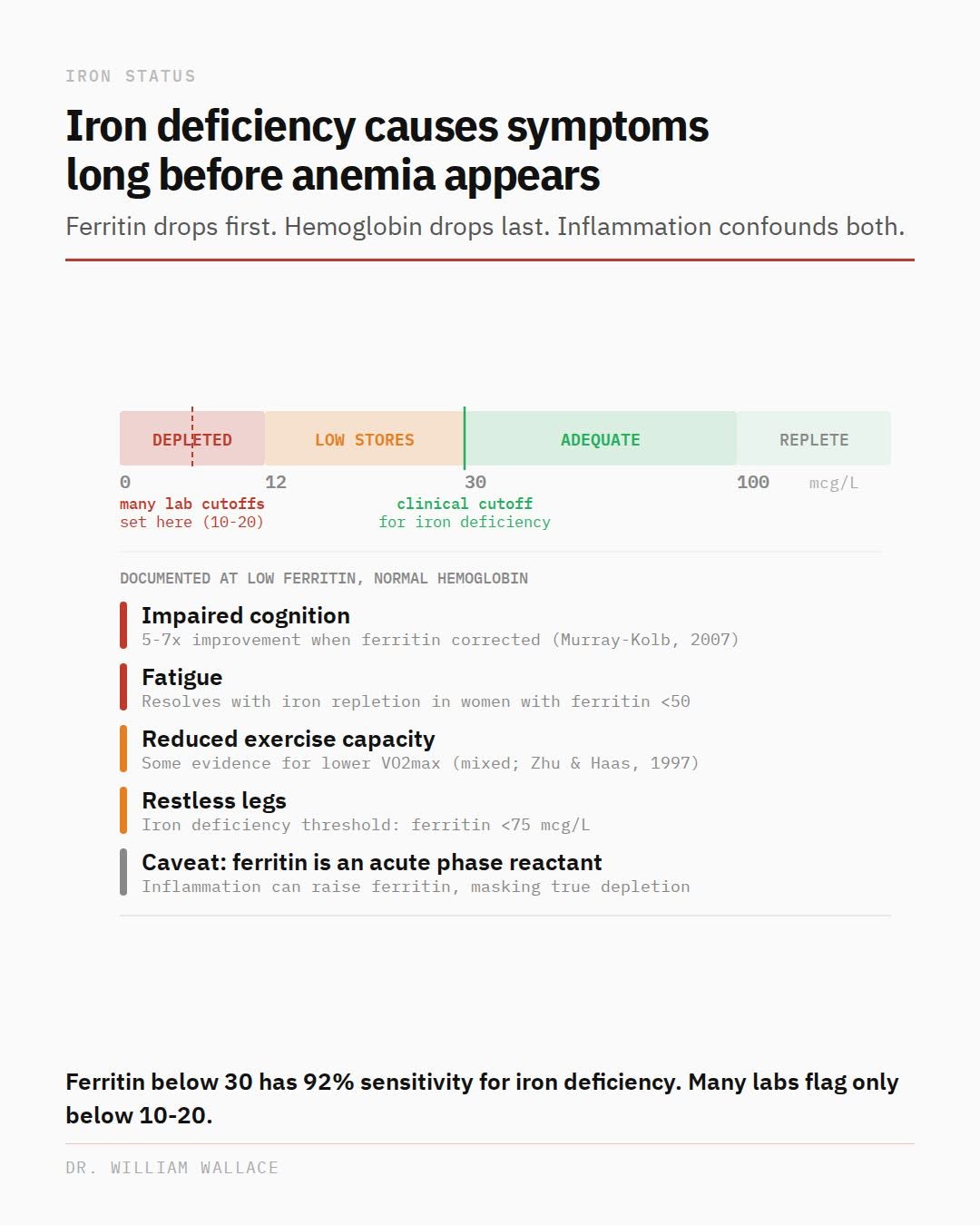
The Floor of the Normal Range
You shouldn't let your levels drop into a true deficiency. If ferritin falls too low (typically below 25-30 ng/mL), it can impair:
Mitochondrial Function: Iron is a core component of the electron transport chain that produces cellular energy (ATP).
DNA Repair: Specific enzymes (polymerases and helicases) require iron-sulfur clusters to maintain your genetic integrity.
Conclusion
This information is for those who are asymptomatic and do not have conditions that necessitate extra iron (such as heavy menstrual cycles or pregnancy). In the absence of a clinical need, the goal is to maintain iron levels that are sufficient to support cellular function without fueling the oxidative stress, lipid peroxidation, and other harm associated with iron overload.
Note that I used Gemini AI to help write and fact check this text.
Again, please consult your doctor. This is intended to serve as information that can help inform your conversation with your physician about this topic.
#ferritinHD #ironHD #agingHD #longevityHD #cvdHD #ferroagingHD