A nice summary of the 3 major RCT’s testing vitamin K2 as an intervention to slow arterial calcification.
The first 2 trials failed. The latest succeeded.
The trial that worked intervened early before significant calcification occurred. The two trials that failed intervened late after significant calcification had already formed and hardened.
Quoted:
Vitamin K2 did exactly what its mechanism predicts in all three trials. The arteries only moved in one of them - the most recent one.
K2 is the cofactor for gamma-glutamyl carboxylase, the enzyme that carboxylates matrix Gla protein (MGP). Carboxylated MGP binds calcium and keeps it out of the arterial wall. Uncarboxylated, it can't. Every trial below confirmed K2 was active by measuring the inactive form, dp-ucMGP, falling.
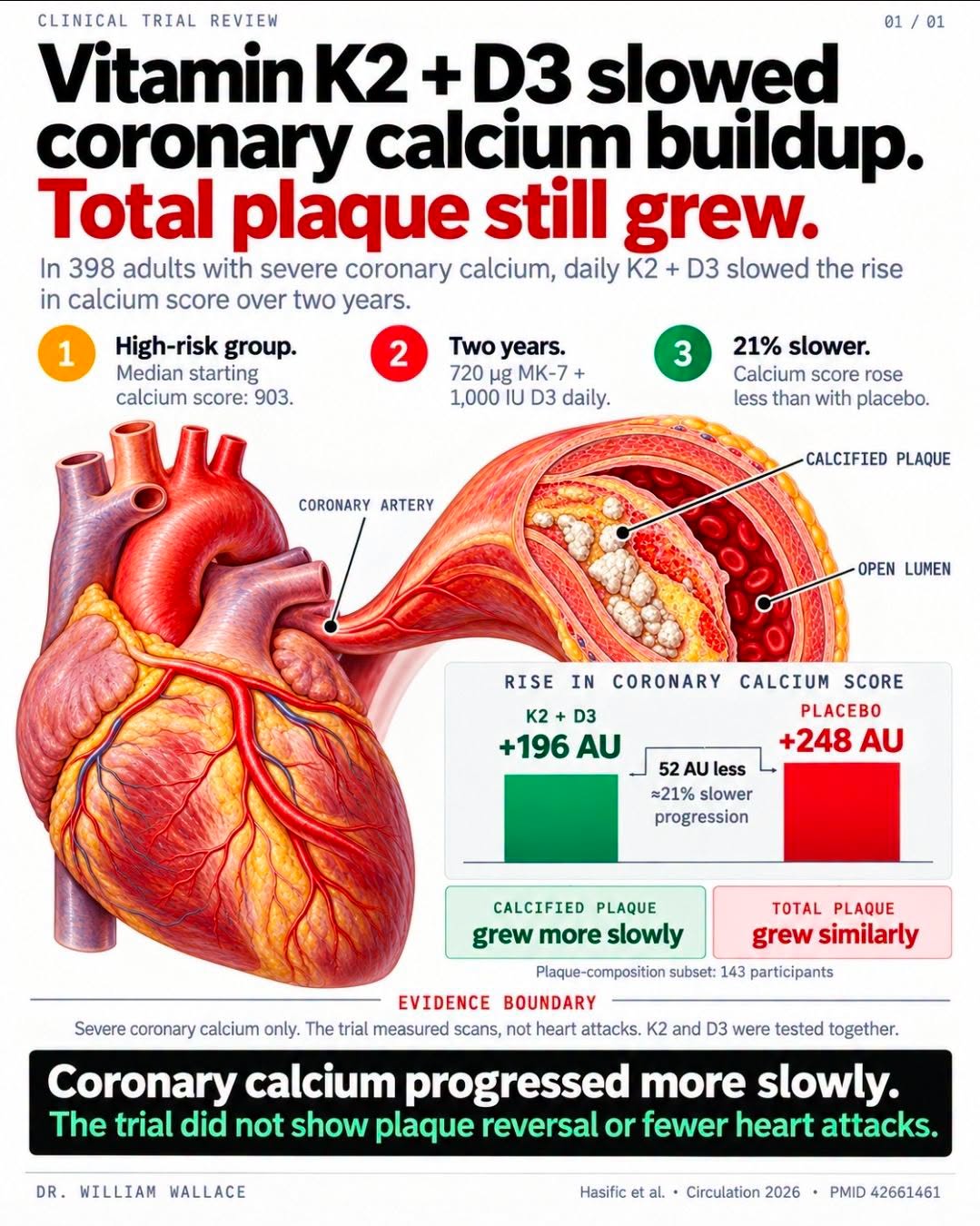
Circulation, 2022: 720 mcg/day MK-7 plus 1000 IU D3, two years, in patients with established aortic valve calcification. Marker fell. Valve calcium unchanged, 275 vs 292 Agatston.
Valkyrie, JASN 2020: 2000 mcg MK-7 three times weekly in hemodialysis patients with extensive calcification. Marker improved. Coronary, aortic, and valvular calcium all unchanged.
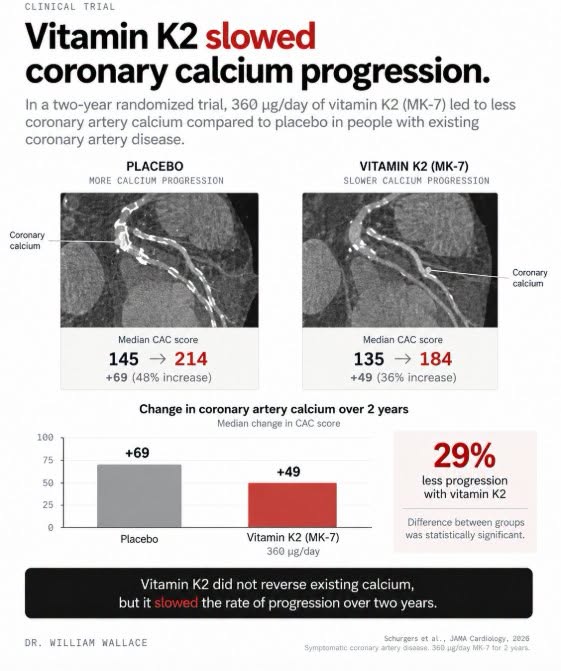
VitaK-CAC, JAMA Cardiology 2026: 360 mcg/day MK-7, two years, in early coronary disease, CAC 50 to 400 Agatston. Progression slowed.
The trial that worked used the lowest dose of the three. It was disease stage. Once calcium mineralizes into hydroxyapatite in the wall, activating MGP probably cant pull it back out. Caught early, while plaque is still soft, MGP might slow the transition.
The claim that started this, that D3 without supplemental K2 forces calcium into your arteries, has never been shown in a controlled trial.