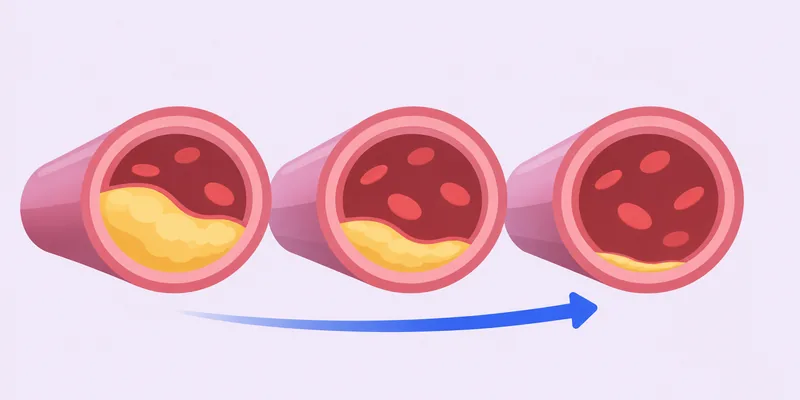
If you start a statin, change your lifestyle, and a repeat calcium scan shows a higher score, it is natural to think you are getting worse. The group's admins argue that is often the opposite of what is happening. A calcium score only counts calcified plaque, and statins are thought to turn dangerous soft, fatty plaque into denser, calcified plaque. That can make the number climb even as the risk of rupture falls1.
This pattern has been called the "statin paradox": statins lower heart attacks and total plaque, yet they are associated with faster coronary calcification2. Gokhan Can's evidence review concludes that statins reduce events and soft plaque but do not slow Agatston score progression, and that this is best understood as plaque repair rather than treatment failure3.
There are real limits to this story. The strongest evidence is for the shift in plaque composition and for statins lowering events; the claim that a rising score is itself reassuring is an interpretation, and Louis Nervegna says that randomized trials with hard outcomes are what really matter4. This summary separates what was measured from how it is interpreted. It is not medical advice; the admins suggest discussing your own scan with your doctor.
How the calcium score works, and why it can mislead
The Agatston formula
The CAC scan measures the area of calcium on each CT slice and multiplies it by a density factor of 1, 2, 3 or 4 depending on how bright (dense) the calcium looks. The factor is a rigid step system, not a smooth curve. Gokhan's example: a plaque on the borderline between medium and high density becomes slightly denser over a year, its factor jumps from 2 to 3, and its score contribution rises 50% even though its size barely changed1. The score is therefore not a precise measure of calcium volume.
Soft, lipid-rich plaque does not show on a CAC scan at all. The post uses the image of "Jell-O" (soft, inflamed, unstable) turning into "concrete" (calcified, stable scar) as statins reduce the lipid core and inflammation1. Louis recommended that article to everyone who tracks CAC7.
Where calcium comes from
Louis explains that calcified plaque develops from soft plaque over a long period, which is why a high CAC predicts risk: it is a proxy for how much soft plaque was there4. He estimates that soft plaque takes 10 to 15 years to begin calcifying8, and describes calcification as arriving in late-stage disease9. A step-by-step article he shared lists calcification as one stage of the plaque story, between plaque growth and rupture or erosion10.
He also uses an analogy: both arterial calcification and calcification around a breast implant are an inflammatory damage response in which calcium salts are laid down in dying or damaged tissue to wall off the area11. This is his framing rather than a trial result.
What the trials show
Calcium keeps rising on statins
The key randomized trials, as summarized in Gokhan's review3:
- St. Francis Heart Trial (4 years): atorvastatin 20 mg did not reduce CAC progression versus placebo, yet clinical events fell 33%.
- SALTIRE (2 years): atorvastatin 80 mg lowered LDL by about 53%, but annual CAC progression was numerically higher on the statin (26%) than placebo (18%).
- BELLES (1 year): high-intensity atorvastatin 80 mg versus moderate pravastatin 40 mg showed similar progression (about 11 to 14%), so higher intensity did not blunt calcification.
The same review cites a large Veterans Affairs retrospective analysis in which the adjusted odds of severe CAC rose with years of statin use: 1.49 for 0 to 5 years, 2.38 for 5 to 10 years and 4.48 beyond 10 years. Gokhan reads this as calcification not plateauing while treatment continues3. Because it is a retrospective association in high-risk patients, it cannot by itself prove cause and effect.
Show data
| Adjusted odds ratio (log scale) | 95% CI | |
|---|---|---|
| 0–5 years of statin use | 1.49 | – |
| 5–10 years | 2.38 | – |
| More than 10 years | 4.48 | – |
What changes inside the plaque
CT angiography lets researchers see plaque by type. In the PARADIGM serial CTA analysis, statin treatment was associated with bigger decreases in low-attenuation and fibro-fatty plaque and bigger increases in dense and very dense calcified plaque. Lead investigator Alexander van Rosendael called this a "more-rapid transformation of soft plaque into the very dense calcium"; without statins all six plaque components grew, whereas statin-treated lesions showed a partial "seesaw" with overall slower progression6. Stephen Nicholls added that statins stabilize plaque "not only by shrinking plaques, but by promoting an increase in calcification"6.
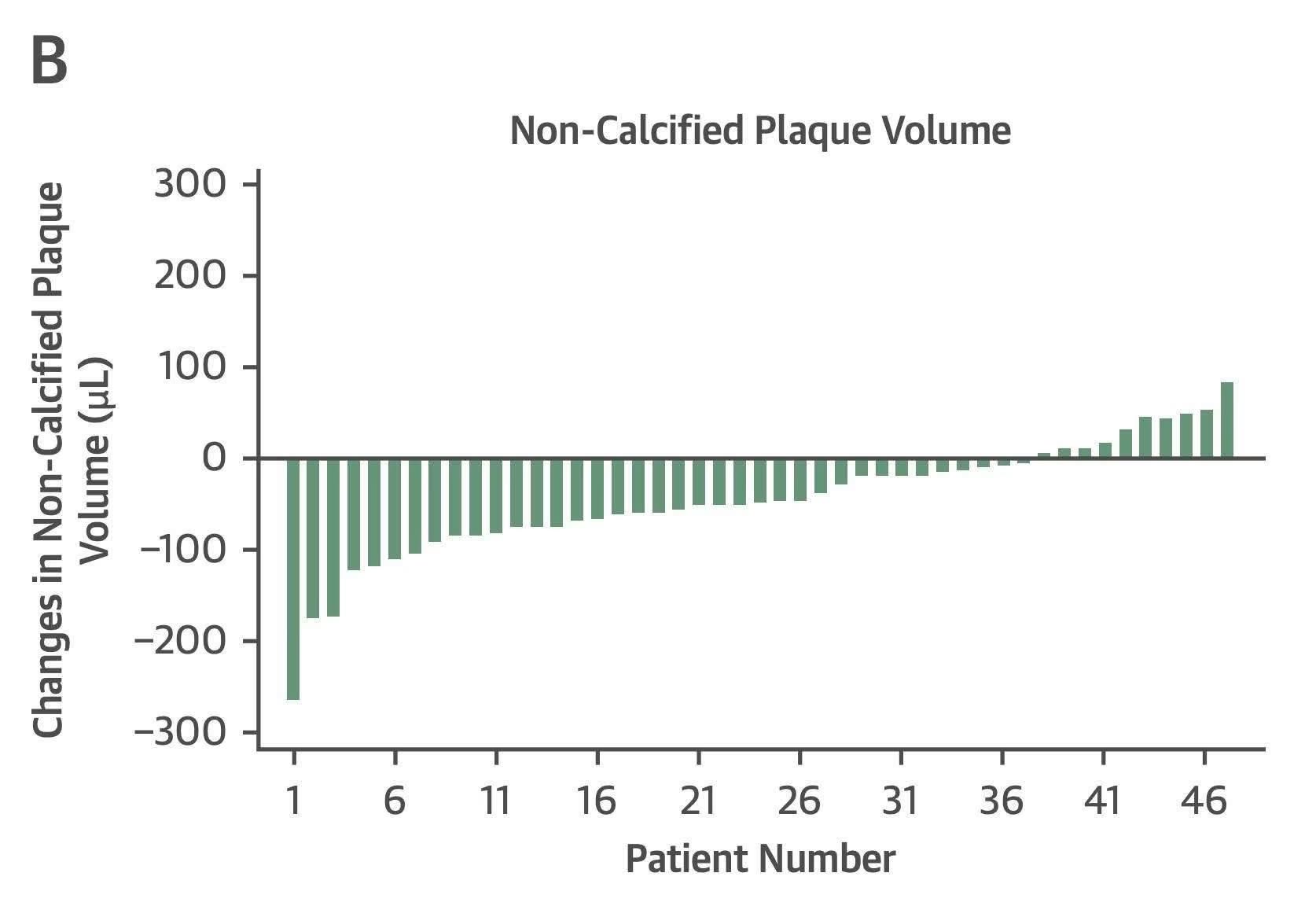
A JACC 2022 plaque-regression review, shared by Gokhan, similarly states that in response to statins fibrous and calcified plaque volumes appear to increase whereas noncalcified, fibrofatty and necrotic core volumes decrease12. In the small evolocumab (Repatha) CT study, soft plaque fell from 607.3 to 562.1 uL while calcified plaque rose from 108.9 to 148.7 uL, leaving total plaque unchanged13.
Show data
| Baseline | 18 months | |
|---|---|---|
| Soft (non-calcified) plaque | 607.3 | 562.1 |
| Calcified plaque | 108.9 | 148.7 |
Total plaque still goes down
Louis stresses that at least six randomized trials show statins reduce total plaque volume (soft plus hard) even though calcified plaque may rise in the short to medium term6. He lists COSMOS (about 5%), SATURN (5.5%), ASTEROID (6.5%), IBIS-4 (7.5%), STABLE (8%) and JAPAN-ACS (17%), and notes the reductions came from soft plaque, large enough that total plaque fell even when calcified plaque stayed the same or increased1415. A chart in a 2022 JACC review suggests regression of total plaque begins once LDL-C falls below roughly 90 mg/dL16.
More recently, FLOWPROMOTE randomized 104 patients to LDL averages of 69.5 versus 42.5 mg/dL; total plaque fell 13.6% versus 21.1% and soft plaque 20% versus 28.2% over 18 months, with 98% of the lower-LDL group showing soft-plaque regression versus 77%17. A meta-analysis of 31 IVUS studies (4,997 patients) linked each 1% reduction in percent atheroma volume to about 20% lower risk of major cardiac events18, and a 2023 JAMA Cardiology meta-analysis found about 19% lower odds per percentage point, though these are associations rather than proof17.
Why softer plaque is the real target
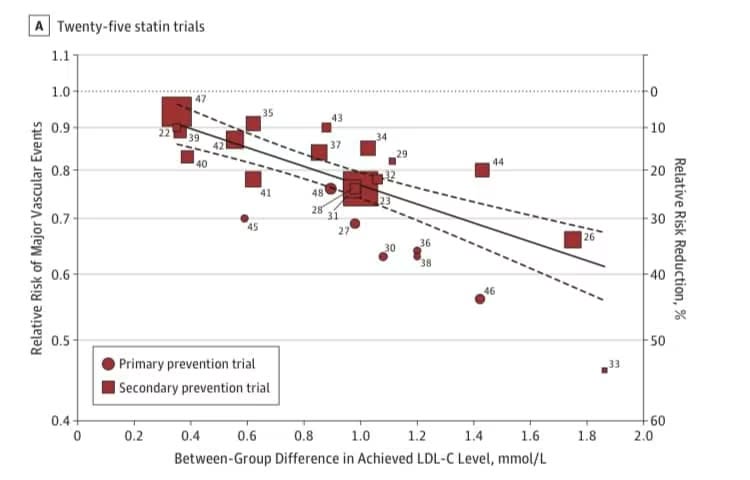
Louis cites a JAMA review: about 64% of heart attacks caused by acute thrombosis come from rupture of soft lipid-rich plaque and about 25% from erosion of soft plaque, with only about 5% involving calcified nodules, so roughly 95% involve soft plaque5. In an earlier post he argues that statins work by preventing new soft plaque, reversing existing soft plaque at low enough LDL, and stabilizing what remains by calcification, and that exercise does something similar19. That post cites a graph of 25 statin trials in which about a 75 mg/dL LDL reduction cut heart attacks and strokes by about 40%19.
The YELLOW study, shared by Louis, found that intensive rosuvastatin reduced lipid-core burden within 7 to 8 weeks, which was described as stabilization rather than shrinking blockages20. The speed of the early benefit after a heart attack, in PROVE IT-TIMI 22 (30-day events 3.0% on atorvastatin 80 mg versus 4.2% on pravastatin 40 mg), is attributed by Louis largely to effects on inflammation, plaque and the endothelium rather than LDL alone, though he notes some argue that part of this is lower LDL2122.
Do PCSK9 inhibitors avoid the calcium rise?
Gokhan argues that PCSK9 inhibitors regress plaque without the "calcific surge". He cites GLAGOV (evolocumab added to statins, LDL 36.6 mg/dL, percent atheroma volume -0.95% versus +0.05%, with no significant increase in dense calcium), PACMAN-AMI (alirocumab "triple regression" without meaningful calcified-plaque increase), and Gao et al. 20222.
In that 2022 randomized trial, 61 coronary patients on moderate statins added alirocumab 75 mg every two weeks for 18 months. Median CAC rose 2.9% versus 10.6% on statins alone (mean +0.6% versus +2.7%, P=0.002), and CAC did not rise significantly from baseline in the alirocumab arm. A retrospective study (Ikegami, 120 patients) found about 14.3% versus 29.7% annual progression. The suggested mechanism is stronger LDL lowering plus Lp(a) reduction, since Lp(a) change correlated with CAC change2324. The authors of the summaries stress these studies are small and larger trials are needed24.
Show data
| With alirocumab or PCSK9 inhibitor | Without | |
|---|---|---|
| Gao 2022 randomized trial, median over 18 months | 2.9% | 10.6% |
| Ikegami retrospective study, per year | 14.3% | 29.7% |
Louis adds caution. No randomized outcome trials test PCSK9 inhibitors as monotherapy, so the long-term advantage over statins is unknown, but adding one to a statin seems to attenuate statin-induced calcification and lowers events more than the statin alone25. The uncontrolled evolocumab CT study mentioned above still showed calcified plaque rising13, which shows the picture is not uniform.
Nuances, controversies and common misconceptions
"A rising CAC is always good"
It is not. The claim is narrower: a rise alongside falling soft plaque and strong treatment can reflect stabilization. Louis says the "obsession online over lowering CAC score is misguided", that calcified plaque is usually not the problem, and, as a theoretical point, that removing calcified plaque might even destabilize a plaque, which is why outcome trials matter4. Dr Gil Carvalho, whose video Gokhan summarized, makes a similar point: arterial calcium is a marker of long-standing plaque, not its cause, and lowering a score can mislead, just as statins raise calcium while lowering risk26.
Can calcium be reversed at all?
Louis says in principle yes: macrophages can act like bone-resorbing cells, and soft-tissue calcification regresses in conditions such as calcific tendonitis, but methods for arteries are speculative28. Anecdotes exist. Gokhan shared one man's report of a CAC falling from 102 to 32 on an intensive protocol with rosuvastatin, ezetimibe and many supplements; he labels it n=1, not a trial29. In small randomized trials, aged garlic extract slowed one-year CAC progression (for example 6.8% versus 26.5% in one study), though some trials added other supplements30. Colchicine 0.5 mg in a CCTA trial slowed calcified plaque progression while reducing percent atheroma volume by over 1%31.
Vitamin K2 and calcification
K2 activates matrix Gla protein, which inhibits calcium deposition in artery walls32. The evidence is mixed. A 2023 meta-analysis of 14 RCTs (n=1,533) found annual CAC change 17.3 Agatston units lower, while the largest trial in 389 men missed significance overall but slowed CAC in those with baseline CAC of 400 or more33. A 2026 JAMA Cardiology trial in adults with symptomatic coronary disease found a median CAC rise of 49 units on 360 mcg/day MK-7 versus 69 on placebo; it did not remove existing calcium34. Another report describes 398 adults with severe calcification, where K2 plus D3 slowed progression about 21% (196 versus 248 points) but total plaque volume rose similarly in both groups35. Gokhan notes no effect on stenosis or total plaque36.
This sets up the same debate. Carvalho argues that slowing calcification without reducing plaque could even be harmful, and no trial shows fewer heart attacks37. Louis notes the trial did not measure soft plaque38, and a shared summary suggests K2 worked only in a trial of early disease, not in established aortic valve or dialysis calcification39. Gokhan's view is that no one would object to K2 but expectations should stay grounded26.
"A zero CAC means I'm safe"
In the Western Denmark registry, 54% of 23,759 symptomatic patients had CAC zero, and half of those with obstructive blockages had zero4041. In REACT, among 30 to 39 year olds with plaque on CT angiography, 41.8% of men and 48.4% of women had a zero score42. Louis notes that a clip he shared says about a quarter to a third of heart attacks occur in people with CAC zero, though no study was cited43.
Should everyone get a CAC scan?
Louis shared a post that two 2026 randomized trials found screening did not change outcomes for the average person: a Danish trial of about 30,000 men showed no reduction in death, heart attack or stroke at seven years (with more serious bleeding), and the US CorCal trial of nearly 6,000 people found event rates identical to a risk calculator. It states guidelines give CAC one job, helping decide on a statin when risk is borderline44. JAMA pieces he shared say the same about borderline or intermediate risk in people not already on statins4546.
Fitness, athletes and other factors
Louis shared a sports-cardiology clip claiming that at the same CAC, fitter people have a much lower 20 to 25 year heart attack risk, and that CAC may overestimate risk in endurance athletes4748. A shared review says exercise combined with LDL below 70 mg/dL is additive, though extreme volumes may raise calcification while producing more stable plaque49. Other factors are tied to CAC too, such as urinary metals in MESA50.
What this means for you
- A rising score on treatment is not automatically failure. The admins suggest looking at the whole picture (LDL, exercise, any CT angiogram) with your doctor1.
- Ask whether soft plaque was measured. CAC cannot see it; the ACC guidance Louis shared recommends AI plaque analysis for people with visible plaque and says CAC reflects calcified plaque only27.
- Low LDL is the lever with the most support. A chart in a JACC review suggests total plaque regression begins below roughly 90 mg/dL16, and a shared review says exercise plus LDL below 70 mg/dL gives additive benefit49.
- Do not chase a lower number. Louis argues the focus should be reversing or stabilizing soft plaque, not lowering CAC4.
- Avoid reacting to a single score. The admins suggest discussing any change to treatment with your doctor; in the trials, statin benefit on events appeared alongside, not despite, rising calcium3.
Frequently asked questions
Why did my CAC go up when my LDL is low?
Because the score weights density, denser plaque scores higher even if it is not bigger, and treated soft plaque tends to calcify1.
Does a higher CAC on a statin mean the statin failed?
Not necessarily. Statins reduced events in St. Francis despite no change in CAC, and total plaque falls in several trials315.
Do PCSK9 inhibitors prevent calcium rising?
In small studies adding alirocumab slowed CAC progression, but there are no monotherapy outcome trials and the evidence is limited2325.
Is a CAC of zero after treatment reassuring?
A zero score does not exclude soft plaque, particularly in younger people; Louis notes soft plaque can take 10 to 15 years to calcify8.
Should I take vitamin K2 to stop calcification?
Trials show slower CAC progression in some groups but no proven reduction in heart attacks, and total plaque did not fall in the trials that measured it3537.