How do you decide whether to start a new medication or supplement, and how do you start it safely? The short answer from the group's posts is to ask four questions in order: how strong is the evidence in people, is the dose and product what the evidence actually tested, what could it interact with or harm, and what will I measure to know whether it is working? The admins repeatedly add that these decisions are best made with a doctor, particularly for high-risk people.12
The group is unusually open to going beyond standard care, but the admins are careful about how. Louis states a personal rule: he does not bet his life on anything not rigorously proven in high-quality randomized trials, and he adds less-proven measures on top of proven treatment rather than instead of it.1 This article collects the group's examples of how that plays out for supplements, long-standing drugs and newer therapies. It summarizes posts and is not medical advice.
Step 1: Place the claim on the evidence ladder
Louis's decision rule
Louis lays out a simple approach. Rely first on interventions backed by multiple large, long randomized controlled trials (RCTs), such as a traditional Mediterranean diet and LDL lowering with medication. Ignore advice that directly conflicts with high-quality RCTs. Consider promising ideas with an open mind, but add them in tiers after the proven basics, because the evidence bar for standard of care is usually very high and throwing it away is, in his words, usually foolish.1
He also cautions against the opposite mistake of demanding RCTs for everything. Long RCTs are impractical for diseases that take decades to develop, and no human RCT showed that smoking causes lung cancer or that trans fats cause heart disease. Reliable knowledge can come from combining prospective cohort studies, short-term biomarker RCTs and animal mechanism studies, judged with the Bradford-Hill criteria.7
Why so many therapies sit in the gray zone
Louis explains that FDA approval requires three phases of trials, typically takes a decade or more and costs at least $100 million, and phase 3 trials often fail. That is why many promising therapies never get tested at that level. Physicians can legally use dietary supplements with GRAS status and prescribe drugs off-label, which lets science-based clinicians go beyond standard care, though that science often does not meet full FDA criteria.8
Examples of early-stage evidence in the group
The posts include many examples of evidence at different rungs, and the admins' own comments show how to read them:
- Mouse data. Vanadyl sulfate extended the lifespan of male mice by 7.4% when started late in life. Louis notes that vanadium is toxic even at lower doses, that long-term safety at the doses used for diabetes was never clear, and that the post describes mice, not people. The quoted summary also notes the lifespan result barely reached statistical significance.9
- Preclinical plus a commercial product. The GLYLO combination (lipoic acid, nicotinamide, piperine, pyridoxine, thiamine) lowered methylglyoxal and extended lifespan in mice, and Louis says a paper on arterial stiffening is expected. The evidence is preclinical and the product is sold commercially, and the same post notes an earlier compound, aminoguanidine, was stopped in human trials because of toxicity despite promising animal data.10
- A claim from an interview. A botanical blend said to release stem cells reportedly returned all 10 heart failure patients to normal function. Louis flags it as promising but unverified, since it rests on an interview and not on published data.11
- Open-label pilots. A pilot gave 20 g/day of creatine for 8 weeks to 20 people with probable Alzheimer's disease; brain creatine rose 11%, compliance was 90% and there were no serious adverse events. It tested feasibility, not whether creatine helps.12
- Trials not yet reported. Lithium orotate is already sold as a supplement, yet human Alzheimer's trials were only starting in spring 2026, after decades of observational signals from drinking water.1314
- Small, lower-quality studies. Louis says studies of plaque-focused supplements, including gotu kola, are small and low quality, and that "we just don't know". A Life Extension summary reports that 60 mg of Centella asiatica extract three times daily hardened carotid plaque by 30% over 12 months, and Louis says it needs larger, higher-quality trials.1516
- Nattokinase. One 1,062-person clinical study reported that 10,800 FU/day improved lipid profile, carotid intima-media thickness and plaque size, while 3,600 FU/day did not.4 Gokhan reads this as suggesting that doses above 8,000 FU/day may reverse plaque progression, while Louis says nattokinase deserves study but the human studies are small and lower quality.1718
- Aged garlic extract. Three small double-blind trials found slower coronary calcium progression (for example 6.8% vs 26.5% in one), but two of the three used co-supplements such as B vitamins, L-arginine or CoQ10, which could have influenced results.19 Louis notes a small CT-angiography RCT showed slower plaque growth, and Gokhan says he has taken it for five years alongside low-dose rosuvastatin, an ACE inhibitor and fish oil.2021
Step 2: Look at what the large trials say
Supplements as a category
Louis quoted a JACC systematic review of 884 randomized trials covering 27 micronutrients and 883,627 participants. Omega-3 reduced cardiovascular mortality (RR 0.93), heart attack (RR 0.85) and coronary events (RR 0.86); folic acid reduced stroke (RR 0.84); and coenzyme Q10 reduced all-cause mortality (RR 0.68). Vitamins C, D, E and selenium showed no effect on cardiovascular disease or type 2 diabetes, and beta-carotene increased all-cause mortality (RR 1.10), cardiovascular mortality (RR 1.12) and stroke (RR 1.09).3 The lesson is that "a supplement" is not a single category: some help, some do nothing and one made outcomes worse.
Show data
| Relative risk (log scale) | 95% CI | |
|---|---|---|
| Omega-3: cardiovascular death | 0.93 | 0.88–0.97 |
| Omega-3: heart attack | 0.85 | 0.78–0.92 |
| Omega-3: coronary events | 0.86 | 0.80–0.93 |
| Folic acid: stroke | 0.84 | 0.72–0.97 |
| Coenzyme Q10: death from any cause | 0.68 | 0.49–0.94 |
| *Beta-carotene: death from any cause | 1.10 | 1.05–1.15 |
| *Beta-carotene: cardiovascular death | 1.12 | – |
| *Beta-carotene: stroke | 1.09 | – |
Basic multivitamins
Louis highlights two RDA-level multivitamin trials. In the Physicians' Health Study II, 14,641 male physicians followed for about 14 years had 8% less total cancer.22 In the COSMOS epigenetic-clock analysis of 958 older adults, a daily multivitamin (Centrum Silver) slowed biological aging by roughly four months over two years, with larger effects in people who were biologically older at baseline. Louis stresses it was a standard multivitamin, not a megadose.2324
Omega-3: benefit with a trade-off
A meta-analysis of 40 trials (135,267 participants) found omega-3 EPA/DHA lowered heart attack by 13%, coronary events by 10%, fatal heart attack by 35% and coronary mortality by 9%, but not the broader composite of cardiovascular events. It suggested 1,000-2,000 mg/day, and Louis adds a warning that several RCTs show a small increase in AFib at high doses.25 Purified EPA (icosapent ethyl, 4 g/day) shrank plaque in the 80-person EVAPORATE trial in people with triglycerides of 135-499 mg/dL, and Louis again warns about AFib and urges talking to a doctor before high doses.2 A group member's report of plaque regression on 6 g/day of over-the-counter EPA with a baby aspirin is a single case; the member himself says he does not recommend others try it without medical supervision because of AFib and bleeding risks.26
Vitamin D: mixed trial results
The vitamin D posts show how results depend on the question asked. In TARGET-D (630 adults after acute coronary syndrome, about 4.2 years), doses tailored to reach 40-80 ng/mL did not significantly cut the primary composite outcome, though heart attack was 52% lower; the authors say this needs validation to rule out data mining.27 A summary of the same trial reports repeat heart attacks of 3.8% versus 7.9%.28 In the VIVID trial, 3,200 IU/day for four weeks did not reduce COVID-19 severity, with a borderline signal for less long COVID (21% vs 25%). Louis notes it started three days after a positive test, which may have blunted the effect.29
Timing and disease stage
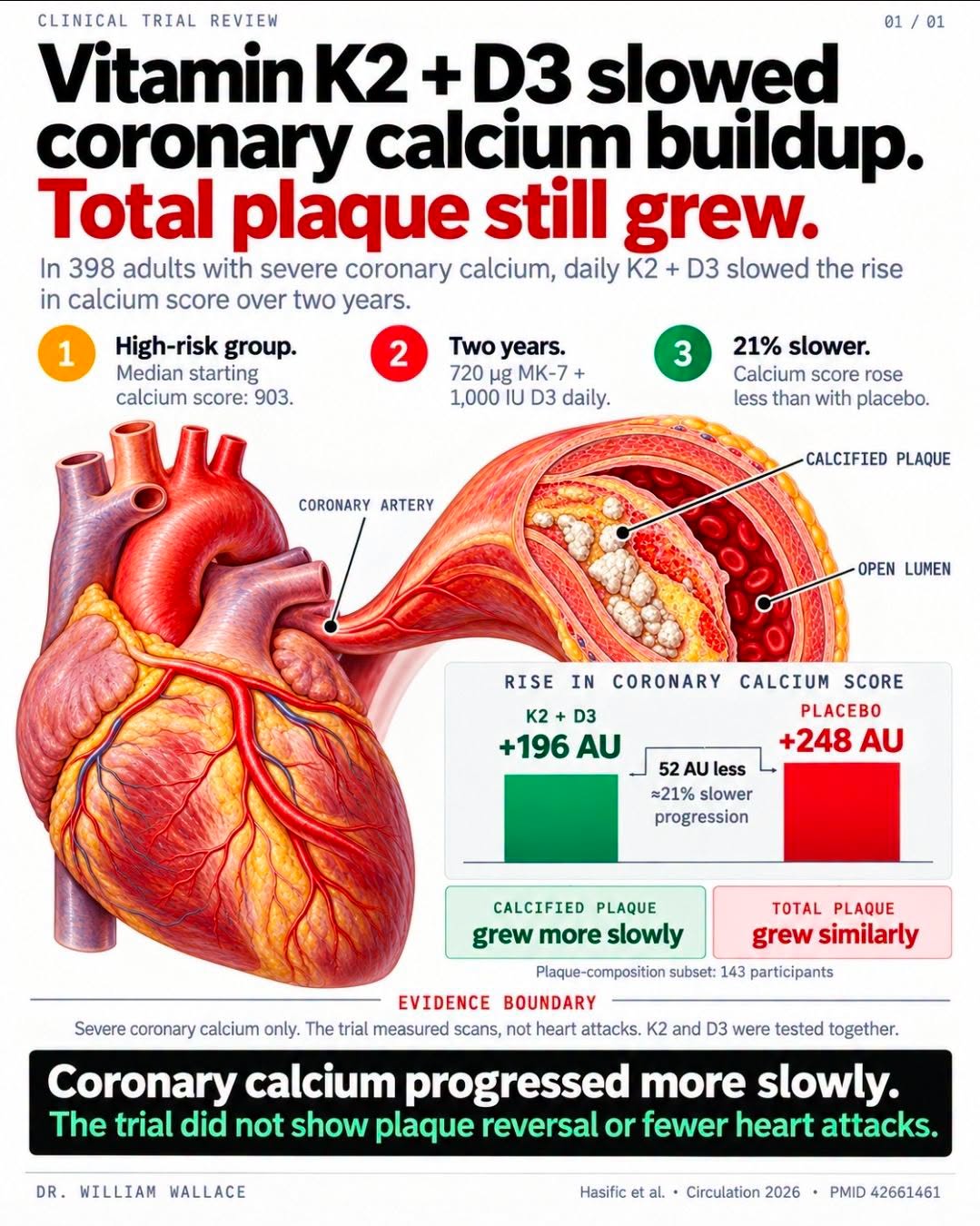
Vitamin K2 shows why the stage of disease matters. A post summarizing three RCTs says K2 lowered its activity marker in all three, but calcification slowed only in the trial that enrolled people with early coronary disease (360 mcg/day MK-7), while trials in established valve or dialysis calcification showed no change.30 Another post reports a 2026 trial of 720 mcg K2 plus 1,000 IU D3 in 398 adults, with about 21% less calcium progression but similar total plaque volume, so it does not show plaque reversal or fewer heart attacks.31 Louis says he takes K2 mainly for its effect on insulin sensitivity, citing three RCTs of 90-360 mcg/day in type 2 diabetes.32
Step 3: Check the dose
Dose is the second place where supplements go wrong. The posts offer several examples:
- Vitamin D response depends on your starting level. On average, 1,000 IU raises blood levels by about 11, 8 or 5 ng/mL when starting at 10, 30 or 50, flattening around 70, and people with obesity respond less.33 In Heaney's study, roughly 1,000, 5,500 and 11,000 IU a day produced about 30, 60 and 84 ng/mL, so ten times the dose gave about 2.8 times the level.33 Rhonda Patrick, as summarized by Gokhan, suggests 4,000 IU/day is generally safe for most people and that individual response varies, so the key is testing blood levels.34
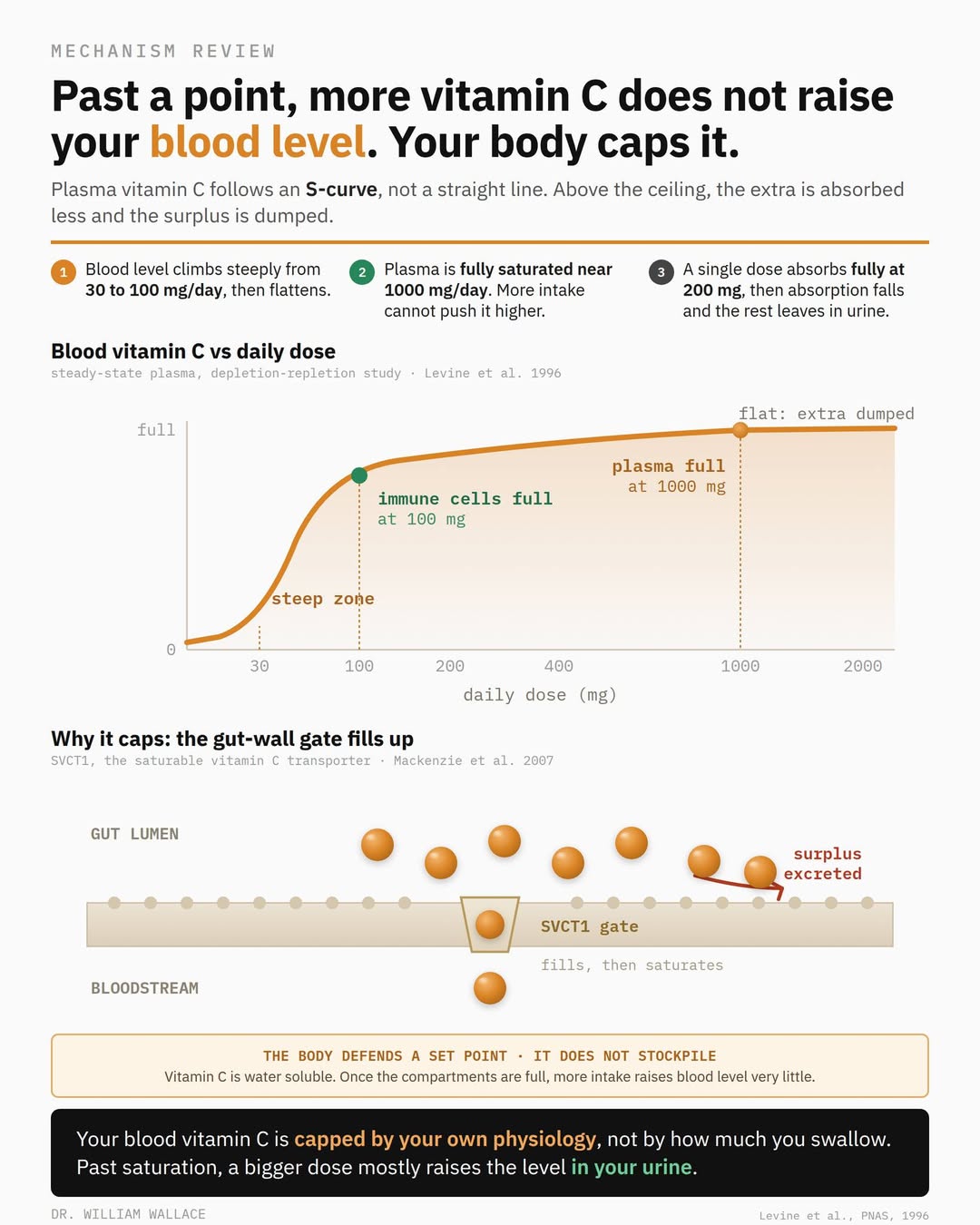
- Vitamin C absorption falls as the dose rises. In Levine's study of seven men, absorption was complete at a single 200 mg dose, around 73% at 500 mg and about 50% at 1,000 mg, and plasma saturated near 1,000 mg/day.3536 Louis says this is why he takes vitamin C in time-release form.35 A related post says neutrophils saturate near 200 mg twice daily in healthy people, and that the needed dose rises during infection.37
- Physiologic versus megadose. Louis notes the body makes around 200 micrograms of melatonin a night while some people take 10 mg or even a gram, which is 50 to 5,000 times more.38
- Dose-dependent benefit. In the omega-3 meta-analysis, the effect on heart attack rose with dose, and the omega-3 index summary says about 2,000 mg/day EPA+DHA is needed to move from an index of 4% toward 8%.2539
- Dose makes the poison. A post on pesticide residues makes the same point from toxicology: risk depends on dose relative to safety thresholds.40
Step 4: Check safety, interactions and product quality
Interactions
Louis calls drug-supplement interactions an underappreciated cause of statin side effects. The cytochrome P450 system in the gut and liver filters foreign substances, and some foods and supplements change how much of a drug you absorb and how fast the liver clears it; the classic example is grapefruit juice, which effectively raises the dose of some statins. Herbs and botanicals are the most likely supplement culprits. His practical steps are to separate dosing times where possible and to adjust the statin dose to the measured LDL; a reader correction notes the grapefruit interaction applies only to certain statins.6
Known risks at higher doses
The posts flag specific problems, usually with the caveat that the evidence differs in strength:
- AFib with high-dose fish oil. Raised repeatedly by Louis.22539
- Vitamin B6. A trial of 100 mg for a month found less depression, but Louis warns prolonged high doses can cause peripheral neuropathy, probably not at 100 mg for most people, and notes the trial was short.41
- Vitamin D toxicity. Louis notes severe hypercalcemia can cause cardiac arrest, coma or kidney failure, in a story of an 89-year-old whose vitamin D was at the laboratory maximum after at least nine months of supplements.42
- Calcium. Gokhan advises never starting calcium on your own because too much may be harmful for the heart.43
- Aspirin. Gokhan notes aspirin has bleeding risk and should be used under medical supervision.44
- Melatonin. In an analysis of more than 130,000 adults with chronic insomnia, use for a year or more was associated with about 90% higher odds of heart failure. Louis stresses it is retrospective and cannot prove causation, but says long-term high-dose effects are not well studied.38
Product quality
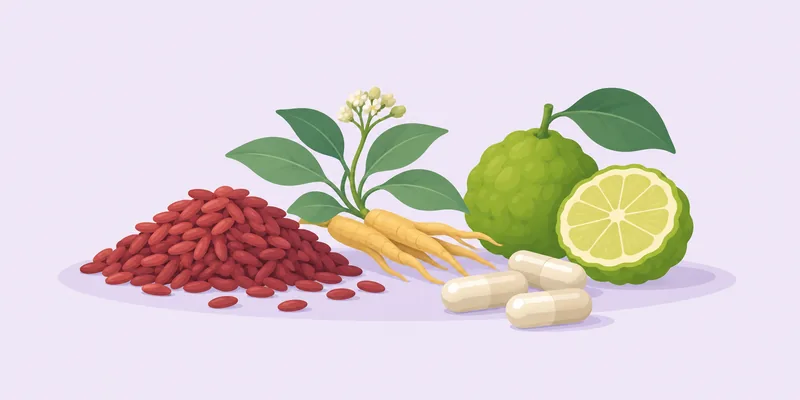
Quality is a separate question from evidence. Louis explains that US red yeast rice is supposed to have its lovastatin removed, yet it still lowers cholesterol through related monacolins. It is unregulated, potency is variable, and there are no large RCTs showing fewer heart attacks or strokes, so he calls it a gamble for high-risk people; some statin-intolerant people tolerate it, and he says to discuss it with a doctor.45 He also criticizes the AG1 greens powder as 75 ingredients at tiny doses with no company-funded studies, which is his opinion and not a cited trial result.46
Baseline tests and monitoring
The posts suggest matching monitoring to the specific risk:
- Statins. A Harvard Health explainer quoted by Louis says serious liver injury is rare, abnormal tests are about as common on placebo, one baseline liver test is recommended before starting, and routine repeat testing is not useful for most people.47
- Vitamin D. TARGET-D adjusted doses every three months to reach a blood target, and Patrick's summary stresses testing levels.2734
- Nattokinase. One group member taking high-dose nattokinase had his clotting time measured (INR, PT, aPTT).48
- Outcome markers. Louis adjusts his statin dose until his LDL is where he wants it.6 Programs such as the Bale-Doneen approach monitor labs, calcium scans and carotid intima-media thickness regularly.49
Established drugs: starting, staying on and stopping
Starting a drug with proven benefit is a different decision from experimenting with a supplement. After a heart attack, high-dose atorvastatin (80 mg) is started immediately; in PROVE IT-TIMI 22 it cut death, repeat heart attack or rehospitalization by almost 30% in 30 days compared with a lower-potency statin, and Louis advises not arguing with hospital staff about it.50
Stopping a proven drug deserves the same scrutiny. In the STREAM trial, 1,880 adults aged 70 or older without known cardiovascular disease were randomized to stop or continue statins. Events were 12.7% with stopping versus 9.2% with continuing, yet the trial formally met a noninferiority margin because the stopping group lost an average of about two weeks of event-free time against a preset limit of 5.2 weeks. Stopping brought no improvement in quality of life, muscle pain, falls or muscle wasting, and the safety board advised discussing restarting. A cardiologist quoted by Louis says stopping can be reasonable for frailty, life expectancy or adverse effects, but not simply because of age.551
Newer drugs call for reading the endpoint carefully. A report on the SELECT trial found semaglutide associated with 41% fewer major cardiovascular events within six months, before substantial weight loss.52 The widely quoted "40% muscle loss" with GLP-1 drugs is, Louis shares, a DXA "lean mass" figure that includes water and organs, while the SEMALEAN trial found lean mass fell about 5%, grip strength rose 4.5 kg and sarcopenic obesity fell from 49% to 33%. His explanation involving autophagy is his own hypothesis.53
Why success stories are not proof
The group includes personal stories of people who reversed plaque with their own protocols. Charles Grashow's calcium score fell from 102 to 32 on a regimen that included rosuvastatin 20 mg, ezetimibe, high-dose nattokinase and other supplements, and Gokhan labels it anecdotal and n=1.48 Dr. Ford Brewer reports cutting his artery age by more than 20 years with rosuvastatin 5 mg, omega-3, niacin, an ACE inhibitor and weight loss.54
Such stories cannot say which component mattered, and Louis notes that a single case report of regression on atorvastatin 10 mg is an outlier. He points instead to randomized trials showing average plaque volume reductions of 5% to 17% with statins, and to the YELLOW-III trial, where a high-dose statin plus a PCSK9 inhibitor reduced plaque volume 4.4% in six months at an average LDL of 39.1 mg/dL.5556
What this means for you
- Identify the type of evidence before starting: mouse, case report, open-label pilot, small RCT, large RCT, guideline.1912
- Put proven therapy first and add supplements on top, not instead.1
- Check that the dose and form match what was studied, since lower doses may do nothing and higher doses may harm.442
- Ask a pharmacist or doctor about interactions, especially with botanicals, and consider separating dose times.6
- For supplements with a known flag (high-dose fish oil, B6, calcium, aspirin, melatonin), discuss with your doctor first.2538414344
- Prefer products with a clear, tested dose, and be wary of unregulated products and marketing claims.4546
- Decide in advance what you will measure (a blood level, LDL, a baseline liver test, a scan) and when you will reassess.62747
- Introduce one change at a time where practical so you can tell what caused a benefit or a problem. This is a practical corollary of the interaction and anecdote cautions, not a rule the posts state.
- Do not stop a proven drug just because of age or a worry about side effects without discussing it.5
Frequently asked questions
Is a natural supplement automatically safer than a drug?
No. The group's examples include vanadium (toxic even at lower doses), vitamin D overdose, B6 neuropathy at prolonged high doses and AFib with high-dose fish oil.9254142 Louis also points out that lovastatin is a natural molecule.45
Why do trial results disagree about the same vitamin?
Differences in disease stage, dose, timing and endpoint can change the result, as with K2 (early versus late calcification) and vitamin D (a tailored-dose trial with a missed primary endpoint, and a COVID trial started days after infection).272930
Can I rely on a single study I read online?
Louis's approach is to want multiple trials when a decision is important, and to treat small or lower-quality studies as promising but unknown.115
Do I need regular blood tests on a statin?
The Harvard Health explainer quoted in the group recommends a single baseline liver test and says routine monitoring is not useful for most people, though checks may continue in people at high risk.47
What if a drug or supplement is not yet proven but I want to try it?
Louis's tiered rule is to add it on top of standard care, after the proven basics, and the admins' repeated advice for higher-risk options such as high-dose EPA is to talk to your doctor first.12