 yassinelab.orgObicetrapib and the Biology of Alzheimer’s PreventionBROADWAY showed a promising p-tau217 signal. The next test is whether a lipid drug can help the right biological population.yassinelab.org
A drug with a challenging name--obicetrapib (pronounced oh-bi-SEH-tra-pib)-- will soon be in a Phase 2 Alzheimer's prevention trial with 75% APOE 4 carriers.
🧠 Big Picture: Dr. Hussein Yassine, Director of the USC Center for Personalized Brain Health and the Yassine Lab, who focuses on APOE 4 and lipid biology, posted on 6/28 about why a drug in development for heart disease and/or high cholesterol may be beneficial for APOE 4/4 carriers with those risk factors--and a positive amyloid biomarker.
An excerpt from his 6/28 Substack at the link is below, with light editing and gratitude for Dr. Yassine's ability to explain complex ideas.
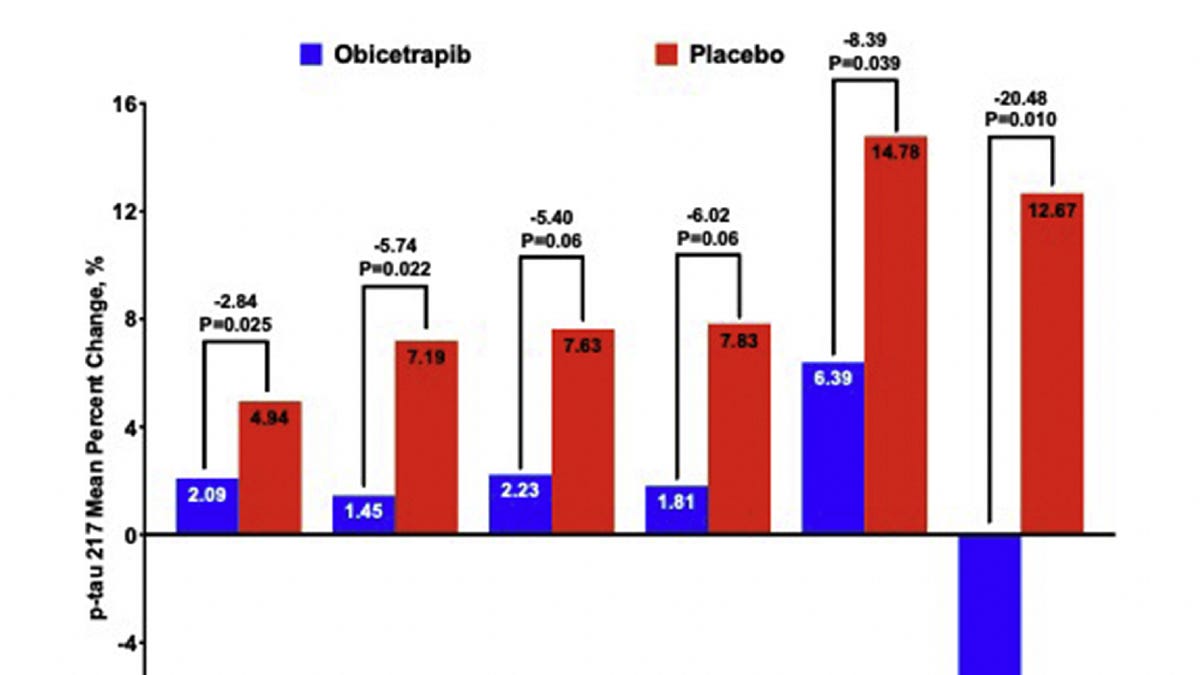
🔹 A recent analysis from the BROADWAY trial reported that obicetrapib slowed the rise of plasma p-tau217 over 12 months in people with cardiovascular disease. That finding deserves attention, especially because the effect was strongest in the small sub-group of APOE 4/4 carriers.
❤️ The question now is whether the signal reflects a real effect on Alzheimer’s biology, whether it is strongest in the right biological subgroup, and whether it eventually translates into cognition or function.
P-tau217 is one of the strongest blood biomarkers we have for Alzheimer’s disease biology. It often rises when amyloid and tau pathology are building in the brain. So when a drug changes p-tau217 in a randomized placebo-controlled study, the field should pay attention.
BROADWAY was designed as a cardiovascular lipid trial. The Alzheimer’s biomarker analysis was pre-specified before the trial started but it was still an analysis within a cohort recruited for another primary disease question. That distinction matters.
👉 The result can lead to an important hypothesis. It does not, by itself, prove Alzheimer’s prevention, clinical benefit, or disease modification.
🔹 Background: How Obicetrapib Affects Lipid Biology
Obicetrapib blocks cholesterol ester transfer protein (CETP), a protein that helps transfer cholesterol between lipoprotein particles in the blood.
When CETP is inhibited, LDL cholesterol falls. ApoB and non-HDL cholesterol fall. Lp(a) can fall. HDL cholesterol rises, and HDL particles may become larger or more functional.
BROADWAY enrolled people with cardiovascular disease (ASCVD) and/or heterozygous familial hypercholesterolemia whose LDL cholesterol remained inadequately controlled despite lipid-lowering therapy.
In that population, obicetrapib lowered LDL-C, raised HDL-C, and lowered Lp(a).
🔹 The Alzheimer’s question is different: whether this peripheral lipid remodeling can also influence Alzheimer’s-related biology [through one or more] plausible pathways:
➤ The effect could be vascular, through lower LDL-C, ApoB, Lp(a), and improved vascular risk biology.
➤ It could be HDL-mediated, through larger or more functional HDL particles that support cholesterol efflux, antioxidant activity, and anti-inflammatory signaling.
➤ It could also involve amyloid handling, including a possible peripheral sink effect where remodeled HDL particles bind or help transport amyloid-related material in blood.
🔹Context is important: The Alzheimer’s biomarker substudy of p-tau levels was from a lipid-risk population, which may be exactly where a lipid-modifying drug is most likely to show a signal.
➤ Of the 1,535 participants in the biomarker analysis, 1,045 were APOE3/E3, 338 were APOE3/E4, 20 were APOE2/E4, and only 29 were APOE4/E4 .
👉 The most striking APOE4/E4 finding came from a small subgroup. Small subgroups can reveal real biology... but it requires replication before it can carry the weight of any clinical claim.
In the BROADWAY p-tau217 substudy, approximately 87% of APOE4 carriers had ASCVD, about 81% had hypertension, and about 38% had diabetes. Among APOE 4/4 participants specifically, about 86% had ASCVD, about 83% had hypertension, and about 45% had diabetes APOE 4/4 participants had higher p-tau217 at baseline, and participants with higher baseline p-tau217 appeared to show greater treatment effects.
🔹The Key Prevention Questions:
- Was the stronger APOE4/E4 reduction in p-tau 218l due to APOE4 biology, higher baseline p-tau217, lipid risk, ASCVD, or some combination of all these factors?
- Does that reduction lead to clinical benefit?
❤️SPINOZA: A trial recruiting 100 APOE 4/4 carriers and 125-150 APOE 3/4 carriers.
SPINOZA is a phase 2b randomized, double-blind, placebo-controlled trial testing obicetrapib in people with preclinical Alzheimer’s disease. Unlike BROADWAY, it is designed around Alzheimer’s prevention.
The primary endpoint is change in plasma p-tau217 at week 52. Secondary endpoints include Aβ42/40, p-tau217/Aβ42, p-tau217/Aβ42/40, p-tau181, and brain-derived tau. Cognition is exploratory and measured with the Preclinical Alzheimer Cognitive Composite 5, or PACC5.
SPINOZA plans to enroll up to 400 participants, including at least 100 APOE4/E4 participants, plus 125–150 APOE3/E4 and 125–150 APOE3/E3 participants [5].
🔹 SPINOZA will test the observed signal from the BROADWAY trial of lower p-tau217 in a preclinical Alzheimer’s population and will recruit a much larger 25% APOE4/E4 subgroup of the total participants..
⭐ KEY TAKE-AWAYS:
➤ For obicetrapib, the most informative population may be people with both Alzheimer’s biology and lipid biology: APOE4 plus elevated p-tau217, high LDL-C or ApoB, elevated Lp(a), low HDL function, ASCVD, metabolic syndrome, or combinations of these factors.
➤ Alzheimer’s prevention trials need to match the drug to the biology it is designed to modify. For obicetrapib, that biology is lipid metabolism.
➤ The right conclusion is not: Obicetrapib prevents Alzheimer’s disease.”
➤ The right conclusion is: “Obicetrapib produced a promising lipid-biology signal that now needs rigorous prospective testing in the right biological population.”
➤ That is how reproducible prevention science can move forward.
Dr. Yassine disclosed on his Substack that he sits on the advisory board of New Amsterdam Pharma, which is developing Obicetrapib.