Statins remain the foundation of cholesterol lowering, and ezetimibe is the usual first add-on. But a growing set of other drugs now exist for people who cannot take statins, who still have high LDL after statins, or who have a problem statins do not touch, such as high lipoprotein(a), or Lp(a). This article covers the main ones in the group's discussions: bempedoic acid, the PCSK9 drugs and inclisiran, the CETP inhibitor obicetrapib, the triglyceride drug olezarsen, and the Lp(a)-lowering drugs pelacarsen and lepodisiran.
The short answer is that these drugs differ greatly in how much evidence stands behind them. Some, like the PCSK9 antibodies, lower LDL by half or more and have outcome-trial support when added to statins. Bempedoic acid has outcome data in statin-intolerant people. Others, like obicetrapib, lepodisiran and olezarsen, lower a number on a blood test impressively, but it is not yet known (or in some cases it has been disappointing) whether that translates into fewer heart attacks.
A theme runs through the group's coverage: lowering a lab number is not the same as lowering risk. Louis Nervegna, one of the group's admins, repeatedly stresses that a drug must show fewer events in large randomized trials before one can assume it protects the heart.5 The sections below follow that principle, and nothing here is personal medical advice; the group's admins consistently suggest discussing options with your own doctor.
The drugs at a glance
| Drug | What it targets | Effect on its target, as reported | Outcome evidence in the posts |
|---|---|---|---|
| Bempedoic acid (oral) | LDL-C | About 23% alone, 38% with ezetimibe10 | 30% fewer events in statin-intolerant people1 |
| PCSK9 antibodies (injection) | LDL-C | About 50–60%10 | Fewer events, on top of statins only11 |
| Inclisiran (injection twice a year) | LDL-C (siRNA) | Not given in the posts | Not given in the posts |
| Obicetrapib (oral) | CETP, LDL-C | About 40% alone, 50% with ezetimibe2 | Results awaited3 |
| Olezarsen | APOC3, triglycerides | Triglycerides about 64% lower7 | No change in plaque at 12 months7 |
| Pelacarsen | Lp(a) | Median 64 versus 233 nmol/L4 | No fewer events (12.3% versus 12.1%)4 |
| Lepodisiran | Lp(a) (siRNA) | 93.9% lower8 | Not yet shown9 |
Where the newer drugs fit: the stepwise approach
Guidelines generally treat these drugs as add-ons rather than replacements. A shared summary of the 2025 ESC/EAS dyslipidaemia guideline update describes a stepwise approach.10
- Ezetimibe is the first-line oral add-on, lowering LDL-C by about 20%.
- Bempedoic acid is an oral option for statin intolerance, lowering LDL-C by about 23% alone and about 38% together with ezetimibe.
- PCSK9 monoclonal antibodies are high-efficacy injectables (about 50-60% reduction) for very-high-risk patients.
- Inclisiran is an siRNA (a small RNA-based medicine) given by injection twice a year, aimed at long-term adherence.
For people who have just had a heart attack or other acute coronary syndrome (ACS), Louis summarizes the 2025 ACC/AHA ACS guideline this way: high-intensity statin for everyone, with the option of starting ezetimibe at the same time. A non-statin agent (ezetimibe, evolocumab, alirocumab, inclisiran or bempedoic acid) is recommended if LDL-C is still 70 mg/dL (1.8 mmol/L) or higher on a maximally tolerated statin, and it is described as "reasonable" to intensify further when LDL-C is 55 to under 70 mg/dL.12 Louis also posted a short list of the most effective statin alternatives: ezetimibe, bempedoic acid, inclisiran, Repatha (evolocumab) and Praluent (alirocumab).13
Ezetimibe itself is covered elsewhere in the archive, but one data point is worth noting here because it shows the logic of stacking drugs. In a study of 299 people with ACS, LDL-C fell 44.4% on a high-intensity statin, 55.5% when rosuvastatin was combined with ezetimibe, and 62.2% when bempedoic acid was added as a third drug; the share reaching LDL below 70 mg/dL rose from 81.6% to 88.7% to 95.2%.14
Bempedoic acid
Bempedoic acid is an oral once-daily tablet that lowers LDL-C and is used mainly by people who cannot tolerate statins, or alongside them.1013 The group's main data point comes from a summary written by Gokhan Can and shared by Louis. It describes an outcomes analysis in 4,206 statin-intolerant, high-risk primary prevention patients given bempedoic acid 180 mg daily or placebo.1
- The main composite (cardiovascular death, nonfatal heart attack, nonfatal stroke or coronary revascularization) fell 30% (HR 0.70, 95% CI 0.55-0.89).
- Cardiovascular death, heart attack or stroke fell 36% (HR 0.64).
- Heart attack fell 39% (HR 0.61), cardiovascular death fell 39% (HR 0.61), and all-cause mortality fell 27% (HR 0.73, 95% CI 0.54-0.98).
- LDL-C fell 21.3% and high-sensitivity C-reactive protein (hsCRP, a blood marker of inflammation) fell 21.5%.
- Side effects included more gout and gallstones, and higher creatinine, uric acid and liver enzyme levels.
Show data
| Hazard ratio | 95% CI | |
|---|---|---|
| Main composite (CV death, heart attack, stroke or revascularization) | 0.70 | 0.55–0.89 |
| CV death, heart attack or stroke | 0.64 | – |
| Heart attack | 0.61 | – |
| Cardiovascular death | 0.61 | – |
| All-cause mortality | 0.73 | 0.54–0.98 |
The same post notes laboratory work in which an enzyme that bempedoic acid blocks, ACLY, drives age-related "senescence" inflammation in aged mice. The post's framing of bempedoic acid as a "potential life extension drug" is speculative and rests on animal data, not human trials.1
Louis's hsCRP summary adds another angle. Drawing on a meta-analysis in Cardiovascular Research, he lists average hsCRP reductions of about 20% for bempedoic acid, 17.3% for statins, 10.3% for fibrates, 6% for PCSK9 inhibitors and 3.2% for ezetimibe. The paper's own illustration, shared in the same post, shows PCSK9 inhibitors slightly raising hsCRP (about +6%) rather than lowering it, and the fibrate reduction as not statistically significant.15 Gokhan highlighted the same paper, which concluded that statins, bempedoic acid, ezetimibe and omega-3 fatty acids reduce CRP independently of how much they lower LDL-C.16 Whether lowering hsCRP itself translates into extra benefit is a separate question the posts do not settle.
A post by Louis (written with AI help) names the CLEAR Outcomes trial as showing fewer cardiovascular events with bempedoic acid in statin-intolerant patients, in contrast with PCSK9 drugs, for which no dedicated statin-free outcome trial exists.11
PCSK9 antibodies and inclisiran
PCSK9 antibodies (Repatha and Praluent) lower LDL-C by roughly 50-60%, and inclisiran works by a different route (siRNA) and is dosed twice yearly.10 The most important caution comes from Louis: the landmark outcome trials (FOURIER and VESALIUS-CV for Repatha, ODYSSEY OUTCOMES for Praluent) tested the drugs on top of statins. No dedicated outcomes trial has shown fewer heart attacks or strokes for these drugs used alone. The monotherapy trials in statin-intolerant people measured LDL-C and tolerability rather than events. Guidelines therefore keep statins first and recommend PCSK9 drugs on their own only for people who cannot take statins. Louis warns that influencers who suggest replacing statins with PCSK9 drugs are going beyond the evidence.11
Louis also posted about early research suggesting PCSK9 inhibition may slow cardiometabolic aging, based on a GeroScience review and a genome-wide analysis of aging traits. He describes it as an emerging area, not an established benefit.17
Obicetrapib and the CETP story
Why earlier CETP drugs failed
CETP (cholesteryl ester transfer protein) moves cholesterol between HDL and LDL particles; blocking it raises HDL cholesterol and lowers LDL cholesterol. Louis explains that the first wave of CETP inhibitors was promising on blood tests but not on outcomes.518 A summary he endorsed lists the HDL-raising failures:6
- AIM-HIGH (niacin): HDL up 25%, no fewer events, stopped early for futility.
- HPS2-THRIVE (niacin plus laropiprant): HDL up, no fewer major vascular events, more serious adverse events.
- dal-OUTCOMES (dalcetrapib): HDL up 31%, no reduction in events.
- ILLUMINATE (torcetrapib): HDL up 72%, with cardiovascular death increased.
- ACCELERATE (evacetrapib): HDL up 130%, no reduction in major adverse cardiovascular events.
A later post gives numbers for torcetrapib (15,067 high-risk patients; deaths rose from 59 to 93 and the trial was stopped) and for dalcetrapib (events 8.3% versus 8.0%).4 Louis's earlier review reached the same conclusion for ApoA-I, the main protein in HDL: drugs and infusions that raised it did not help, and Mendelian randomization (a genetic method that uses inherited variants as a natural experiment) agrees.19
His interpretation is that HDL is largely a marker of insulin sensitivity. Risk falls when HDL rises because insulin sensitivity improves, not because of the HDL itself, though he allows that some HDL subfractions might still prove protective.620
What is different about obicetrapib
Obicetrapib is a low-dose oral CETP inhibitor made by NewAmsterdam Pharma. Louis says it appears to avoid some problems of the earlier drugs and that it is being developed mainly for its ability to lower LDL-C and other atherogenic (plaque-forming) lipoproteins.221
- Regulatory status: on 21 September 2026 the European Commission granted marketing authorization, described as the first approval anywhere, for Ubeslo (obicetrapib 10 mg) and Evlarco (obicetrapib 10 mg plus ezetimibe 10 mg).2
- LDL lowering: the company reports reductions of up to about 40% alone and about 50% with ezetimibe compared with placebo, with tolerability comparable to placebo. In the BROADWAY trial (adults with cardiovascular disease on maximally tolerated lipid therapy, 10 mg for one year) the LDL-C reduction was 29.9%.222
- Other lipids: a study in high-risk people already on statins found meaningful reductions in LDL-C and other atherogenic lipids with higher HDL-C.3
- Not yet proven: Louis wants to see whether this translates into fewer heart attacks and deaths. The post announcing EU approval is explicit that obicetrapib is not approved for Alzheimer's treatment or prevention.23
The Alzheimer's angle
Much of the group's interest in obicetrapib is about the brain, particularly for carriers of the APOE4 gene variant. A BROADWAY substudy reported at an Alzheimer's conference found that obicetrapib reduced p-tau217, an Alzheimer's blood biomarker, with the largest effect in APOE4 carriers. The analysis included 1,535 participants with known APOE status, 367 of them APOE4 carriers, and in people with two APOE4 copies p-tau217 was 20.5% lower than on placebo.22 Another post lists five biomarkers that moved favorably (p-tau217, Abeta42/40, the p-tau217/Abeta ratio, GFAP and NfL), with placebo-adjusted benefits of 13.67 to 22.65%.23 A phase 2 prevention trial is planned in which about 75% of participants will be APOE4 carriers.21
There are important caveats, some stated by the posts themselves:
- These are biomarker results, not memory or dementia outcomes, in a subgroup that needs replication.23
- Posts describe the analysis differently: one calls it prespecified, another post hoc.1822
- The researchers quoted believe the effect may come from raised HDL as well as lowered LDL, while another quote suggests much of the benefit may simply reflect better cardiovascular health.1822
Louis also shared genetic evidence (a 2024 Mendelian randomization on CETP variants and dementia, with early supportive findings from centenarian and cohort studies), but the post itself states this is early and not proof of clinical benefit.24
Triglyceride and remnant drugs: olezarsen
Olezarsen is an RNA-targeted drug that inhibits APOC3 and lowers triglycerides. In an imaging study it reduced triglycerides about 64%, remnant cholesterol about 72% and ApoB about 16% versus placebo, with no change in LDL-C. Yet 12-month CT angiography showed no difference in non-calcified, low-attenuation or total plaque (primary endpoint p=0.36), and 97% of participants were already on therapy.725 (Different posts call this result BRIDGE-TIMI 73a and ESSENCE-TIMI 73b.)726
Louis's reading is that lowering high triglycerides without treating the underlying insulin resistance does not slow plaque growth. He argues that unless triglycerides are above about 400-500 mg/dL, lowering them with drugs makes little difference to plaque or hard outcomes, and that ApoB already captures the risk carried by VLDL particles.726 The post notes that very severe hypertriglyceridemia still raises pancreatitis risk.26 Ethan Weiss, quoted by Gokhan, called it one of the most interesting null results in a long time.25 A cardiologist commentary in the shared material pointed to possible methodological flaws, such as heavy background treatment and short follow-up, so the question is not entirely closed.7
Lp(a) drugs: pelacarsen and lepodisiran
Lp(a) is an LDL-like particle with an extra protein tail (apolipoprotein(a)). It is largely set by genes, roughly one in five people have a high level, and statins, ezetimibe, fibrates and fish oil do not lower it. New drugs lower it by 80 to 99%, but the posts note that lower numbers had not been proven to prevent heart attacks.9 Genetic estimates suggest that, particle for particle, Lp(a) carries about six times the risk of LDL.927
- Lepodisiran: an siRNA that blocks liver production of Lp(a). In an NEJM trial of 320 people, the 400 mg dose lowered Lp(a) by a placebo-adjusted 93.9% (days 60-180), lasting up to a year, with only mild injection-site reactions.8
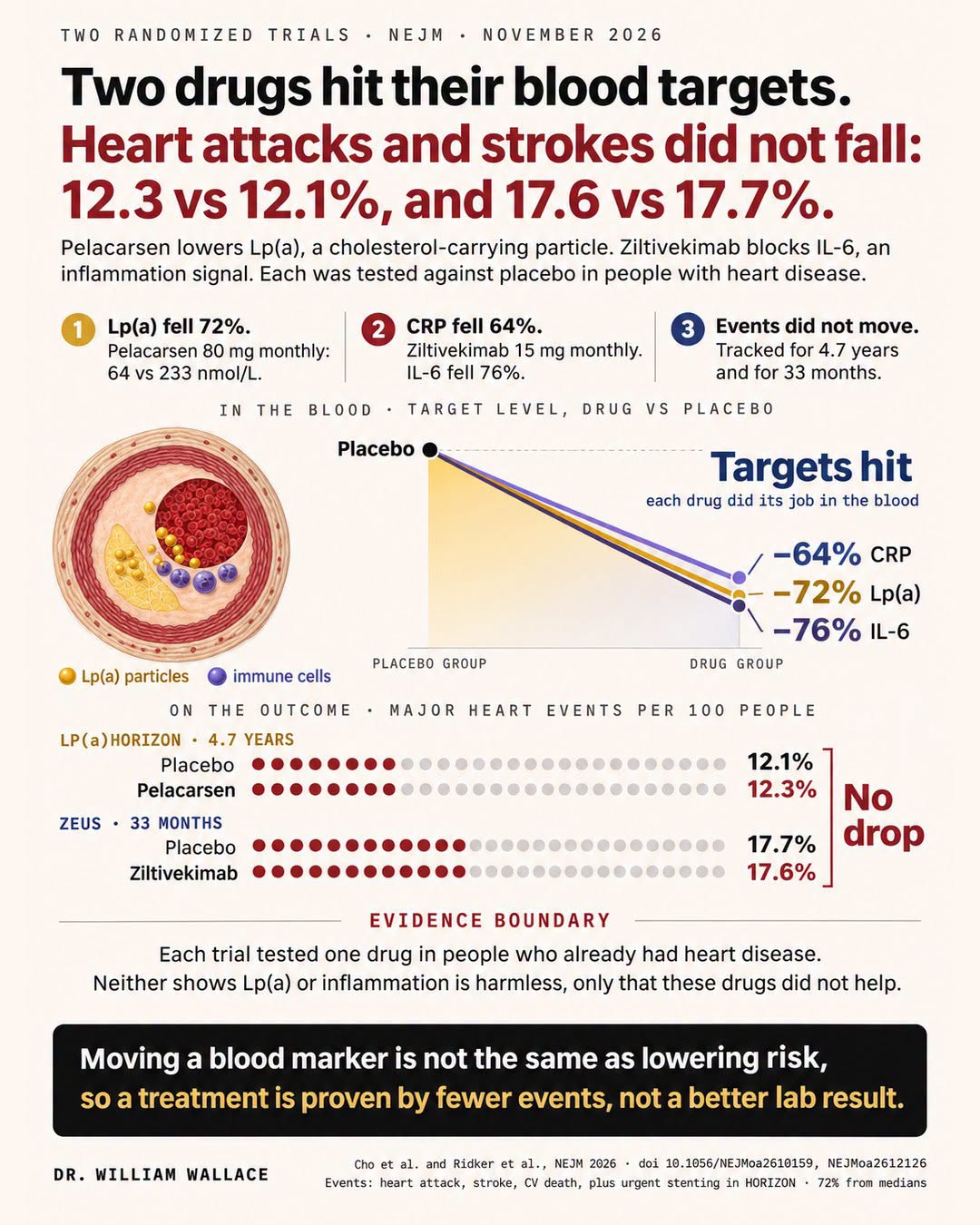
- Pelacarsen: in Lp(a)HORIZON (8,322 people with prior heart attack, stroke or peripheral artery disease), median Lp(a) was 64 versus 233 nmol/L after one year, but over 4.7 years the main event composite occurred in 12.3% versus 12.1% on placebo.4
A Nature news feature that Louis shared explores why the trial may have been neutral. Experts quoted raised several possibilities: participants were already very well treated, with some of the lowest LDL levels ever seen in a randomized trial, so aggressive LDL lowering may have blunted Lp(a) risk. Four or five years of treatment may be too short, or treatment may have started too late. Subgroups, such as people with the highest Lp(a) or those not on antiplatelet drugs, still need examination.27 The shared NEJM summary adds that the trial does not prove Lp(a) is non-causal, since it enrolled people who already had disease.4 Lepodisiran's own outcome benefit has not been shown, and the group's Lp(a) explainer likewise says trials designed to answer the question were still reporting.9
Nuances and common misconceptions
- A lab improvement is not a clinical benefit. Niacin and CETP inhibitors lowered LDL and changed HDL, and still failed. Louis notes this is why the FDA requires large outcome trials for a heart-attack-prevention indication.5 The same pattern recurred recently with pelacarsen and with ziltivekimab, which cut CRP by 64% and IL-6 by 76% but produced event rates of 17.6% versus 17.7%.4
- Newer is not automatically better. PCSK9 drugs may work as well as or better than statins, but the honest answer, according to Louis, is that this has not been shown.11
- Non-statin drugs act in the blood, not the brain. Louis explains that PCSK9 inhibitors, ezetimibe and bempedoic acid do not influence brain cholesterol production, because the brain makes its own cholesterol separately, whereas lipophilic statins such as atorvastatin do enter the brain.28 Yet a large Mendelian randomization of about 1 million people found that genetic variants mimicking statins (HMGCR), ezetimibe (NPC1L1) and CETP inhibition were linked to 76%, 82% and 70% lower dementia risk per roughly 40 mg/dL lower non-HDL cholesterol, while PCSK9-type variants showed no benefit. These are lifelong genetic effects, not drug trials.29
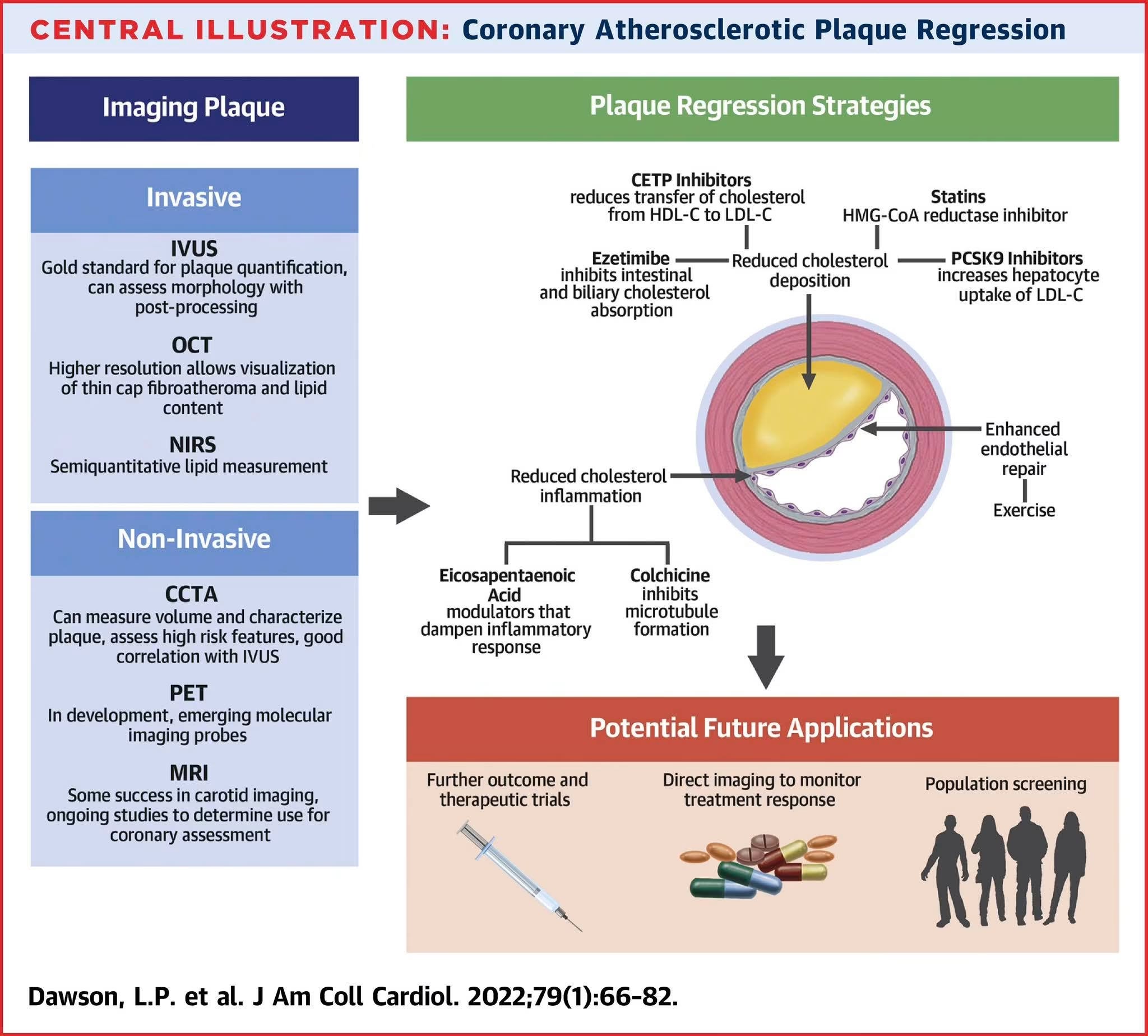
- Plaque is another yardstick. The group has a summary graphic of medication strategies shown to regress plaque in randomized trials, tagged with statins, PCSK9 inhibitors, ezetimibe, EPA and colchicine; the olezarsen result shows that a big change in one lipid does not guarantee plaque change.730
Show data
| Drug | Placebo | |
|---|---|---|
| Pelacarsen, Lp(a)HORIZON (Lp(a) lowered) | 12.3% | 12.1% |
| Ziltivekimab, ZEUS (CRP and IL-6 lowered) | 17.6% | 17.7% |
| Dalcetrapib (HDL raised) | 8.3% | 8.0% |
What this means for you
- If LDL remains above target on a statin, the guideline path described in the group is to add ezetimibe first, then consider bempedoic acid, a PCSK9 antibody or inclisiran. Discuss which step suits your risk with your doctor.1012
- If you cannot tolerate statins, the group's list of alternatives is ezetimibe, bempedoic acid, inclisiran, Repatha and Praluent; bempedoic acid has outcome data in statin-intolerant people, while PCSK9 antibodies have outcome proof mainly on top of statins.11113
- If you take bempedoic acid, the reported side effects to ask about are gout, gallstones and changes in uric acid, creatinine and liver enzymes.1
- Treat obicetrapib as new and not yet outcome-proven: it is approved in the EU for LDL lowering, but heart-attack results and any Alzheimer's benefit are still to be shown.23
- Lp(a) is genetic; the group's explainer suggests asking your doctor for a single test, because the number does not change much but guides how aggressively to manage other risks. Lp(a)-lowering drugs have not yet shown fewer events.49
- Do not judge a drug by HDL or triglycerides alone; the group's admins focus on LDL and ApoB, and on insulin sensitivity for triglycerides and HDL.2026
Frequently asked questions
Is obicetrapib available now?
It was approved by the European Commission on 21 September 2026, reported as the first approval anywhere, in two forms (obicetrapib alone and combined with ezetimibe). The posts do not describe approval elsewhere.2
Does raising HDL protect the heart?
Not according to the trials the group cites: five major HDL-raising trials failed to cut events, and torcetrapib increased deaths.46 Obicetrapib is mainly valued for its LDL-C lowering, not for raising HDL.2
Can PCSK9 drugs replace statins?
Louis says no outcome trial supports that. Their proven benefit is on top of statins, and guidelines recommend them alone mainly for people who cannot take statins.11
Why did the Lp(a) drug not reduce heart attacks?
The posts say it is not yet clear. Possible explanations include very well-controlled LDL in participants, short treatment duration, late treatment and the need for subgroup analysis.427
Do cholesterol drugs also lower inflammation?
Yes, to differing degrees: hsCRP fell on average by about 20% with bempedoic acid, 17.3% with statins and 3.2% with ezetimibe, according to a meta-analysis Louis cited.1516