BREAKING Lp(a) NEWS
Big news in the Lp(a) world this week, and not the news most of us were hoping for unfortunately.
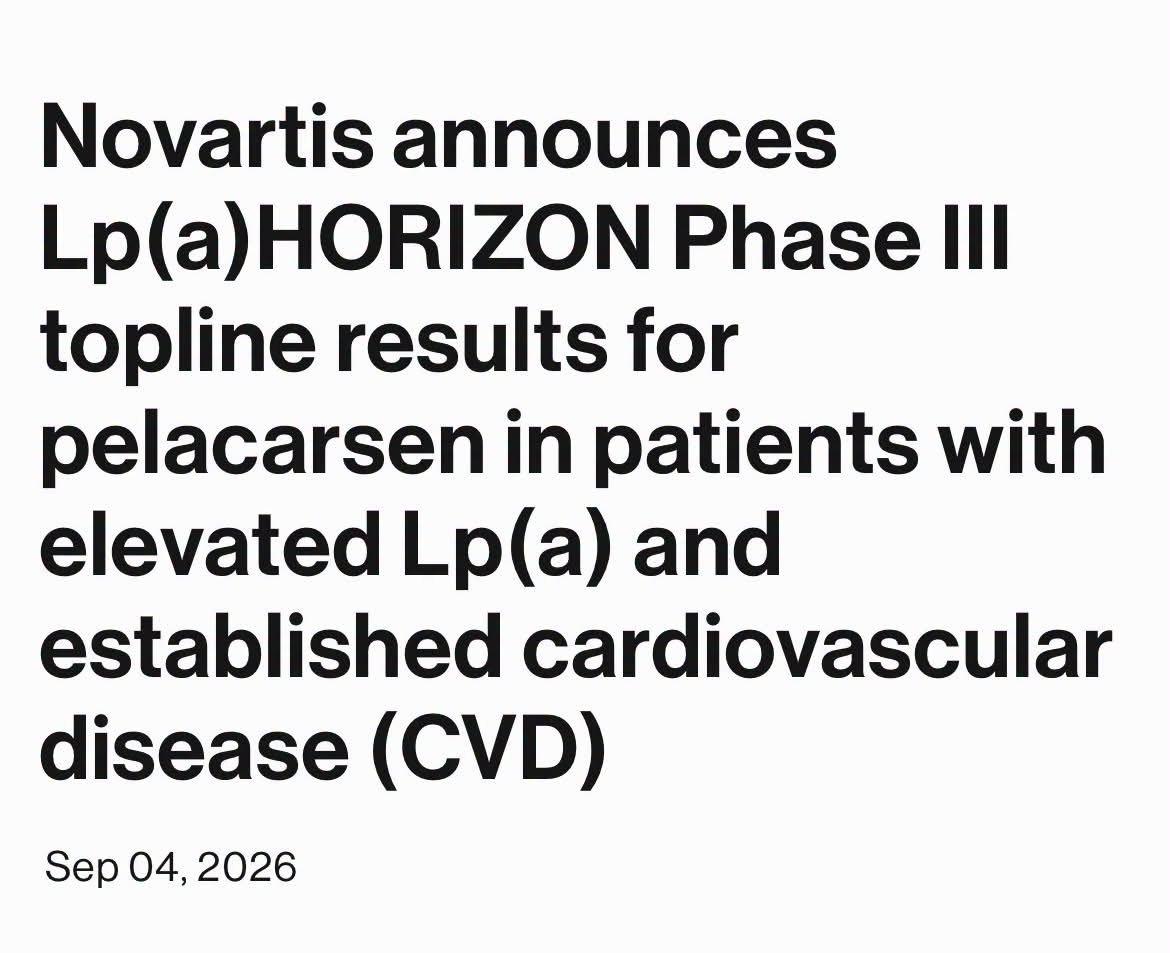
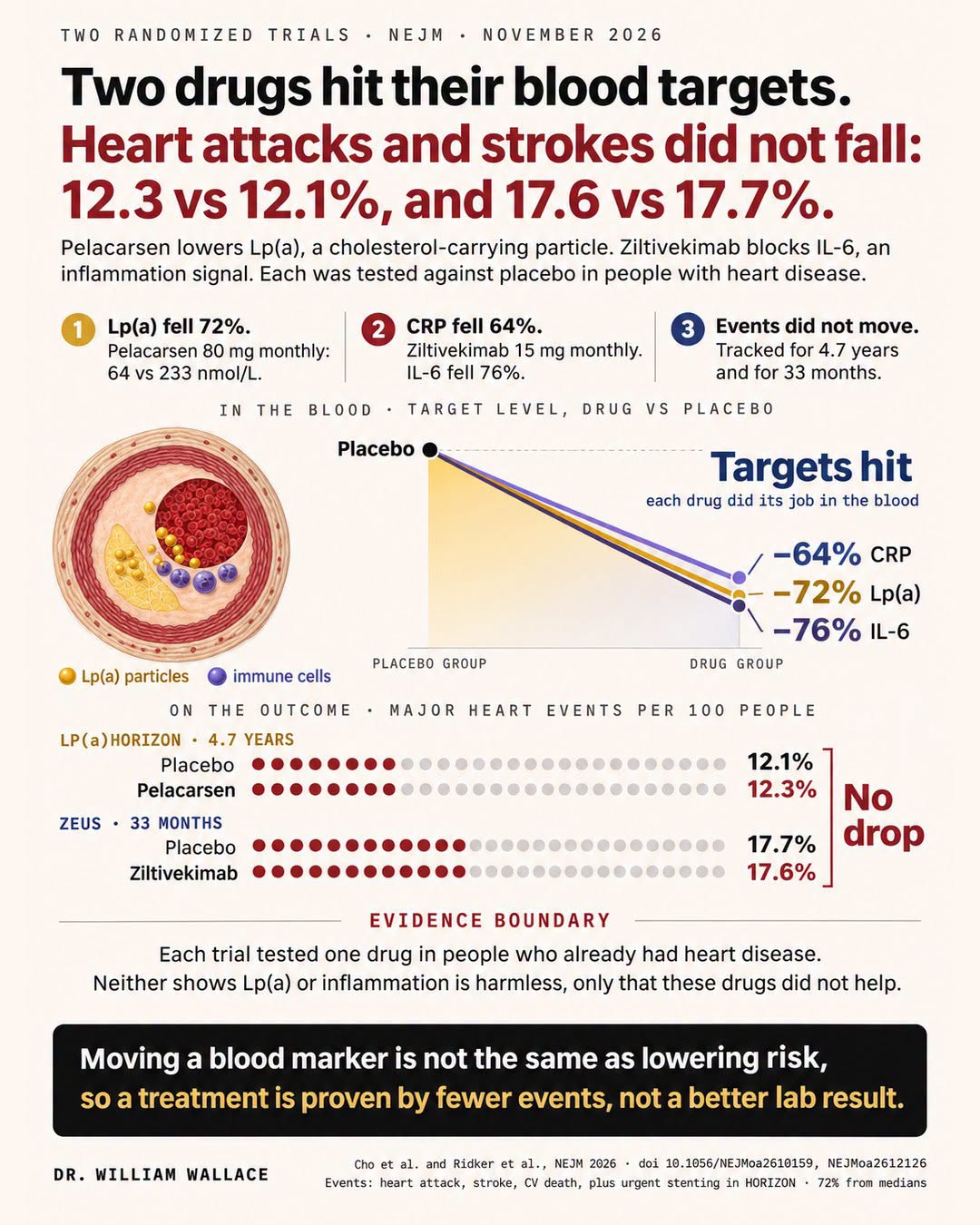
The Novartis Lp(a) HORIZON trial, the first large study designed to test whether lowering Lp(a) with a drug actually prevents heart attacks and strokes, released its topline results and MISSED ITS PRIMARY ENDPOINT. In simple terms: in people who had already had a heart attack, stroke or noted peripheral artery disease, lowering their Lp(a) (exact amount not yet known) did not reduce cardiovascular events compared to placebo.
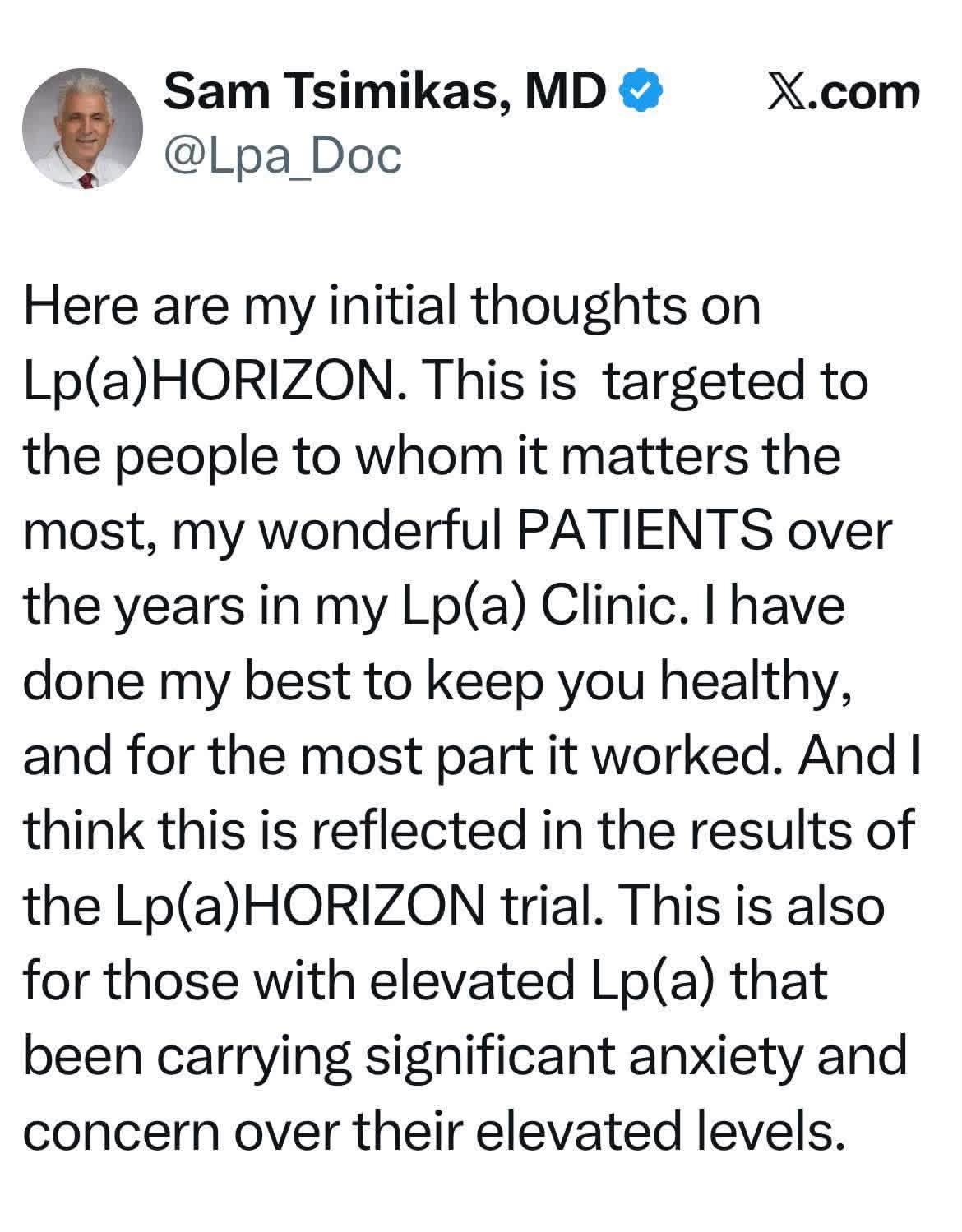
Because this is such a significant result, and because so many of you out there have high Lp(a) and have been waiting years for this, I don't want to give you my own take. I'd rather pass a summary along of the thoughts of Dr. Sam Tsimikas, who is one of the world's leading Lp(a) researchers and has spent decades investigating this question.
What we know:
The evidence that high Lp(a) is linked to heart attack, stroke, PAD and aortic valve disease is enormous. Hundreds if not thousands of genetic and population studies point the same direction. That hasn't changed.
But crucially most of that evidence came from general populations, often before the era of very aggressive LDL lowering and modern secondary prevention. We've had much less information about how much risk Lp(a) still carries once someone has had an event and is already being treated aggressively.
And HORIZON patients were quite aggressively treated. Their LDL cholesterol averaged already down around 65. Something crucial most people don't know: a standard LDL-C number includes the cholesterol riding on Lp(a) particles. So in people with very high Lp(a), like in this trial, the "true" LDL may have been closer to 45 to 50, maybe lower.
This raises a very important, very basic question: once you've pushed LDL that low, how much extra benefit can you still show by lowering one more cholesterol-carrying particle?
Put another way- If a fire is burning and you take away most of the logs, how much extra benefit do you get from also taking away a bunch of (technically easier to burn) twigs?
What he says we don't know yet:
A lot.
Was the corrected LDL actually that low?
Did the drug lower the oxidized phospholipids that ride on Lp(a) and may be responsible for much of its inflammatory damage?
Did we even measure the right thing for trial entry?
We measure particle count, but two people with the same Lp(a) number might carry very different amounts of the harmful stuff inside those particles.
He also raises an important point about genetics. Genetic studies reflect a lifetime of exposure starting at birth. A drug trial treats people late in life, after decades of arterial damage and usually after an event has already happened. Those are not the same experiment, and we may have assumed they were.
Other open questions: Again, does Lp(a) still matter less once LDL is very low?
Does everyone already being on aspirin or other blood thinners blunt the clotting part of Lp(a) risk?
Was there something specific about this drug, the dose, the timing, or the patient population?
And maybe the most interesting one:
Why are these very well treated patients still having events at all?
What's driving that leftover risk?
Inflammation?
Clotting?
Plaque that was already too far along?
Something we aren't measuring?
He also wonders whether we've been focusing so heavily on how many lipoprotein particles are in the blood that we've underweighted what happens to them once they get into the artery wall and become oxidized. For some people the answer may still be removing more particles. For others it might be preventing that damage in the first place.
What this means for you right now, in his words more or less, and also as I always say:
Especially if you've already had a heart attack, stroke or PAD, the lesson is actually very clear:
Treat every established risk factor aggressively.
Eat and live as well as possible.
Get LDL and apoB very low.
Control blood pressure.
Control blood sugar.
Don't smoke.
VERY IMPORTANTLY therefore, if nothing else, the HORIZON trial, may simply help show what excellent secondary prevention looks like.
If you have high Lp(a) and have never had an event, the genetic and population data still point to higher lifetime risk. PLEASE DO NOT TAKE THE RESULTS HERE TO SUGGEST OTHERWISE, or let others convince you can now ignore a high Lp(a). This trial DOES NOT SHOW THAT.
There are four more big Lp(a) outcome trials still to come out, using different drugs and different designs, and it would be a mistake to draw sweeping conclusions before they do.
ONE MORE VERY IMPORTANT THING TO CONSIDER:
For those who believe big pharma buries bad results to keep the money flowing, please take a good look at what just happened. A company spent roughly a decade and an ENORMOUS amount of money on a drug it very much wanted to work, and planned on working, ran a trial of over 8,000 people, and then announced publicly that it failed. Not only that, the scientist most closely tied to the drug's development is the one openly listing all the reasons it may not have worked. That is as clear an example of what is still obviously an imperfect and sometimes corrupt system this time doing exactly what it is supposed to do. This doesn't mean the industry is above criticism, it absolutely positively isn't, but "they bury the failures" is pretty hard to square with a failure this big being reported this openly by its biggest proponent.
Dr Tsamikas’ closing thought:
The story of Lp(a) therapy is still just beginning, and definitely not ending with this trial. And a lot of gratitude is owed to the thousands of patients who volunteered for this trial, and to the researchers and companies who put enormous resources into actually testing the question rather than just theorizing about it.
More to come as the full data come out.