Two heart drugs crushed their lab targets and did nothing for the heart.
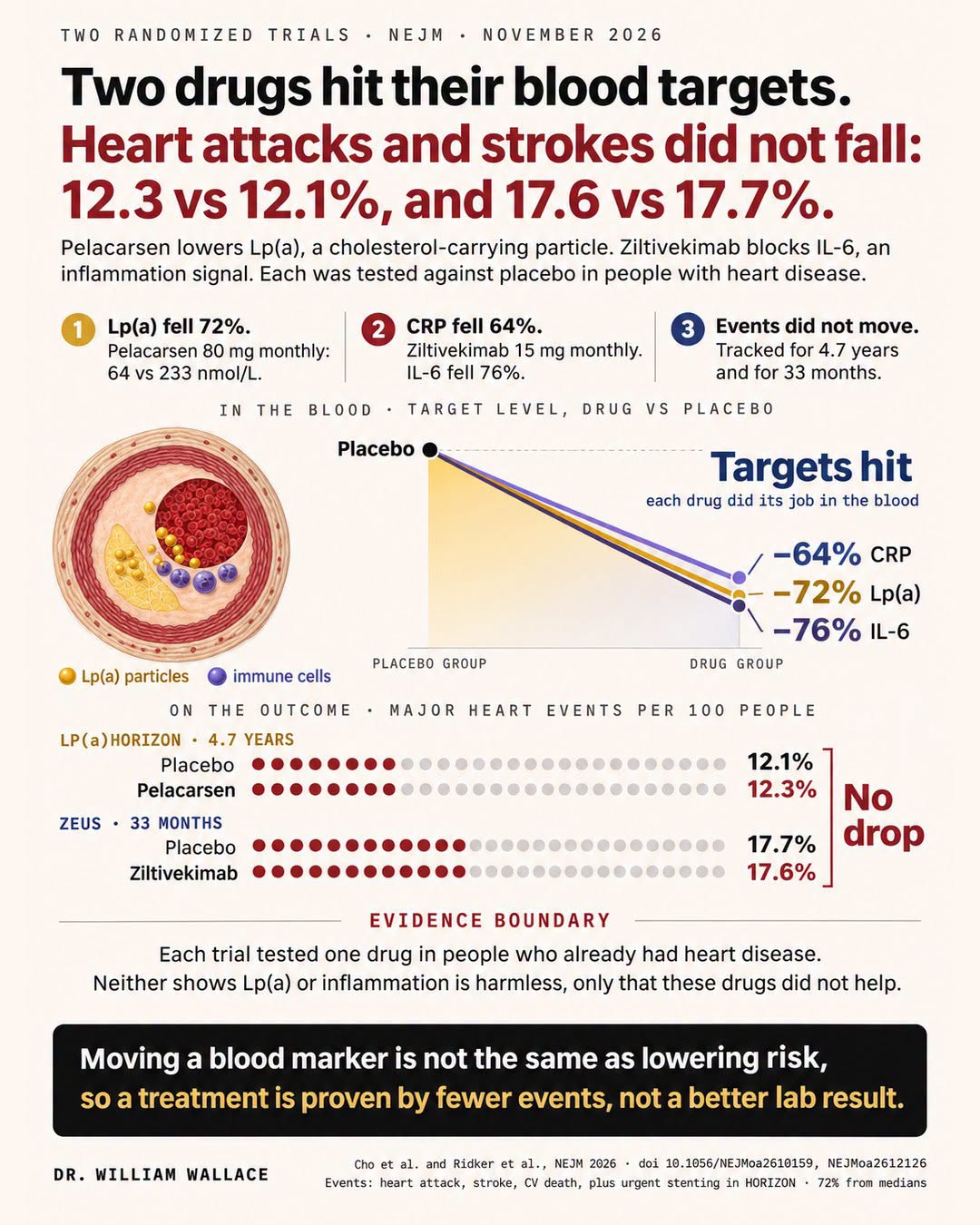
Two large trials just published in the New England Journal of Medicine went after two of cardiology's most promising targets. In Lp(a)HORIZON, 8,322 people with a prior heart attack, stroke or peripheral artery disease and high lipoprotein(a), a mostly inherited cholesterol-carrying particle, took monthly pelacarsen or placebo. After one year, median Lp(a) was 64 nmol/L on the drug versus 233 on placebo. Over 4.7 years, heart attack, stroke, cardiovascular death or an urgent artery-opening procedure struck 12.3% of the drug group and 12.1% of the placebo group.
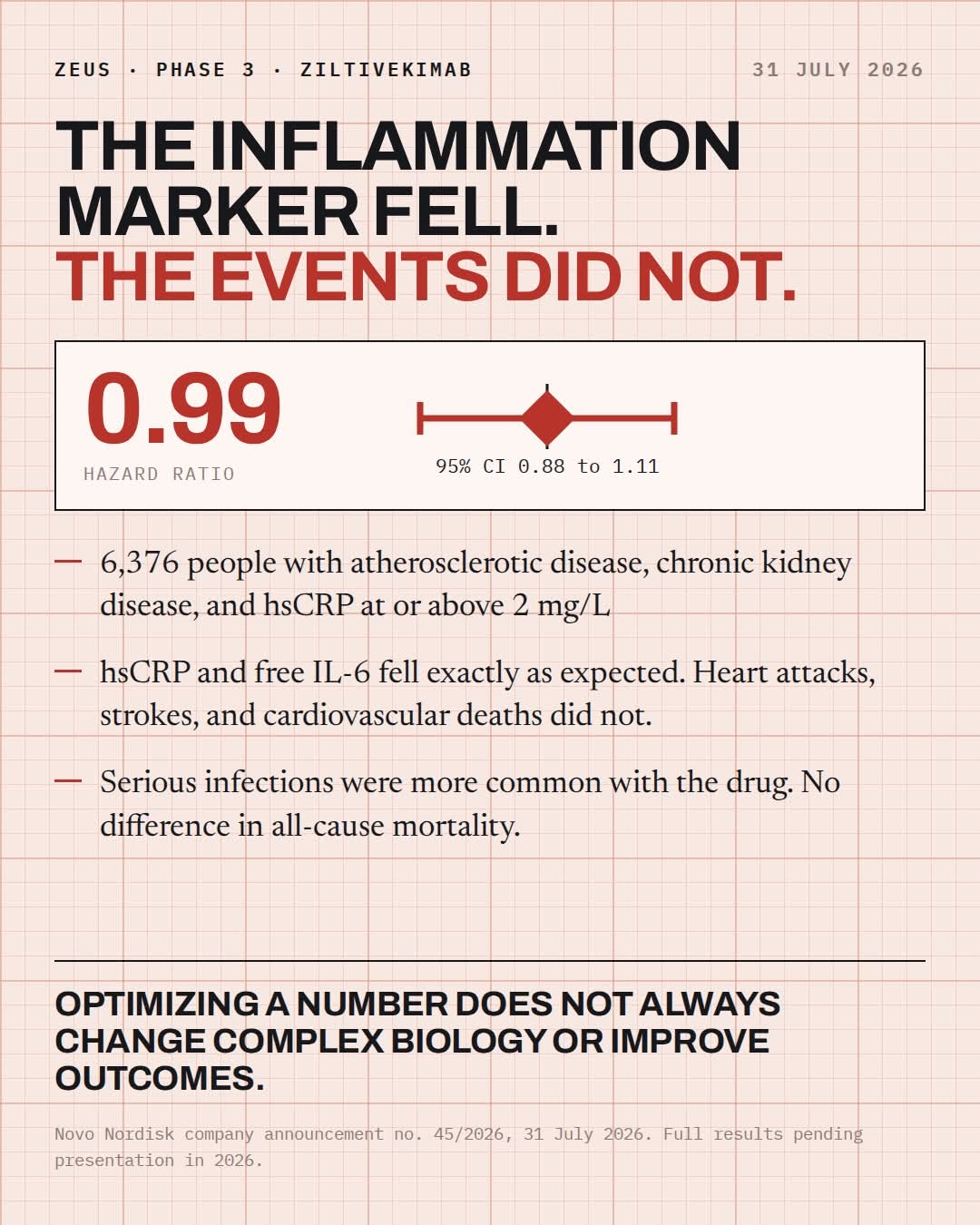
In ZEUS, 6,376 people with clogged arteries, chronic kidney disease and high CRP took monthly ziltivekimab, which blocks the inflammation signal IL-6. Compared with placebo, CRP fell 64% and IL-6 fell 76%. Over 33 months, heart attack, stroke or cardiovascular death occurred in 17.6% versus 17.7%.
Medicine has seen this movie before. In 2007, torcetrapib raised "good" HDL cholesterol by 72% and cut LDL by 25% in 15,067 high-risk patients, yet deaths rose from 59 to 93 and the trial was stopped early. In 2012, dalcetrapib raised HDL 31 to 40% in 15,871 heart patients, and events landed at 8.3% versus 8.0% on placebo. A number that tracks with risk is not always a lever that changes it.
These results have limits. Both trials enrolled people who already had heart disease, and the ZEUS patients were very sick. Neither proves high Lp(a) or chronic inflammation is harmless. They show that these two drugs did not prevent events. Two other Lp(a) drugs, olpasiran and lepodisiran, are still in outcome trials with no results yet.
A better lab number is a promise. Fewer heart attacks, strokes and deaths is the proof.