Press release on the Lp(a) HORIZON trial from the Cleveland Clinic
Quoted:
Phase 3 of the Lp(a)HORIZON trial examined patients with existing heart disease who were already taking standard treatments.
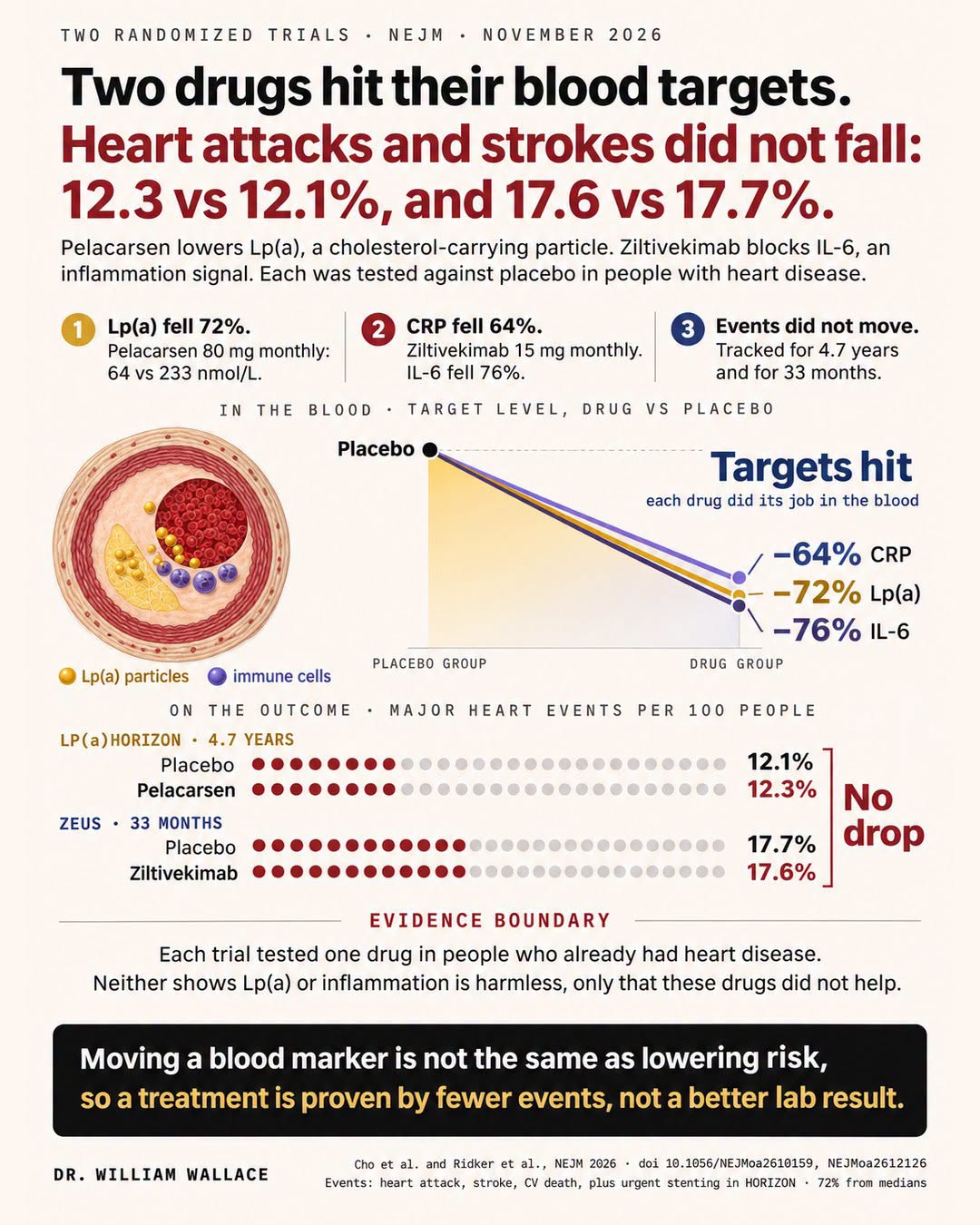
The primary endpoint was the time until a patient’s first major cardiovascular event – defined as heart-related death, heart attack, stroke or urgent heart procedure needing hospitalization. The primary endpoint occurred in 12.3% of patients in the pelacarsen treatment group and 12.1% in the placebo group.
The results were presented today during a late-breaking science presentation at the American Heart Association’s Scientific Sessions 2026 in Chicago and were simultaneously published in the New England Journal of Medicine.
“Although the results are disappointing, neutral trials also provide scientific insights that help inform future research efforts,” said senior author Steven Nissen, M.D., Chief Academic Officer of the Heart, Vascular & Thoracic Institute at Cleveland Clinic. “A single trial does not provide definitive evidence of a lack of benefit of lowering lipoprotein(a) as a strategy to reduce cardiovascular risk.”
Elevated Lp(a) is estimated to affect 64 million people in the United States and 1.4 billion people worldwide.
The double-blind, randomized, placebo-controlled trial involved patients from 797 sites in 42 countries and included patients 18 to 80 years old who had prior cardiovascular disease and a Lp(a) level of greater than or equal to 70 mg per deciliter. From December 2019 through July 2022, 8,322 patients were randomly assigned to receive pelacarsen 80 mg or matching placebo via a self-administered injection every month.
Patients were followed for a median of 57 months (4.7 years) for both treatment groups.
Established cardiovascular disease was defined as a prior heart attack or a stroke occurring between 3 months and 10 years prior to enrollment, or symptomatic peripheral arterial disease. Patients received secondary prevention therapies before enrollment, including maximally tolerated lipid-lowering treatment according to local guidelines.
Key secondary endpoints included time to death from any cause and the change in Lp(a) levels after one year. The study also looked at two narrower combinations of heart events: one excluding urgent procedures and another focusing specifically on coronary-related heart events instead of stroke.
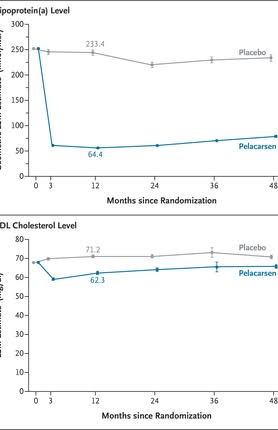
The reduction from baseline in Lp(a) after one year was 3.2% in the placebo group and 78.4% in the pelacarsen group with an estimated treatment difference of 77.7% percentage points.
After one year, LDL (“bad”) cholesterol fell to 62.3 mg/dL with pelacarsen, but rose to 71.2 mg/dL with the placebo. Overall, pelacarsen lowered LDL by 13.3 percentage points compared to placebo.
Serious adverse events occurred in 37.3% of patients in the pelacarsen group and in 41.1% of the placebo group. Adverse events were more common in the pelacarsen group, including flu-like symptoms, injection site reactions and other events that led to permanent study drug discontinuation.
“The HORIZON trial is not the end of the story,” added Dr. Nissen. “Ongoing trials are studying different populations, such as primary prevention or aortic stenosis, and different therapies such as small interfering RNA (siRNA) that silences specific genes by breaking down complementary messenger RNA. We look forward to their results.”