Lipoprotein(a), written Lp(a) and pronounced "L-P-little-a", is a cholesterol-carrying particle that looks like LDL but has an extra protein tail attached. Its level is set almost entirely by your genes, it barely changes over a lifetime, and a high level is common: roughly 1 in 5 people. It has been linked to heart attack, stroke, aortic valve stenosis and peripheral artery disease, and it can be high even when a standard cholesterol panel looks normal.12
Because the level is inherited and stable, the group's posts and the 2026 ACC/AHA lipid guideline converge on one simple message: get it measured at least once.23 Testing does not change your number, but it tells you how seriously to manage the risk factors you can influence.2
What to do about a high result is now genuinely uncertain. In September 2026 the first large outcome trial of an Lp(a)-lowering drug, Lp(a)HORIZON, was announced as a failure, and the full results in November confirmed there was no reduction in heart attacks or strokes despite a very large drop in Lp(a).45
What Lp(a) is
An LDL particle is a globule of fat wrapped in a protein called apolipoprotein B (apoB). Lp(a) is built on the same plan, with one major difference: it carries an additional tail made of apolipoprotein(a), or apo(a), attached to the apoB-100 part of the particle.17 The tail loops into segments called kringles, and people carry anywhere from 1 to more than 40 copies of one kringle type. The fewer the copies, the smaller the particle and the higher the Lp(a) level, apparently because liver cells find it easier to produce and secrete the smaller particles.7
Lp(a) is counted inside your LDL-C
Louis Nervegna uses a boats-and-cargo analogy. LDL and Lp(a) are different "boats", but both carry the same "cargo", LDL cholesterol. The LDL-C on a lab report therefore reflects cholesterol from both LDL particles and Lp(a) particles, and in people with very high Lp(a) a significant share of reported LDL-C may come from Lp(a).89 He extends the analogy to apoB: apoB is the "sign" on every atherogenic boat (LDL, VLDL and Lp(a)), so an apoB test counts the total number of such particles.10 Lp(a) and VLDL (which carries most triglyceride) are both apoB-tagged too.11
Genetics and stability
Gokhan Can's explainer summarizes the key facts: Lp(a) level is 80-90% genetically determined, is fully expressed by 1-2 years of age, reaches adult levels by about age 5, and outside of acute inflammatory states stays relatively stable regardless of lifestyle. Elevated Lp(a) is estimated to affect more than 1.4 billion people worldwide, making it the most common genetic lipid disorder.1
Why it may be more dangerous than LDL
A Nature feature quoted in the group says that, particle for particle, Lp(a) carries about six times the risk of LDL. Possible reasons include more effective cholesterol deposition in artery walls, more inflammation, and, in Børge Nordestgaard's view, an effect on blood clotting.7
Several mechanisms are discussed in the posts:
- Cholesterol deposition. The apo(a) protein makes the particle particularly sticky inside the artery wall, so LDL cholesterol gets trapped and forms plaque.812
- Clotting. Apo(a) closely resembles plasminogen, the body's clot-dissolving protein, and competes with it.1314 Louis also describes apo(a) as prothrombotic, making clots form more easily if a plaque ruptures.8
- Oxidized phospholipids (OxPL). Lp(a) is the main carrier of these damaged, inflammatory fats in the blood, via a lysine binding site in the kringle IV type 10 domain. A commentary summarized in the group says OxPL switch on monocytes to make more tissue factor, a main trigger of clotting, and that patients with stents who had higher Lp(a) and OxPL had stronger clots on a specialized test.1314 Some authors suggest that Lp(a) harm comes largely through OxPL, and that OxPL content may predict risk better than Lp(a) itself, which could explain why some people with very high Lp(a) have clean arteries.15
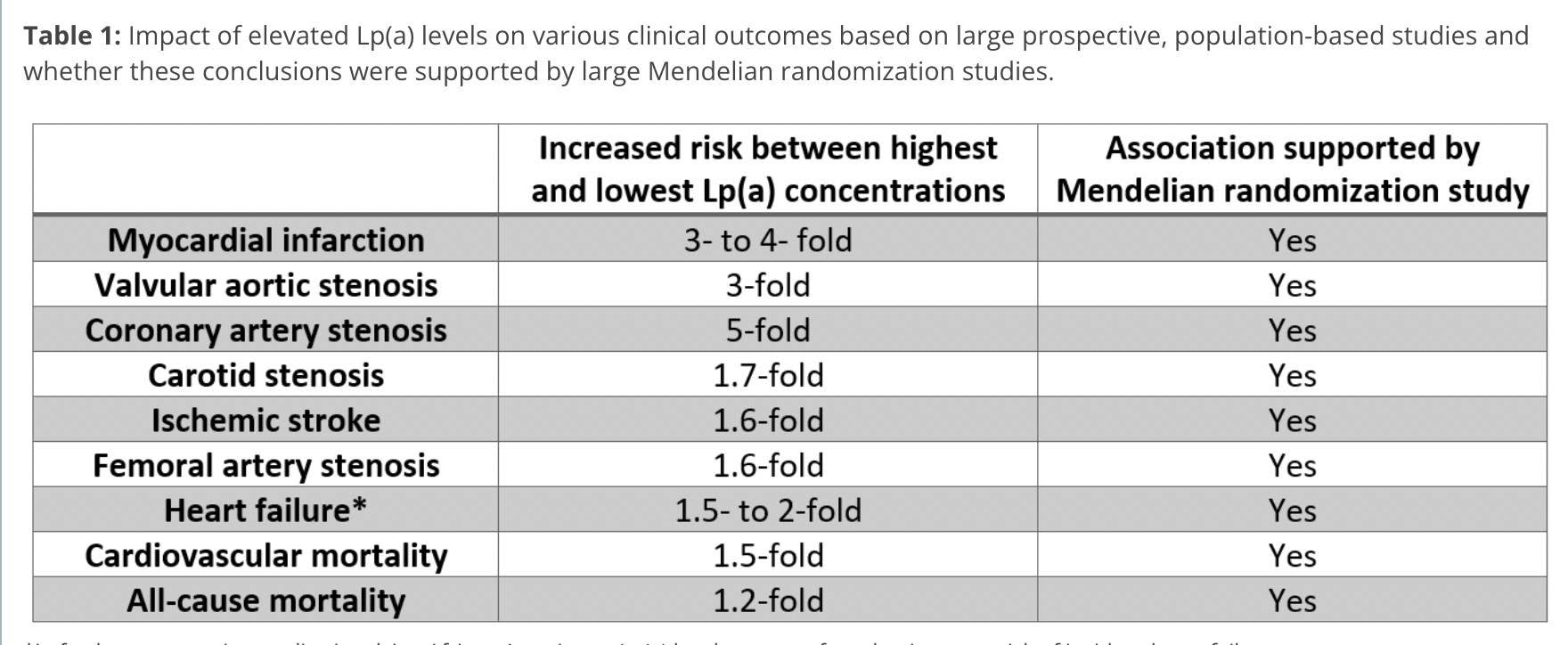
High Lp(a) is linked to coronary heart disease, heart attack, ischemic stroke, aortic valve stenosis and peripheral artery disease.116
Louis notes that people with very low or undetectable Lp(a) have no significant ill effects, so it does not appear essential in modern humans; it may have offered ancestors some advantage, and high Lp(a) might be linked to lower risk of diabetes and hemorrhagic stroke, though it strongly raises cardiovascular risk.17
What the evidence says about risk
Thresholds and how much risk
Gokhan's explainer cites levels above 50 mg/dL or 125 nmol/L as associated with increased atherosclerotic cardiovascular disease (ASCVD) risk, along with other cited findings such as an odds ratio of 1.48 for heart attack above 50 mg/dL in INTERHEART and roughly doubled ischemic stroke risk with smaller apo(a) isoforms and higher levels.1 The 2026 ACC/AHA guideline, as summarized by Louis, defines high Lp(a) as 125 nmol/L (50 mg/dL) or more, associated with about a 1.4-fold increased long-term risk of heart attack or stroke, and says 250 nmol/L is associated with at least a two-fold risk.3
Louis cites a review stating that in primary prevention every 50 mg/dL increase in Lp(a) corresponds to a hazard ratio of 1.16 for cardiovascular mortality. His own linear extrapolation (250 mg/dL implying roughly an 80% higher risk) is an illustration, not a trial result.18
A Mass General Brigham registry analysis suggested the usual cutoff may be too high. The 125 nmol/L guideline threshold is the 80th percentile, yet major adverse cardiovascular event risk over more than a decade was already 14% higher in the 51st-70th percentile (42-111 nmol/L; adjusted HR 1.14, 95% CI 1.05-1.24), and the hazard ratio rose to 1.21 for the 71st-90th percentile (112-215 nmol/L).19
Show data
| Adjusted hazard ratio | 95% CI | |
|---|---|---|
| 51st–70th percentile (42–111 nmol/L) | 1.14 | 1.05–1.24 |
| 71st–90th percentile (112–215 nmol/L) | 1.21 | – |
In the Women's Health Study, followed for 30 years with 3,662 first major cardiovascular events, the top versus bottom quintile hazard ratios were 1.70 for hsCRP, 1.36 for LDL cholesterol and 1.33 for Lp(a). Each contributed independently, and the combination predicted best.20
Show data
| Hazard ratio | 95% CI | |
|---|---|---|
| hsCRP (inflammation) | 1.70 | – |
| LDL cholesterol | 1.36 | – |
| Lp(a) | 1.33 | – |
Lp(a) and LDL lowering: a genetic estimate
A UK Biobank natural-randomization (genetic) analysis by Brian Ference, covering 445,765 participants, compared average Lp(a) (20 nmol/L) with higher Lp(a) (123 nmol/L). Lifelong higher Lp(a) was associated with a projected 37% higher risk of major coronary events, and that excess was completely offset in people who also had genetically lower LDL-C.21 The offset required LDL-C about 0.5 mmol/L (19 mg/dL) lower at every age, and the later LDL lowering starts, the larger the reduction needed. For Lp(a) 150 nmol/L above the median, the needed reduction was 0.6, 0.7, 0.9 and 1.1 mmol/L if started at ages 30, 40, 50 and 60; for 250 nmol/L above the median, starting at 50 or 60 needed 1.5 or 1.9 mmol/L.21 This is a modeled genetic estimate, not a treatment trial.
Risk modifiers in MESA
Louis has shared several analyses from the MESA cohort, a prospective observational study that can show associations but not causality.2223
- Coronary calcium (CAC). Risk was highest with elevated Lp(a) and CAC of 100 or more; with CAC of 1-99 the risk was about the same whether Lp(a) was high or low, and over a decade a CAC of zero seemed to "trump" high Lp(a), per a quoted investigator.2425 A later JACC analysis found higher relative risk with elevated Lp(a) across CAC strata, but low absolute event rates when CAC was 0.26 A counterpoint quoted from a National Lipid Association update: Lp(a) is not consistently associated with baseline CAC or CAC progression, so a zero score does not remove Lp(a)-related risk, particularly in younger adults.27
- Inflammation (hsCRP). Over 13.6 years and 684 events, no significant risk from Lp(a) was seen when hsCRP was under 2 mg/L. With hsCRP of 2 or more, Lp(a) of 50-99.9 mg/dL had HR 1.36 and 100 mg/dL or more had HR 2.09 (interaction p = 0.04). Participants were lower-risk people averaging 62 years, so applicability to younger or higher-risk people is unclear.28
- Visceral fat. Lp(a) of 50 mg/dL or more combined with a waist-to-hip ratio at or above the 90th percentile carried an HR of 2.34 (95% CI 1.61-3.40); in the lower two waist-to-hip tertiles Lp(a) was not significantly associated with ASCVD, and BMI did not modify the risk. Louis suggests losing visceral fat and liver fat is important with high Lp(a), while noting the study is observational.23
Louis summarizes these as three markers that seem to offer extra protection in people with high Lp(a): CAC below 100, hsCRP below 2 mg/L and low visceral fat, adding "please don't bet your life on this being true."2225
Lowering Lp(a): drugs and trials
The Lp(a)HORIZON trial
Pelacarsen, developed by Ionis and tested by Novartis, was the first drug to be tested in a large randomized outcome trial for Lp(a) lowering.429 Details from the posts:
- Design. 8,322 patients (797 sites, 42 countries, ages 18-80) with a prior heart attack, ischemic stroke or symptomatic peripheral artery disease and Lp(a) of at least 70 mg/dL, randomized to pelacarsen 80 mg monthly by self-injection or placebo; median follow-up 57 months (4.7 years). All were on maximally tolerated lipid-lowering therapy.530
- Lp(a) effect. Lp(a) fell about 78%; at 12 months it was 64.4 versus 233.4 nmol/L on placebo (baseline median 236).530
- Outcome. The primary endpoint (cardiovascular death, heart attack, stroke or urgent procedure) occurred in 511 patients (12.3%) on pelacarsen and 503 (12.1%) on placebo (hazard ratio 1.02, 95% CI 0.90-1.15, P = 0.76).5 In patients with baseline Lp(a) of 90 mg/dL or more, the rates were 12.3% in both groups (hazard ratio 1.00).5
- Safety. Serious adverse events occurred in 37.3% on pelacarsen versus 41.1% on placebo, though flu-like symptoms, injection-site reactions and events leading to discontinuation were more common on pelacarsen.530
Louis stresses there was "not even a trend" towards benefit.5
The full slides and a Nissen interview were also shared.3132 Steven Nissen, the senior author, said a single neutral trial does not prove a lack of benefit from lowering Lp(a), and pointed to ongoing trials in other populations such as primary prevention or aortic stenosis.30
Louis said the result "is going to seriously call into question the assumption that Lp(a) is directly causal in heart disease."4 A New York Times article quoted in the group raised the possibility that Lp(a) may be a marker of risk, "like white hair is a mark of aging", though many researchers were not ready to abandon the hypothesis.33 Louis himself still leans toward causality because of Mendelian randomization studies, while acknowledging that tool has a short track record.34
Why might it have failed?
Several explanations have been aired, and none is proven:
- Patients were already very well treated. Participants were on optimal treatment, with some of the lowest LDL-C levels ever seen in a randomized trial; a cardiologist quoted by Nature said aggressive LDL lowering may "negate a lot of risk associated with Lp(a)".7 Louis offers a similar speculation: once LDL-C is low enough, there may be too little cholesterol available to cause major damage, even if many Lp(a) particles carry it. He labels this his own speculation.35
- Statins may neutralize OxPL. 78% of HORIZON patients were on high-intensity statins. Louis proposes that atorvastatin may "disarm" Lp(a) by blocking oxidation; this rests on a lab-based abstract (Sherratt et al., European Heart Journal) in which atorvastatin's active metabolite inhibited the oxidation of Lp(a) and small dense LDL better than other statins, and it remains a hypothesis.36
- Too short or too late. Atherosclerosis develops over decades while treatment lasted a few years; a cardiologist cited in Nature said four or five years may not be enough, and damage may have been done already.7
- The population studied. Sam Tsimikas, an Ionis executive and Lp(a) expert, notes that most evidence linking Lp(a) to disease came from general populations, often before aggressive LDL lowering, and the trial enrolled people who already had disease.29 Another summary agrees that neither trial proves Lp(a) or inflammation is non-causal.37
The group placed HORIZON alongside ZEUS, an IL-6 trial where CRP fell 64% yet events were 17.6% versus 17.7%, and older failures such as torcetrapib (HDL up 72%, deaths up from 59 to 93). The lesson drawn: moving a lab number does not guarantee benefit.373839
Tsimikas himself reads HORIZON as a "major success" because it suggests Lp(a) risk may be managed by keeping LDL-C at 65 or lower, blood pressure at 120 or lower, controlling other risk factors and taking proven medicines regularly. In his Lp(a) clinic, about 75% take a statin, 50% ezetimibe and 50% a PCSK9 inhibitor, plus aspirin used judiciously in primary prevention and universally in secondary prevention.6 Weigh this against his affiliation with the drug's developer.29
Other Lp(a)-lowering drugs
Other agents produce very large drops in Lp(a), but outcome data are pending. Lepodisiran, an siRNA, lowered Lp(a) by 93.9% (placebo-adjusted) at 400 mg in a 320-person NEJM trial, lasting up to a year with only mild injection-site reactions.40 A single-dose therapy lowered it by more than 94% for nearly a year in a phase 1 trial,41 and a Lilly drug cut it 94% in a mid-stage trial; Gokhan noted the key question is whether these drugs reduce cardiovascular events.42
Existing treatments and supplements
Statins
Statins raise Lp(a) by roughly 5-20% in meta-analyses of randomized trials, but Stanford's Joshua Knowles explains this is clinically unimportant and that statins are an important part of treating genetically high Lp(a).4546 Louis points to more than 25 statin trials, in which lowering LDL by about 75 mg/dL cut heart attack or stroke by about 40% on average, including in people with high Lp(a).1245 A graphic in the group notes that across 147 trials, statins, ezetimibe, fibrates and fish oil did not lower Lp(a).2
PCSK9 inhibitors
A meta-analysis cited by Louis found PCSK9 inhibitors lower Lp(a) by an average of 27%.44 Louis argues that no randomized trial shows PCSK9 inhibitor monotherapy lowers heart attacks, so people taking one mainly to lower Lp(a) should revisit that choice given HORIZON; statins, or statins plus a PCSK9 inhibitor, have outcome evidence in people with high Lp(a).47
Niacin
Louis's views on niacin have changed. He noted that niacin can be very effective at lowering Lp(a) (one member saw a 40% drop on 1,500 mg), a small trial showed about 28% in men, and rare cases of up to 80% are reported, but it has never been proven to reduce heart attacks, strokes or mortality.434849 Two large trials found no added benefit and more side effects when niacin was added to high-dose statins, and he would not combine them.4850 After HORIZON he no longer sees a use case for niacin in high Lp(a), except perhaps for people who refuse all pharmaceuticals.50
Aspirin
Louis suggests baby aspirin may be worth considering in high Lp(a), linking a 2025 review arguing Lp(a) may redefine aspirin's role in primary prevention.51 He also notes aspirin reduces clotting risk.13
Diet and supplements
The evidence here is thin. Ginger 1,600 mg/day for 8 weeks lowered Lp(a) by about 5 ng/mL from a low baseline of 27 in a small trial of 57 men with atherosclerosis.52 Vitamin C at 1 g/day for 8 months did not lower Lp(a) in a randomized trial of 101 healthy adults.53 A PREDIMED-Plus analysis of 348 participants linked a higher share of extra virgin olive oil to about 22% lower Lp(a), but this was observational and significant only in one group.54
Nuances and common misconceptions
- "My Lp(a) changed a lot, so my intervention worked." Lp(a) is an acute-phase reactant. Infection, surgery, extreme exercise, strong vaccine reactions or inflammatory flares can temporarily shift results, and guidelines advise against testing during acute inflammation. Large swings usually reflect inflammation rather than a supplement or drug.55 Louis also cautioned that a very large reported drop from lifestyle change might simply be a lab error.56
- "Statins raised my Lp(a), so statins are bad for me." Statins raise Lp(a) only about 5-20% in most cases; a huge increase often points to an unrelated inflammatory issue rather than the statin.4555
- "Adding Lp(a) improves risk calculators." Adding Lp(a) did not meaningfully improve the accuracy of the PREVENT equations, though an editorial notes measuring it can still personalize risk because Lp(a) is causal.5758
- "HORIZON proves Lp(a) is harmless." Not so. The trial tested one drug in people with established disease; experts cited in the group say a single neutral trial does not close the question, and the genetic and observational evidence is unchanged.2930
What this means for you
Posts from the group's admins describe the following ideas. None is individual medical advice, and decisions belong with your doctor.
- Consider asking your doctor to measure Lp(a) once; the 2026 ACC/AHA guideline recommends measuring it at least once in adulthood, and repeat testing is generally not needed because lifestyle changes minimally affect it.3
- Avoid testing during an acute illness or inflammatory flare, and interpret large swings cautiously.55
- If high, the posts emphasize driving LDL-C (and apoB) low with proven therapy, since Lp(a) cargo counts toward LDL-C. Statins have outcome evidence in high Lp(a), and Tsimikas's approach adds ezetimibe and PCSK9 inhibitors as needed.612
- Keep blood pressure and other risk factors controlled; Tsimikas gives targets of LDL-C 65 or lower and blood pressure 120 or lower.6
- A CAC scan may help refine risk: MESA data suggest CAC of 0 means low 10-year absolute risk, but a zero score does not fully remove risk in younger people.2627
- Check hsCRP and waist-to-hip ratio, since MESA suggests risk concentrates when these are high.2328
- Discuss aspirin with your doctor if Lp(a) is high.51
- Be cautious about unproven Lp(a)-lowering supplements, and avoid combining niacin with high-dose statins.50
- Watch for outcome trials of newer Lp(a)-lowering drugs.3042
Frequently asked questions
Can I lower my Lp(a) with diet or exercise?
Mostly not. Lp(a) is 80-90% genetic and stable regardless of lifestyle, and lifestyle changes minimally affect it.13 Small studies of ginger or olive oil exist, but none shows a benefit on heart attacks.5254
Is Lp(a) really a cause of heart disease, given the HORIZON result?
The question is open. Louis said HORIZON seriously challenges the assumption, but he remains cautiously optimistic because of Mendelian randomization.434 Others note the patients were already very well treated and treatment may have been too short.7
Does a CAC score of zero mean I can ignore high Lp(a)?
Not entirely. MESA suggests 10-year absolute risk is low with CAC of 0, but a National Lipid Association update quoted in the group says Lp(a) is not consistently tied to CAC, so risk may persist, particularly in younger adults.242627
Do statins make Lp(a) worse?
Slightly (about 5-20%), but the posts argue this does not matter clinically, because statins still reduce heart attacks and strokes in high Lp(a).4546
Why did my Lp(a) jump between tests?
Acute-phase inflammation is a common reason: infection, surgery, extreme exercise or a flare can raise it for weeks.55 Autoimmune and inflammatory conditions are also associated with higher Lp(a).59