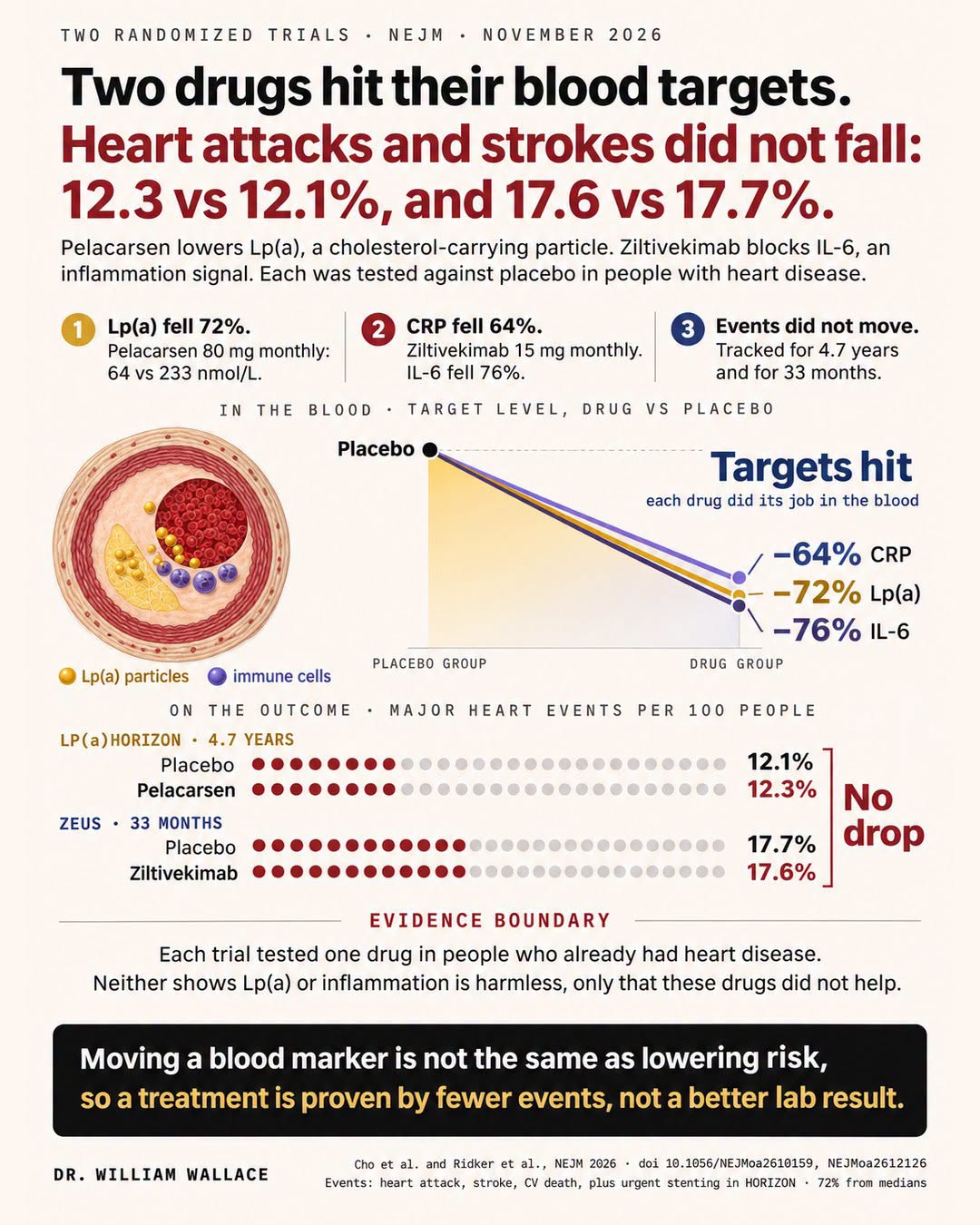
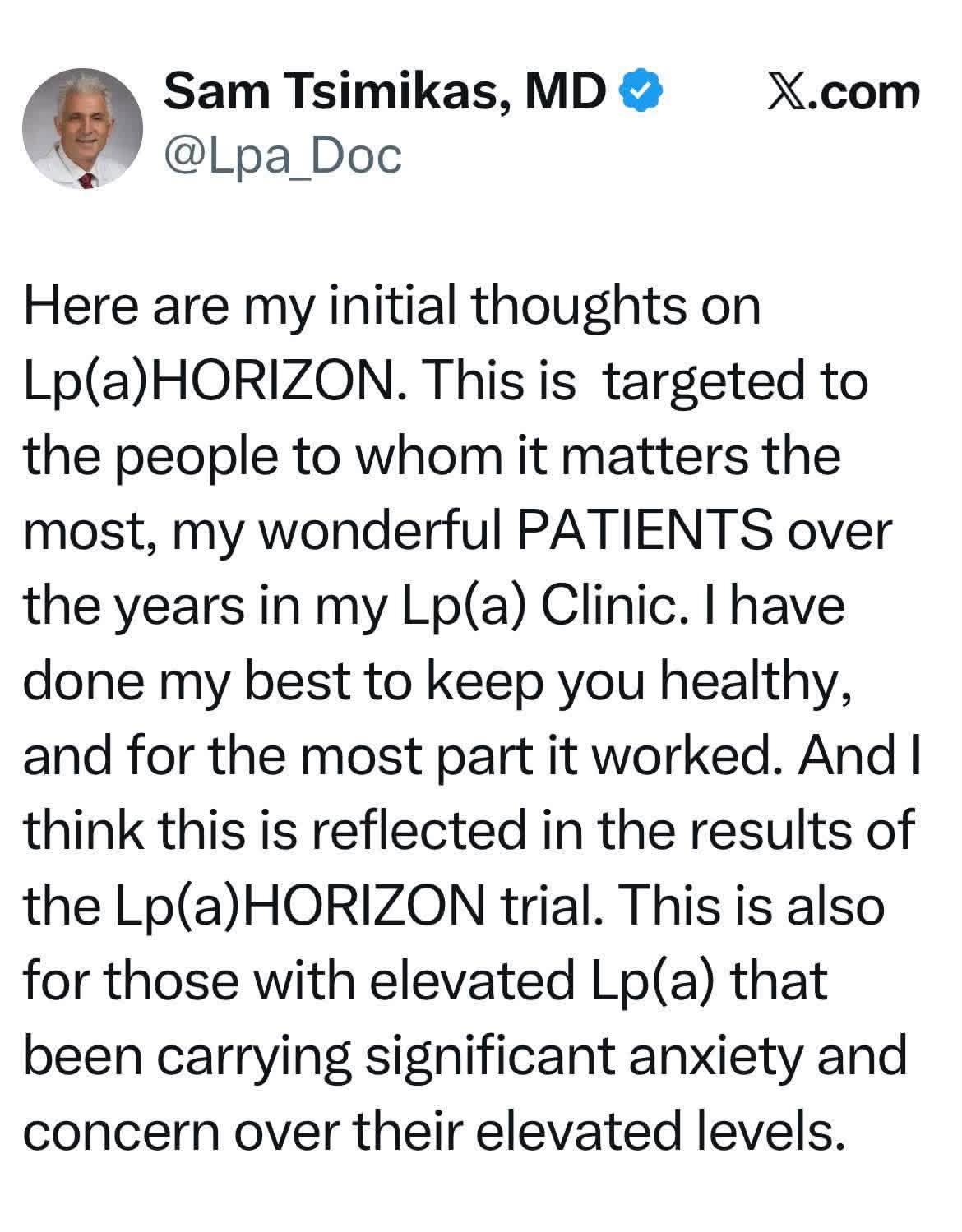
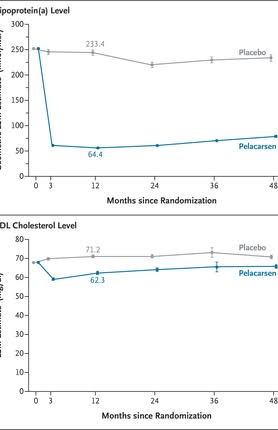
Why did lowering Lp(a) fail to reduce risk of heart attacks and strokes in the recent HORIZON trial?
This new article in Nature discusses that question.
Note that the full results of this trial will be released in just a few days (November 7).
Quoted:
Structurally, Lp(a) isn’t much different from LDL. Both are essentially globs of fat surrounded by a protein called apolipoprotein B. Both are produced in the liver. There is, however, one major difference. Lp(a) has a tail composed of apolipoprotein(a), which loops in segments called ‘kringles’ — named after the twists of a Scandinavian pastry. Lp(a) levels depend, in part, on the number of copies of a particular type of kringle encoded in the gene for apolipoprotein(a). People carry anywhere from 1 to more than 40 copies; the fewer the copies, the smaller the particle, and the higher the Lp(a) level. That is because liver cells seem to have an easier time producing and secreting the smaller particles.
Researchers are still trying to unpack how that structural difference affects the particle’s function and its role in cardiovascular disease. Particle for particle, Lp(a) carries six times the risk that LDL does. That could be because it’s more effective at depositing cholesterol on artery walls, or because it promotes inflammation, which can contribute to plaque deposition. But Nordestgaard thinks it has more to do with the impact of Lp(a) on blood clotting. The particle’s tail might make it more difficult for the body to break down clots, which could lead to larger blockages.
But high Lp(a) levels don't always cause problems. Bhatia says that sometimes older people have high Lp(a) levels but never have a cardiovascular event. "And sometimes we don't even see plaque when we look with imaging," he says. "It may just be that it's the overall picture of risk, and that Lp(a) is just one piece of that bigger puzzle.”
Quoted:
First, cardiologists want to know more about the Lp(a)HORIZON study participants and the other medications they were taking. The study, which began in December 2019, enrolled 8,323 people with cardiovascular disease who had already had a heart attack, an ischaemic stroke or been diagnosed with peripheral arterial disease, which occurs when a plaque restricts blood flow to the arms or legs. The protocol required participants to be “optimally treated” for cardiovascular risk factors other than Lp(a). So participants were taking medicines to control their blood pressure, manage their diabetes and lower their LDL levels. In fact, Nordestgaard says that participants had some of the lowest LDL-cholesterol levels ever in a randomized trial. Although it is clear that Lp(a) is a risk factor for cardiovascular events independently of LDL, “it may be simply that when you aggressively lower LDL that you negate a lot of risk associated with Lp(a)”, says Roger Blumenthal, a cardiologist at Johns Hopkins University in Baltimore, Maryland.
Cardiologists also want more information on whether there was a trend towards statistical significance in any of the subgroups — perhaps those who had the highest Lp(a) levels or those who received treatment for the longest period of time. Atherosclerosis develops over decades, but participants received monthly injections of pelacarsen for just a few years. “And it may be that four or five years isn’t enough,” Blumenthal says. It’s also possible that treatment happened too late in the course of the disease, when the damage was already done.
Ann Marie Navar, a preventive cardiologist at the University of Texas Southwestern Medical Center in Dallas, wants to know whether pelacarsen showed some sign of benefit in people who weren’t taking medications to prevent clotting. Some studies suggest that the risk of high Lp(a) is lessened in people taking aspirin. “I don’t know if we’re going to see many people not on any sort of antiplatelet or antithrombotic, but that’s going to be a group I’m going to be looking really closely at,” she says.
She also wants to see data on adherence. “Phase II studies of pelacarsen suggest a fairly high rate of injection-site reactions and adverse events, and we’re asking a lot of people to stay in these trials for many years,” she says.
Navar, Blumenthal and many other cardiologists are looking forward to more information coming out about the trial. They’re also adamant that the trials’ negative results don’t change the recommendation that people get their Lp(a) levels tested. Testing enables physicians to identify people with high Lp(a) and work to improve management of their other risk factors.
Lp(a)HORIZON is the first trial of Lp(a)-lowering therapy to reach completion. Just because it failed, it doesn’t necessarily mean the other ongoing trials will. The two other injectable medications in trials — olpasiran from Amgen and Eli Lilly’s lepodisiran — use a different mechanism from pelacarsen and are more potent, reducing Lp(a) levels by 90% or more. Eli Lilly is also testing an oral pill called muvalaplin6 that reduces Lp(a) levels by 85%. Each study differs slightly in its design, in ways that might change the outcome, too.
“If [HORIZON] really is stone-cold neutral, then we as a scientific community really need to sit down and understand what led us astray with the genetics,” O’Donoghue says. “Because it does call into question then the ability of genetics to predict a viable therapeutic target.”