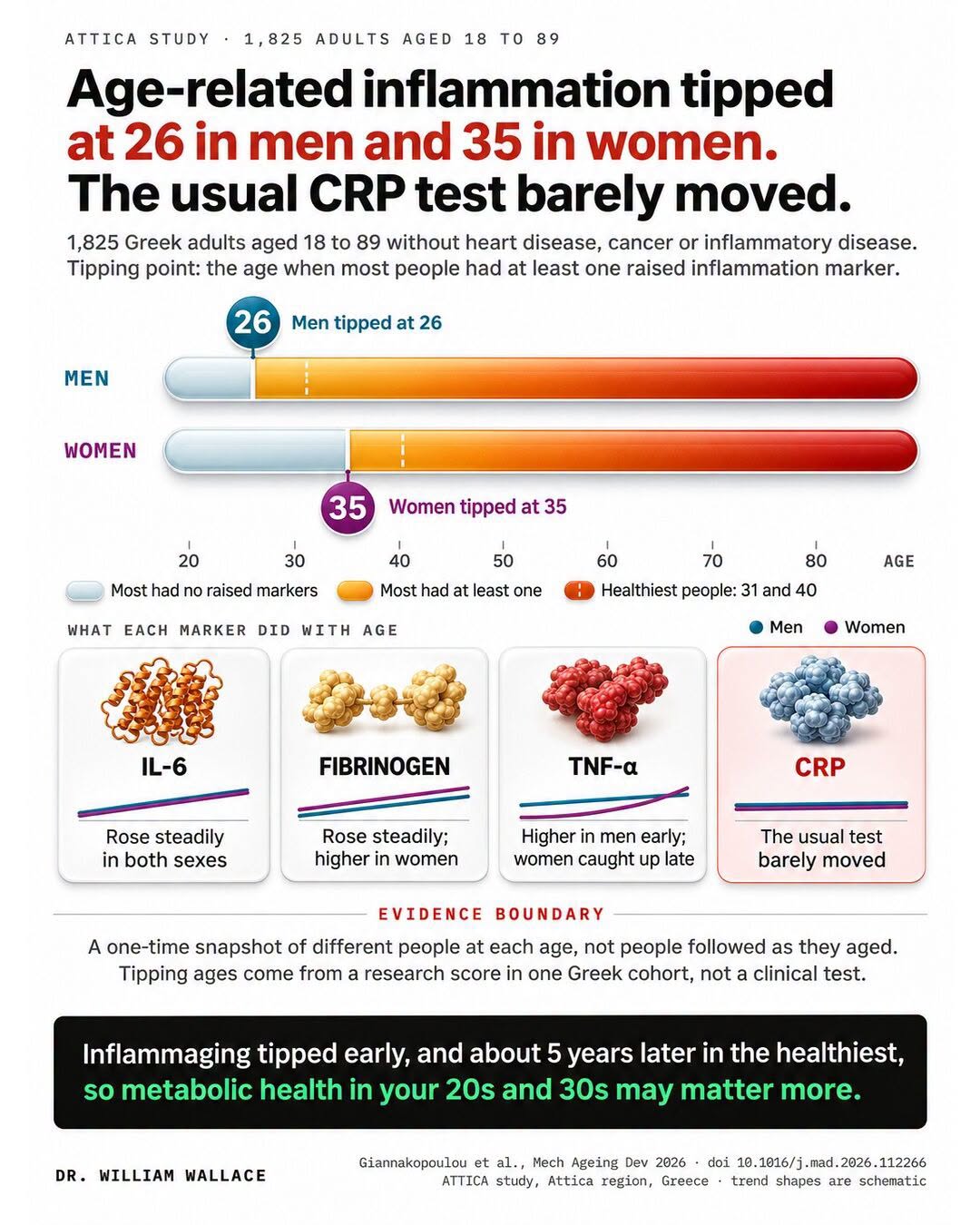
Inflammaging— the gradual increase in chronic inflammation that worsens with age— appears to begin in men around the age of 26yo, and in women around 35yo.
#inflammagingHD #inflammationHD #agingHD #longevityHD #il6HD #tnfalphaHD #fibrinogenHD #hscrpHD #atticaHD
The slow, low-grade inflammation behind many diseases of aging may start switching on in your late twenties and thirties rather than in old age.
Scientists call this process inflammaging, a term the Italian immunologist Claudio Franceschi introduced in 2000 to describe the gradual rise in background inflammation that comes with age. A 2018 review by Luigi Ferrucci and Elisa Fabbri described how most older adults develop it and how it raises the risk of heart disease, diabetes, kidney disease, dementia, frailty and early death.
A new analysis of the ATTICA study asked when that shift begins. Researchers measured blood markers of inflammation in 1,825 Greek adults aged 18 to 89 who had no heart disease, cancer or chronic inflammatory disease, and combined IL-6, TNF-alpha and fibrinogen into a single immune activation score. Most men had crossed into the activated range by about age 26 and most women by about 35, and the healthiest participants crossed roughly five years later. IL-6, a signaling protein released by immune cells and fat tissue, and fibrinogen, a clotting protein, rose steadily with age in both sexes, with fibrinogen running higher in women. TNF-alpha was higher in men earlier in life while women caught up later, and CRP, the inflammation test most doctors order, barely changed with age.
Those markers matter because earlier studies tied them to real outcomes. Among 1,293 healthy older adults in Iowa, people with the highest IL-6 levels were nearly twice as likely to die over the following four to five years, and a pooled analysis of 31 studies covering more than 154,000 people linked higher fibrinogen to more heart attacks, strokes and deaths. Visceral fat, the fat packed around the abdominal organs, is one likely source of this signal, since a 2007 study of people with severe obesity found that blood draining that fat carried about 50 percent more IL-6 than blood elsewhere in the body.
Because ATTICA is a single snapshot of different people at different ages rather than the same people followed over time, it shows when inflammation tends to be higher, not how it changes inside one person. The tipping ages come from a research score in one Greek cohort rather than a test you can order, and these markers predict risk without proving that lowering them prevents disease. Even so, the fact that the healthiest people crossed the line about five years later suggests that metabolic health in your twenties and thirties may shape how you age more than most of us assume.
Sources: Giannakopoulou et al., Mechanisms of Ageing and Development, 2026; Franceschi et al., Annals of the New York Academy of Sciences, 2000; Ferrucci and Fabbri, Nature Reviews Cardiology, 2018; Harris et al., American Journal of Medicine, 1999; Fibrinogen Studies Collaboration, JAMA, 2005; Fontana et al., Diabetes, 2007.