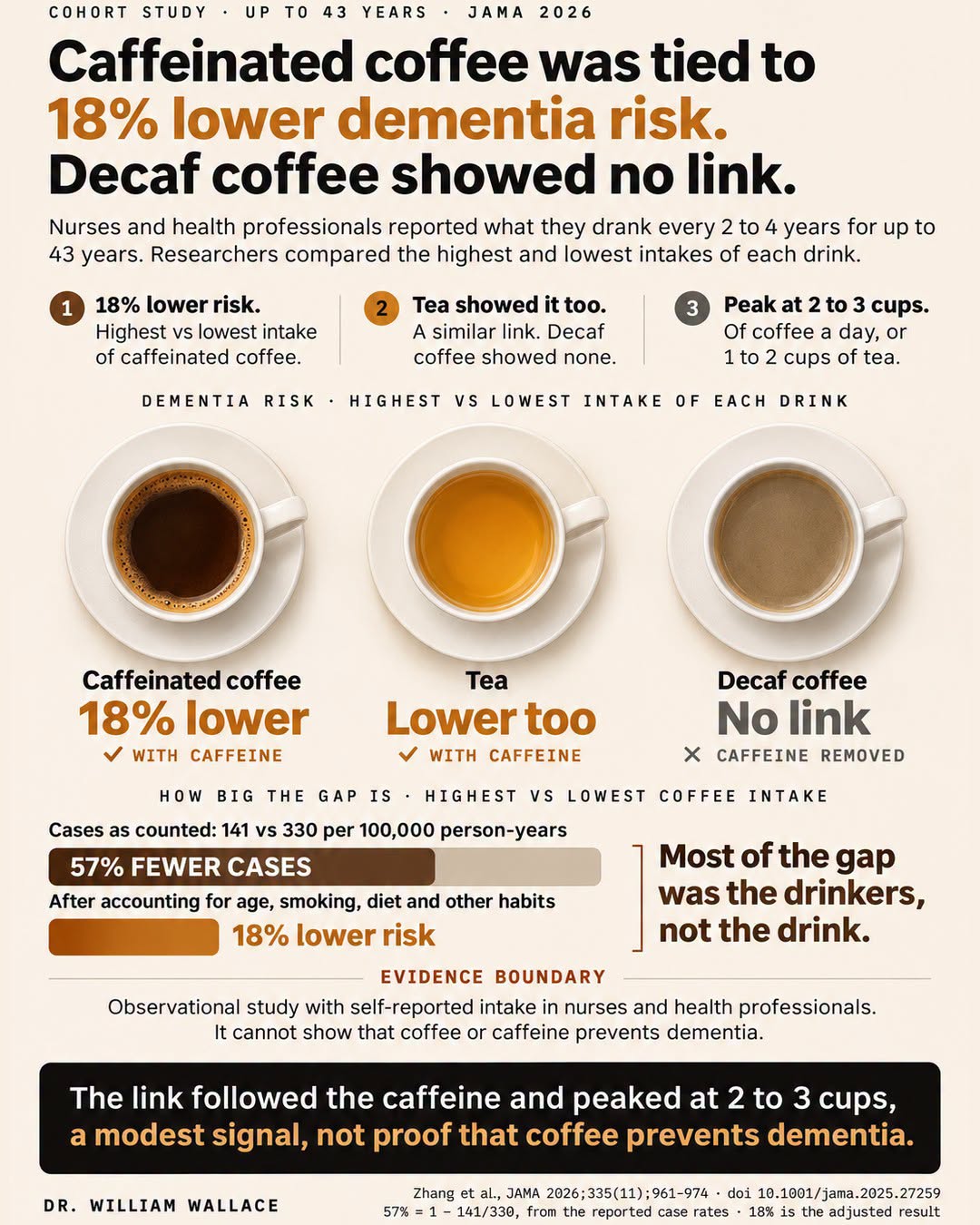
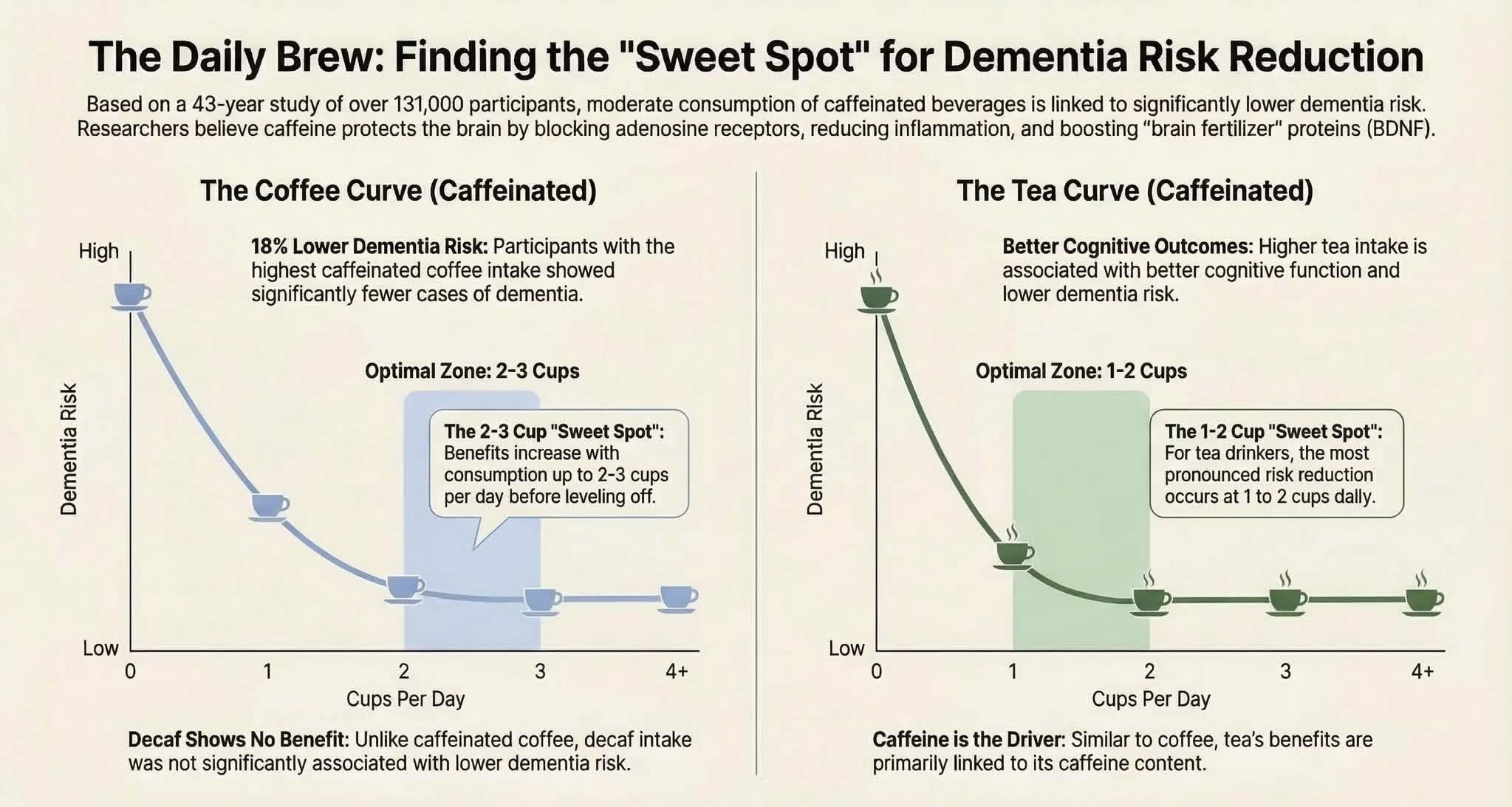
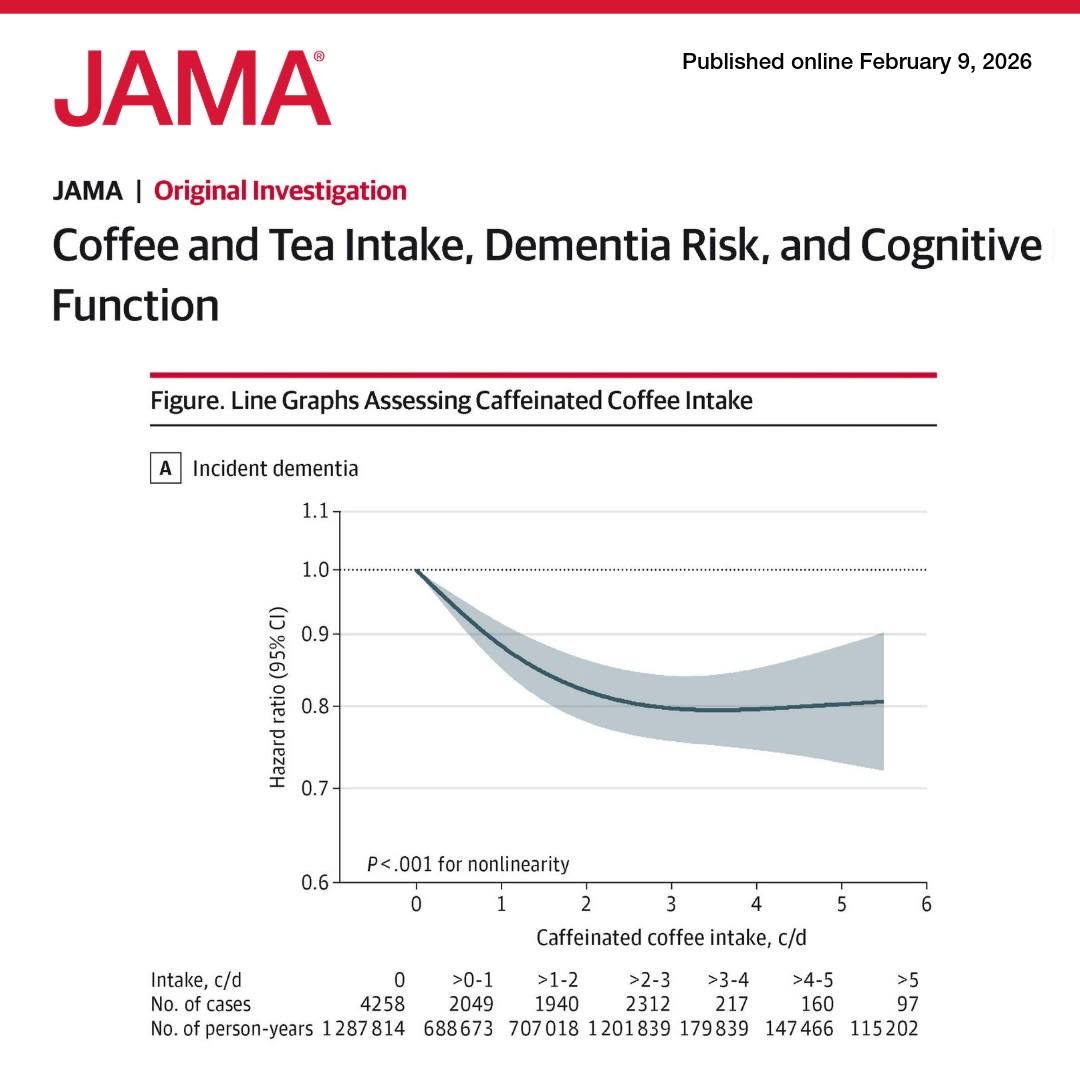
People who drank the most caffeinated coffee over several decades had an 18% lower risk of dementia than those who drank the least, after accounting for other differences between them. Decaf showed no such link.
This is not the first study to find this pattern. In the UK Biobank, 365,682 adults aged 50 to 74 who drank 2 to 3 cups of coffee and 2 to 3 cups of tea a day had a 28% lower risk of dementia over about 11 years than people who drank neither. The same cohort has also produced a caution. In a separate analysis of 398,646 participants, drinking more than 6 cups a day was linked to 53% higher odds of dementia than drinking 1 to 2 cups, and people who drank no coffee or only decaf also had higher odds.
The new JAMA study followed 131,821 US nurses and health professionals for up to 43 years, asking about coffee and tea every 2 to 4 years, and recorded 11,033 dementia cases. Raw dementia rates were 141 per 100,000 person-years in the highest caffeinated coffee group and 330 in the lowest, a 57% gap. But the groups differed in many ways, including age, smoking, alcohol, and diet. Among the nurses, 32% of the heaviest drinkers smoked, compared with 7% of the lightest. Once those differences were accounted for, the gap shrank to an 18% lower risk. Tea showed a similar pattern. The lowest risk sat at about 2 to 3 cups of coffee or 1 to 2 cups of tea a day, with no added benefit beyond that. On telephone thinking tests in the nurses, the highest coffee group scored 0.11 points higher on a 41-point scale, a gap the authors compare to about 0.6 years of normal aging.
Coffee and tea intake was self-reported, people in the early stages of dementia may change their habits, and the participants were mostly health professionals, who are not typical of everyone. The missing link for decaf could mean caffeine matters, or that people switch to decaf because of health problems, which the authors themselves raise. An observational study cannot show that coffee or caffeine prevents dementia. If you already enjoy 2 to 3 cups a day, this gives you no reason to stop. It is not a reason to start, or to drink more.
Sources: Zhang et al., JAMA, 2026; Zhang et al., PLOS Medicine, 2021; Pham et al., Nutritional Neuroscience, 2022.