Coffee and tea are among the group's most-discussed drinks, and the picture is, on balance, reassuring. Across large cohorts and several meta-analyses, people who drink moderate amounts of coffee tend to have lower rates of heart disease, stroke, type 2 diabetes, liver disease and dementia than people who drink none. Tea shows a similar, though less thoroughly documented, pattern. In July 2026 an American Heart Association (AHA) scientific statement described up to about five cups of coffee a day as safe for most adults and linked to lower cardiovascular risk.12
The main caveat, which Louis Nervegna repeats often, is that almost all of this evidence is observational. Coffee drinkers differ from non-drinkers in many ways, and there are no long-term randomized trials of coffee for disease prevention. Louis writes that the exact optimum intake is hard to pin down: "Maybe it's a little lower. Maybe it's a little higher. We won't know for sure until we (one day) have randomized trials."3 He also notes that the research is "mostly observational, but there is an enormous amount of it."4
Two wrinkles matter: how coffee is brewed affects cholesterol, and decaf seems to keep many metabolic and cardiovascular associations but not the dementia one.
What coffee and tea contain and why that matters
Coffee is not a single compound. It contains well over 100 bioactive compounds, including caffeine, polyphenols such as chlorogenic acid, and oily compounds called diterpenes (cafestol and kahweol).89 Polyphenols are plant chemicals with antioxidant and anti-inflammatory properties; chlorogenic acid is coffee's main one, linked in the posts to healthier blood vessels, lower inflammation and better insulin sensitivity.10 Tea's main polyphenols are catechins, including EGCG in green tea.1112
Several posts argue that caffeine is only part of the story:
- In the Nurses' Health Study, decaffeinated coffee was also linked to a lower stroke risk, which the authors read as a sign that components other than caffeine may be protective.13
- Coffee, but not caffeine alone, changed brain network connectivity on functional MRI in a small study, and caffeine alone did not reproduce coffee's bowel-stimulating effect after gastrointestinal surgery.1415
- Louis shared work suggesting caffeic acid (unrelated to caffeine) activates a stress-protective receptor called NR4A1, and a cell-model study in which chlorogenic acid, kahweol and other coffee compounds bound the same receptor, which is raised by exercise. This is cell-level evidence only.1617
- A fission yeast study found that caffeine activates AMPK, a cellular "fuel gauge". It was in yeast, so human relevance is unproven.18
- Louis shared a popular-science claim, with no cited study, that coffee diterpenes activate PPAR-gamma, which he thinks may help explain coffee's links to less liver scarring and better insulin resistance.19
What the evidence shows for the heart
Cohorts and meta-analyses
Several posts quote the Harvard T.H. Chan Nutrition Source summary of the coffee literature:132021
- Among 83,076 women in the Nurses' Health Study, 4 or more cups a day was linked to a 20% lower stroke risk than no coffee, and 2 or more cups of decaf to an 11% lower risk. No such link was seen for tea or soda in that analysis.
- In a cohort of 37,514 women, 2-3 cups a day was linked to a 21% lower risk of heart disease.
- A meta-analysis of 21 prospective studies tied about 3 cups a day to a 21% lower risk of cardiovascular death compared with non-drinkers.
- A meta-analysis of 36 studies found 3-5 cups a day linked to a 15% lower risk of cardiovascular disease compared with the lowest intake, while 6 or more cups a day was neither higher nor lower.
A large UK Biobank analysis, published in the Journal of Clinical Endocrinology & Metabolism, followed over 500,000 people aged 37-73 for about 11 years. After excluding people who already had cardiometabolic disease, three cups of coffee a day was associated with a 48% lower risk of new-onset cardiometabolic multimorbidity (two or more of type 2 diabetes, coronary heart disease and stroke), and 200-300 mg of caffeine a day with a 41% lower risk. Moderate caffeine intake was also linked to lower levels of VLDL, a triglyceride-rich lipoprotein.2223 A later post describes the same finding in 188,000 UK adults free of cardiometabolic disease at baseline. It adds that VLDL lipids, the amino acid histidine and glycoprotein acetyls, a marker of low-grade inflammation, were the metabolites that statistically linked coffee to lower risk, and that up to three cups a day was also linked to a lower chance of progressing to a second chronic disease in people who already had one.3
The AHA statement
In July 2026 the AHA published a scientific statement in Circulation. The posts quote it as saying that up to 400 mg of caffeine a day, equal to up to five 8-ounce cups of caffeinated coffee, is generally safe for most adults and appears linked to a lower risk of several cardiovascular conditions, including heart failure, heart disease and stroke, in some individuals.124 Another summary says the greatest benefits were generally seen at 2-4 cups, often extending up to 5, and that coffee was linked with lower risks of type 2 diabetes, coronary disease, heart failure, stroke and AF. Tea was also associated with better outcomes.225
The statement also draws a line around energy drinks and caffeine supplements: higher amounts, as in energy shots, may raise blood pressure or the risk of an irregular heart rhythm, particularly in people who are not habitual caffeine users, and individual responses vary with genetics. The authors say more research is needed.12
Blood pressure
A Spanish-language post summarizing a 2024 review by Ungvari and Kunutsor says moderate coffee (1-3 cups a day) causes only a slight, temporary rise in blood pressure, that regular drinkers develop tolerance to caffeine's pressor effect, and that moderate intake does not lead to long-term hypertension. The review described a weak protective effect for metabolic syndrome and fatty liver and consistent, dose-dependent evidence for lower type 2 diabetes and chronic kidney disease risk, with risk mainly at excessive intake.8
Atrial fibrillation: the DECAF trial
Patients with AF have long been told to avoid coffee. The DECAF randomized trial, published in JAMA in 2025 and presented at the AHA Scientific Sessions, tested that advice directly. It enrolled 200 habitual coffee drinkers with persistent AF or atrial flutter who had just had electrical cardioversion (a procedure to reset the rhythm). For six months they either continued at least one cup of caffeinated coffee a day or abstained from all coffee and caffeine. AF or flutter recurred in 47% of the coffee group versus 64% of the abstainers, a 39% lower hazard of recurrence, and no safety concerns were reported.526
Two cautions come with this. The participants were long-term drinkers (about 7 cups a week), and the summary stresses the trial "doesn't justify starting or increasing caffeine intake", especially for people who have had adverse responses.5 The AHA itself notes that some people still find caffeine triggers or worsens their AF symptoms and suggests asking a doctor whether continuing coffee is safe after treatment.26 The explanations offered (adenosine-receptor blockade, polyphenol anti-inflammatory effects, abstainers swapping to sugary drinks) are speculative.5 A separate summary also mentions AF cohorts with roughly a quarter fewer major cardiac events in daily coffee drinkers.10
Brewing, cholesterol and roast: the main downside
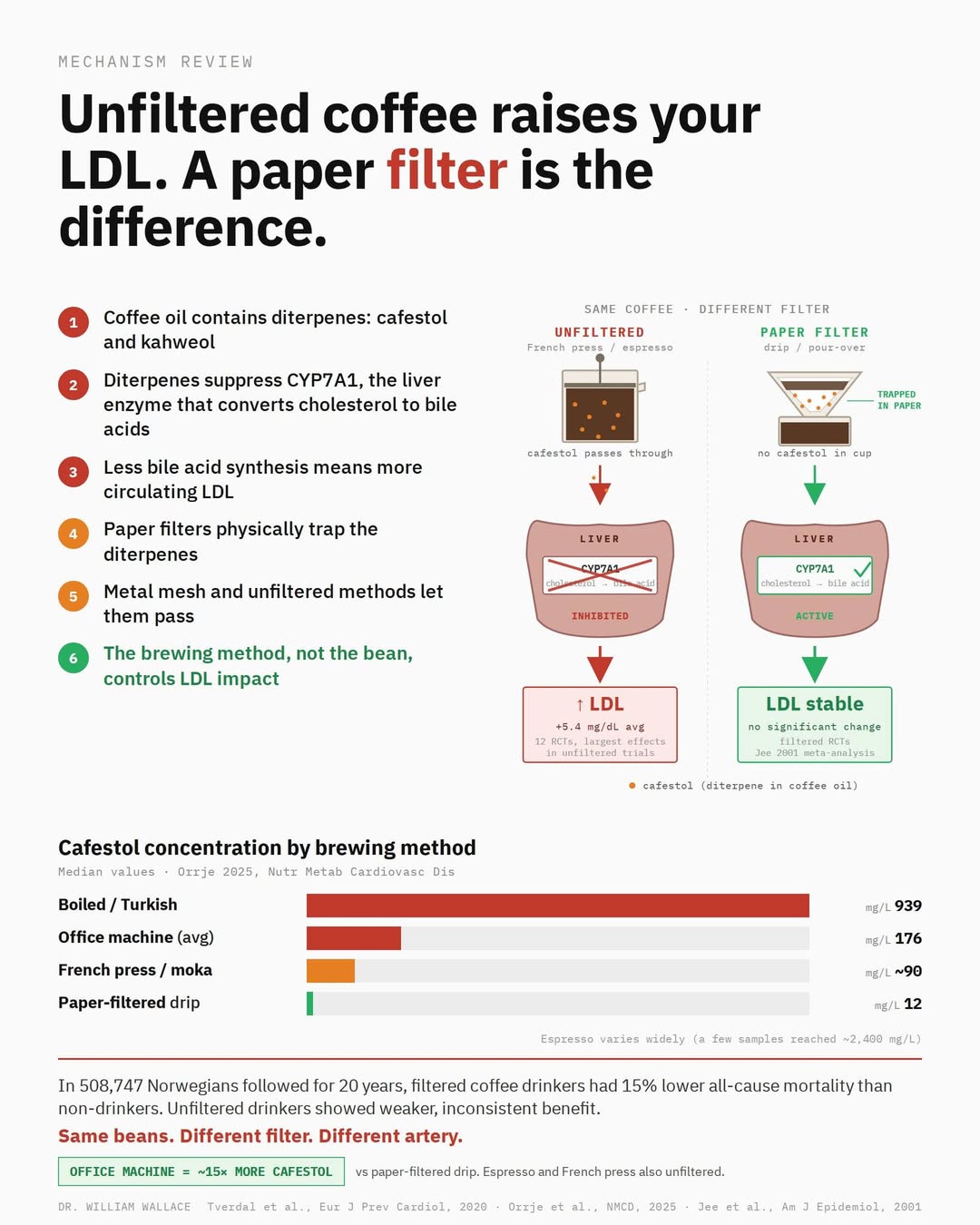
The best-documented downside of coffee is its effect on LDL cholesterol when it is unfiltered. Coffee beans contain the diterpenes cafestol and kahweol, which travel in the coffee oil. Cafestol activates a liver receptor called FXR, which suppresses CYP7A1, the enzyme that converts cholesterol to bile acids, so the liver clears less LDL.9 According to the shared explanation, Jee and colleagues (2001, American Journal of Epidemiology) pooled fourteen randomized trials and found that unfiltered coffee raised total and LDL cholesterol in a dose-dependent way while filtered coffee had essentially no effect.9
A more recent 24-week randomized trial in 46 healthy adults compared about 0.9 L a day (roughly 5-6 cups) of French-press coffee with paper-filtered coffee. Unfiltered coffee raised LDL by about 9-14%, around 0.26 mmol/L (about 10 mg/dL) more than filtered coffee. French press, boiled, Turkish, moka and espresso retain more diterpenes, while paper filters remove most of them.6 Louis describes the effect as small but real, and a FoundMyFitness episode description he shared likewise favors filtered over French press coffee.927
Roast level is a separate question. Louis notes that more roasting lowers polyphenols such as chlorogenic acid.28 A Spanish crossover trial compared lightly roasted, phenolic-rich coffee (about 400 mg hydroxycinnamic acids and 130 mg caffeine per cup) with regular roast (about 150 mg and 70 mg). Body fat percentage fell 1.4% with the light roast, but body weight and metabolic syndrome markers did not change, and the light-roast group consumed nearly twice the caffeine.28
Brain, aging and longevity
Dementia
A JAMA cohort study pooled the Nurses' Health Study (86,606 women) and the Health Professionals Follow-up Study (45,215 men), 131,821 people in total, followed for up to 43 years with 11,033 dementia cases.729 Higher intake of caffeinated coffee and tea was associated with lower dementia risk and modestly better cognitive performance. The association was strongest at moderate intake, about 2-3 cups of caffeinated coffee or 1-2 cups of tea a day, and higher intakes added no further benefit. Decaf showed no significant relationship with dementia or cognition.293031 After adjustment, the highest caffeinated coffee group had an 18% lower risk than the lowest.729
The follow-up summary is careful about confounding. Raw dementia rates were 141 versus 330 per 100,000 person-years, a 57% gap, but the groups differed in many ways; among the nurses, 32% of the heaviest drinkers smoked versus 7% of the lightest, so the adjusted 18% gap is the one to rely on.7 The same summary cites UK Biobank data in which 2-3 cups of coffee plus 2-3 cups of tea a day was linked to 28% lower dementia risk, and a separate analysis in which more than 6 cups a day was linked to 53% higher odds of dementia than 1-2 cups, with no-coffee and decaf-only drinkers also having higher odds.7 Together, these point to a U-shape in which moderate intake looks best.
Other brain-related posts:
- Among older adults with AF, higher coffee intake was linked to about 11% better processing speed, coordination and attention scores, and inflammatory markers more than 20% lower at five cups a day versus under one.32
- A shared summary reports that unsweetened caffeinated coffee was linked to a 37% lower risk of Parkinson's disease and a 34% lower risk of Alzheimer's and related dementias in one large study, with caffeine's blocking of adenosine A2A receptors as a proposed mechanism supported mainly by animal work.33
- Professor Astrid Nehlig proposes, on a podcast, that caffeine blocks adenosine receptors and so gives the brain a kind of workout.34
Mortality and healthy aging
A review of coffee and human aging in Ageing Research Reviews (2024), shared by Gokhan, concluded that regular moderate coffee intake is associated with lower all-cause mortality and fewer cardiovascular, stroke and cancer cases.35 A quoted Rhonda Patrick interview claims 1-3 cups a day goes with about 30% lower all-cause mortality and roughly one year younger epigenetic age, and a FoundMyFitness summary gives up to 27% lower all-cause mortality, 0.7-1 year younger epigenetic age per cup and 34-41% lower odds of accelerated biological aging at 3 or more cups. These come from video and podcast summaries, not papers, though Louis presents them as accumulating evidence that coffee may modestly slow aging.42736
In the Nurses' Health Study, women who drank 1-3 cups of caffeinated coffee a day in their 50s were more likely to reach older age free of major chronic disease and with good cognitive, physical and mental health. This analysis of more than 47,000 women over 30 years was presented at the American Society for Nutrition meeting.37
Diabetes, liver and other conditions
A meta-analysis highlighted in a Journal of Functional Foods review found 5 cups a day versus none was associated with a 29% lower risk of type 2 diabetes (RR 0.71; 95% CI 0.67-0.76), with each extra cup about 6% lower. Caffeinated coffee was about 7% lower per cup and decaf about 6%, so decaf looked similar for diabetes. Data beyond six cups a day were described as murky.38
Louis states that many studies link coffee with lower risk of cirrhosis and liver cancer, without citing one in that post.39 A shared Medscape item says coffee compounds have antifibrotic and metabolic effects that reduce the incidence and progression of liver disease.40
In a pooled analysis of 9,548 head and neck cancer cases and 15,783 controls from 14 studies, coffee and tea intake was linked to lower risk, and Louis reads it as reassuring about hot coffee and throat cancer. He still says it is probably safest not to drink coffee when it is extremely hot, and he argues that coffee extract should be tested in long-term randomized trials.41
Tea: green, black and hibiscus
Tea has less direct heart-outcome data in the group's posts than coffee, but several lines of evidence appear.
- Green tea and artery function. Gokhan summarizes research that green tea acutely improves endothelial function, including a study of 14 healthy participants whose flow-mediated dilation (FMD, a measure of how well an artery widens) rose 3.69% at 30 minutes. He also cites cohort and meta-analyses linking green tea to lower all-cause and cardiovascular mortality in Chinese and Japanese populations. He also discusses lifespan findings in mice, flies and worms, noting that not every experiment extended life; this is a blog summary, not clinical guidance.11
- Black tea and milk. In a European Heart Journal crossover trial from Charite Berlin (2007), 16 healthy postmenopausal women drank black tea, black tea with skimmed milk, or water on three separate days. Plain tea improved FMD compared with water, but the benefit vanished when milk made up about a tenth of the cup. In rat arteries, milk caseins blocked tea's nitric oxide effect. Louis notes many studies show polyphenols improve FMD. The trial was small and short, so it is a hint, not a rule.12
- Hibiscus. Gokhan brews hibiscus with green tea. He cites a randomized acute study in which hibiscus extract raised plasma nitrites and nitrates (p=0.016) and improved FMD by about 2 percentage points at 2 and 4 hours, and a meta-analysis of 17 randomized trials with a 7.1 mmHg lower systolic blood pressure and a 6.76 mg/dL lower LDL, greatest in people with elevated blood pressure at baseline. Hibiscus is technically an herbal infusion, not tea.42
- Green tea in a diet trial. In the DIRECT-PLUS randomized trial (294 adults with abdominal obesity, 18 months), a "green Mediterranean" diet with 3-4 cups of green tea daily, a Mankai green shake and walnuts reduced liver fat by 38.9% versus 19.6% for a standard Mediterranean diet and 12.2% for healthy-eating guidance; fatty liver prevalence fell to 31.5%, 47.9% and 54.8% respectively. Because the diet bundled several changes, the trial cannot isolate what tea did.4344
- Animal data. A 2025 mouse study found green tea extract (about 2-5 cups human-equivalent) improved muscle insulin sensitivity in obese mice, far from clinical proof.45
A TwinsUK study of more than 3,100 adults over ten years found that diets rich in tea, coffee, berries, nuts and whole grains were linked to healthier blood pressure and cholesterol and lower predicted cardiovascular risk. It is observational.46
Louis argues that fears about green tea harming the liver are overblown compared with misuse of over-the-counter painkillers, and that traditional amounts are very unlikely to be dangerous.47 This is his opinion; people with liver disease should check with their doctor.
Nuances and common misconceptions
- "Coffee is bad for the heart." The group's evidence reverses the older view, although the AHA says individual responses vary.126
- "More is better." Not supported. Benefits level off around 3-5 cups in the Harvard meta-analysis and the AHA summary, and the UK Biobank dementia data suggest possible harm above 6 cups.2713
- "Decaf is the same." It depends on the outcome. Decaf looked similar for diabetes and was linked to lower stroke risk in the Nurses' Health Study, and Harvard says decaf probably keeps most benefits, but it showed no dementia link in the JAMA cohort.13313848
- Observational data. Confounding such as smoking is a real concern, and the one randomized trial (DECAF) tested a narrow question in AF patients.57
What this means for you
These are the points drawn from the group's posts. They are not personal medical advice, and the admins' own caveat is that people at high risk should use diet in addition to, not instead of, their cardiologist's treatment.49
- The evidence in the group points to roughly 2-4 cups of coffee a day, and the AHA statement describes up to 400 mg of caffeine (about five 8-ounce cups) as generally safe for most adults.12
- If LDL is a concern, paper-filtered coffee avoids most of the cafestol effect, while French press, boiled and espresso coffee keep it.6
- Energy drinks and caffeine supplements are a different story, per the AHA statement, and worth discussing with a doctor.12
- Gokhan notes that he drinks green tea with hibiscus, plus coffee, daily and finds the effects noticeable in his labs and energy, which is a personal experience, not a trial result.4250
- If you have atrial fibrillation, the AHA suggests asking your doctor whether continuing coffee is safe, because some people find caffeine triggers symptoms.26
- Caffeine's half-life is about 5 hours but can stretch to 9 or more in slow metabolizers (liver enzyme CYP1A2 variants), so late coffee may linger in some people.51
- If you drink black tea for its artery effects, the one small trial suggests drinking it without milk.12
Frequently asked questions
Is coffee safe if I have heart disease or high blood pressure?
Moderate habitual intake of 1-3 cups was described as causing only a slight, temporary blood pressure rise without long-term hypertension, and the AHA calls up to 400 mg of caffeine generally safe for most adults.18 Individual responses vary, so people with known heart conditions are advised to check with their own doctor.26
Can I drink coffee after treatment for atrial fibrillation?
In the DECAF trial, people who continued coffee after cardioversion had fewer recurrences (47% versus 64%) than those who abstained, with no safety concerns.5 The trial does not show that starting coffee is beneficial, and some people do find caffeine triggers AF.526
Does decaf work as well as regular coffee?
For diabetes and stroke associations, decaf looked comparable, and Harvard answers "probably yes" for overall benefits. For dementia in the large JAMA cohort, only caffeinated coffee (and tea) showed an association.13313848
Does it matter how I brew my coffee?
Yes for cholesterol. Unfiltered methods such as French press, boiled, moka and espresso keep the diterpenes that raise LDL, while paper filtering removes most of them.69
Should I add milk to my tea?
In a small 2007 crossover trial of 16 women, the artery benefit of black tea disappeared when skimmed milk was added, and lab work implicated milk caseins binding tea catechins. It is one small study, so the evidence is limited.12