(no text — see the shared post below)
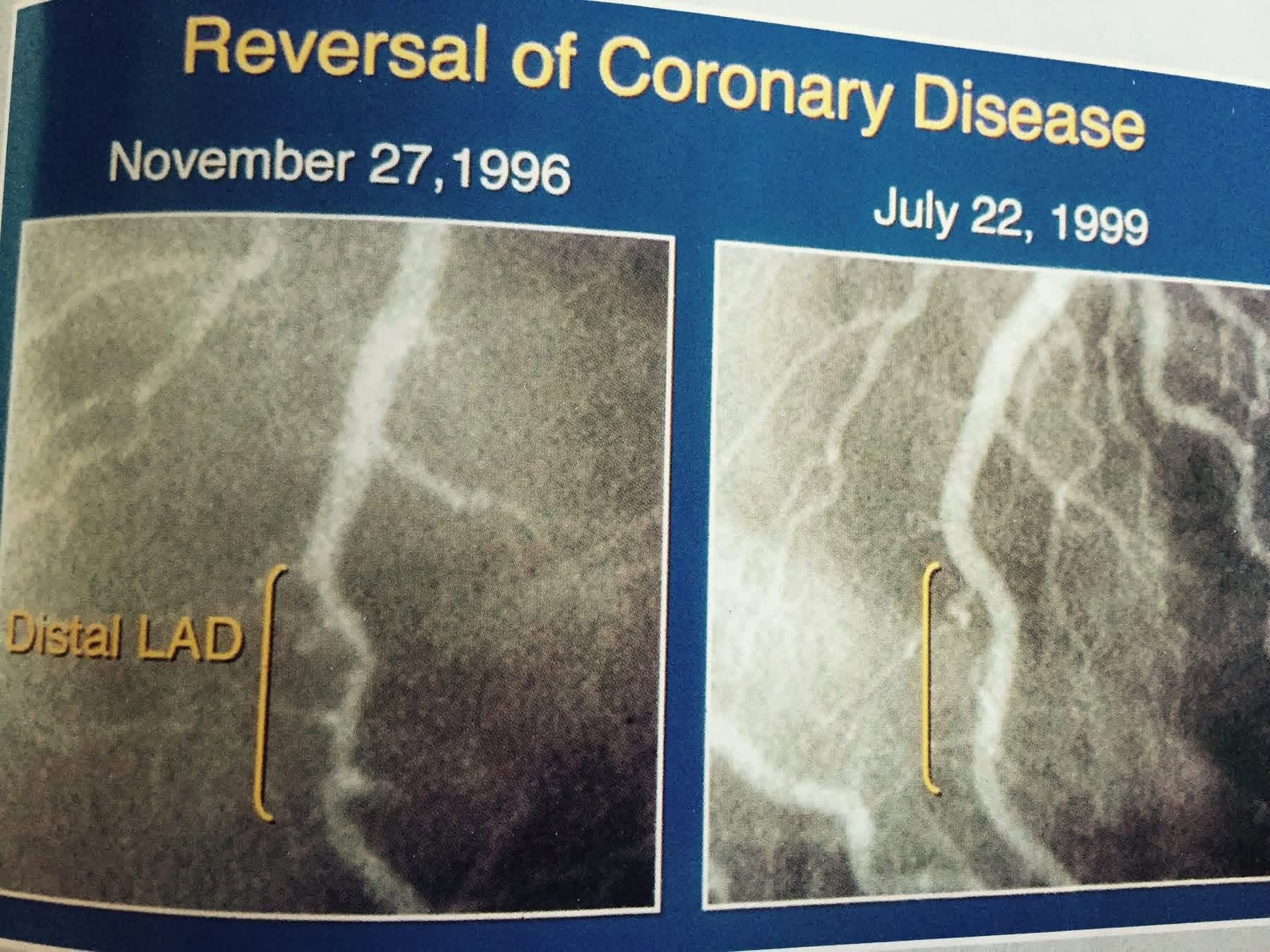
Caldwell Esselstyn claims that this angiogram of his former patient Joseph Crowe is proof that his diet is a “cure for heart disease”.
Here’s the truth:
The baseline angiogram was taken directly after a heart attack. As a result, Joseph Crowe’s baseline angiogram reflected a composite of fixed plaque, acute superimposed thrombus, and focal vasospasm.
The dramatic opening of the artery seen two and a half years later reflects the natural healing and thrombus dissolution that occurs after an acute coronary event, alongside any vascular benefits of his strict diet.
Attributing the entire visual transformation solely to plaque regression from diet dramatically overstates what the angiographic data actually demonstrates.
As a side note, Joseph Crowe died at 72yo. This is despite following this diet for the last 28 years of his life. The cause of death was never publicly released. His obituary stated that the death occurred “after a prolonged illness”. In fairness, he did live nearly three decades after a severe heart attack at age 44, which represents significant long-term survival. (As a surgeon at the Cleveland Clinic, he presumably took advantage of the best therapies to treat CVD as they became available, in addition to following the diet.) Nevertheless, the average life expectancy for a male in the USA is 76.5 years.
Here is a full breakdown:
Joseph Crowe’s baseline angiogram was taken following an acute myocardial infarction (heart attack), and this context is a major reason why many cardiologists caution against using this specific angiogram as evidence of dietary plaque regression.
- The Context of the Baseline Angiogram
Dr. Caldwell Esselstyn’s book and published clinical papers note that Dr. Crowe's initial catheterization was performed in the acute setting following his heart attack.
When a patient experiences an acute coronary syndrome (ACS) or myocardial infarction, the severe luminal narrowing visualized on a lumenogram is rarely composed of stable atherosclerotic plaque alone.
- Why an Acute Angiogram Exaggerates Luminal Improvement
Comparing a baseline angiogram taken during an acute event with a follow-up angiogram taken years later creates a misleading visual contrast due to three distinct physiological factors:
A. Intracoronary Thrombus Resolution
The Mechanism: An acute heart attack occurs when an unstable plaque ruptures or erodes, triggering the immediate formation of a blood clot (thrombus) on top of the plaque. This thrombus accounts for a significant portion of the arterial blockage seen on the acute angiogram.
The Effect: Over time, the body’s endogenous fibrinolytic system naturally breaks down and dissolves the acute thrombus (a process known as spontaneous recanalization). When the artery is re-imaged months or years later, the lumen appears dramatically wider simply because the temporary clot is gone—not necessarily because the underlying lipid-rich plaque wall shrank.
B. Resolution of Vasospasm and Local Inflammation
The Mechanism: Acute plaque rupture causes intense local inflammation, endothelial dysfunction, and severe vascular smooth muscle constriction (vasospasm) around the lesion site.
The Effect: As the acute phase resolves and inflammatory tone normalizes, the focal vessel spasm relaxes. This restored vessel caliber expands the lumen on subsequent imaging, mimicking true plaque regression.
C. Limitation of 2D Angiography vs. Intravascular Ultrasound (IVUS)
Luminography vs. Wall Volume: Standard coronary angiography is merely a "shadowgram" of the vessel interior—it measures luminal diameter, not plaque volume inside the vessel wall.
True Regression Metrics: Modern lipidology trials (such as the ASTEROID, SATURN, and GLAGOV trials using high-dose statins or PCSK9 inhibitors) evaluate true plaque regression using Intravascular Ultrasound (IVUS). These trials show that even under extremely aggressive lipid-lowering therapy (LDL-C < 30–50 mg/dL), true atheroma volume regression is typically modest (around 1% to 2% reduction in total plaque volume), even when luminal improvement appears visually larger.
The bottom line:
While Esselstyn does acknowledge in his book that the catheterization and angiogram occurred immediately following a heart attack, he does NOT acknowledge the clinical significance of that timing regarding thrombus resolution or focal vasospasm.
Instead, he uses the post-event angiogram as the baseline "before" image and compares it to a follow-up image taken nearly two and a half years later, framing the visual expansion of the lumen as evidence of pure dietary plaque regression
There is no question that the Esselstyn diet is heart healthy. We have lots of evidence that plant-based diets rich in whole foods are protective against heart disease. Virtually everyone in mainstream cardiology now recommends that patients with heart disease eat more whole plant-based foods.
That being said, it is hyperbole to claim that this diet is a “cure for heart disease”. There is no credible evidence to back up that claim. The best evidence that we do have suggests that plant-based diets lower risk, but should be combined with other healthy lifestyle modifications and the best available medical treatments in order achieve proven results.
This post was written in collaboration with Gemini AI.
#reverseHD #esselstynHD #joecroweHD