500 mg of cocoa flavanols a day cut deaths from heart disease by 27% in older adults.
Cocoa flavanols help the lining of blood vessels make nitric oxide, which lets arteries relax. A 2017 Cochrane review by Ried and colleagues pooled 40 treatment comparisons in 1,804 mostly healthy adults and found that flavanol-rich cocoa lowered systolic and diastolic pressure by about 1.8 points each over two to 18 weeks.
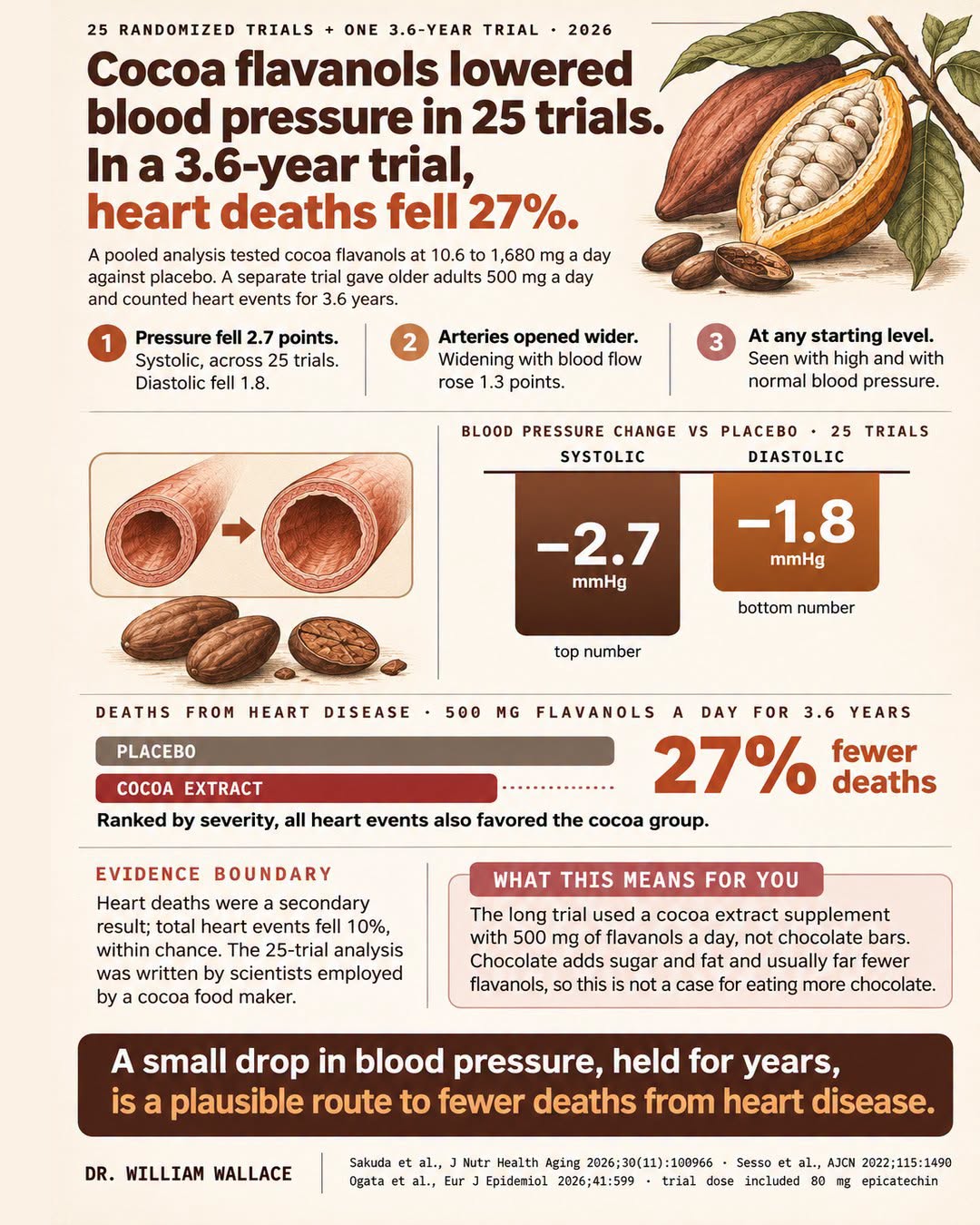
An updated meta-analysis in the Journal of Nutrition, Health and Aging now pools 25 randomized trials with 1,167 participants taking 10.6 to 1,680 mg of cocoa flavanols a day. Systolic pressure fell 2.7 mmHg and diastolic pressure 1.8 mmHg compared with placebo, in people with high blood pressure and in people with normal blood pressure. Flow-mediated dilation, a measure of how well an artery widens with blood flow, rose 1.3 percentage points, and higher doses were linked to larger drops in pressure.
The COSMOS trial tested whether this carries through to the heart. It gave 21,442 US adults, women 65 and older and men 60 and older, a cocoa extract with 500 mg of flavanols a day, including 80 mg of epicatechin, or a placebo for a median of 3.6 years. Total cardiovascular events fell 10%, which was within chance, while deaths from cardiovascular disease fell 27%. A 2026 reanalysis by Ogata and colleagues ranked events by severity, with deaths counted ahead of heart attacks and strokes, and the comparison favored the cocoa group.
A drop of a few points looks small on a single reading, but held for years across a population it is a plausible route to fewer deaths from heart disease.
Heart deaths were a secondary outcome in COSMOS, and its primary outcome was not significant. The 25-trial analysis was funded by the cocoa food maker Meiji and written by scientists employed by Meiji and a marketing firm. Certainty of evidence was moderate for systolic pressure and limited for the other measures.
References
- Sakuda M, et al. J Nutr Health Aging. 2026;30(11):100966.
- Sesso HD, et al. Am J Clin Nutr. 2022;115(6):1490-1500.
- Ogata S, et al. Eur J Epidemiol. 2026;41(5):599-609.
- Ried K, et al. Cochrane Database Syst Rev. 2017;4(4):CD008893.