Examine: Is saturated fat bad for your health?
Historical Context
The article provides historical context for why saturated fat has been viewed as unhealthy. In the 1950s, studies began linking saturated fat consumption to increases in blood cholesterol levels. This research, combined with observational studies on diet and heart disease, led Dr. Ancel Keys to propose the "diet-heart hypothesis" in the mid-20th century.
This hypothesis suggested that dietary saturated fat raises blood cholesterol levels and thus increases the risk of heart disease. Despite some researchers arguing there were flaws in Keys' data, this hypothesis became widely accepted in academic and medical communities and continues to influence dietary guidelines today.
Saturated Fat and Heart Health
The article goes into detail on how saturated fat may impact various risk factors for heart disease:
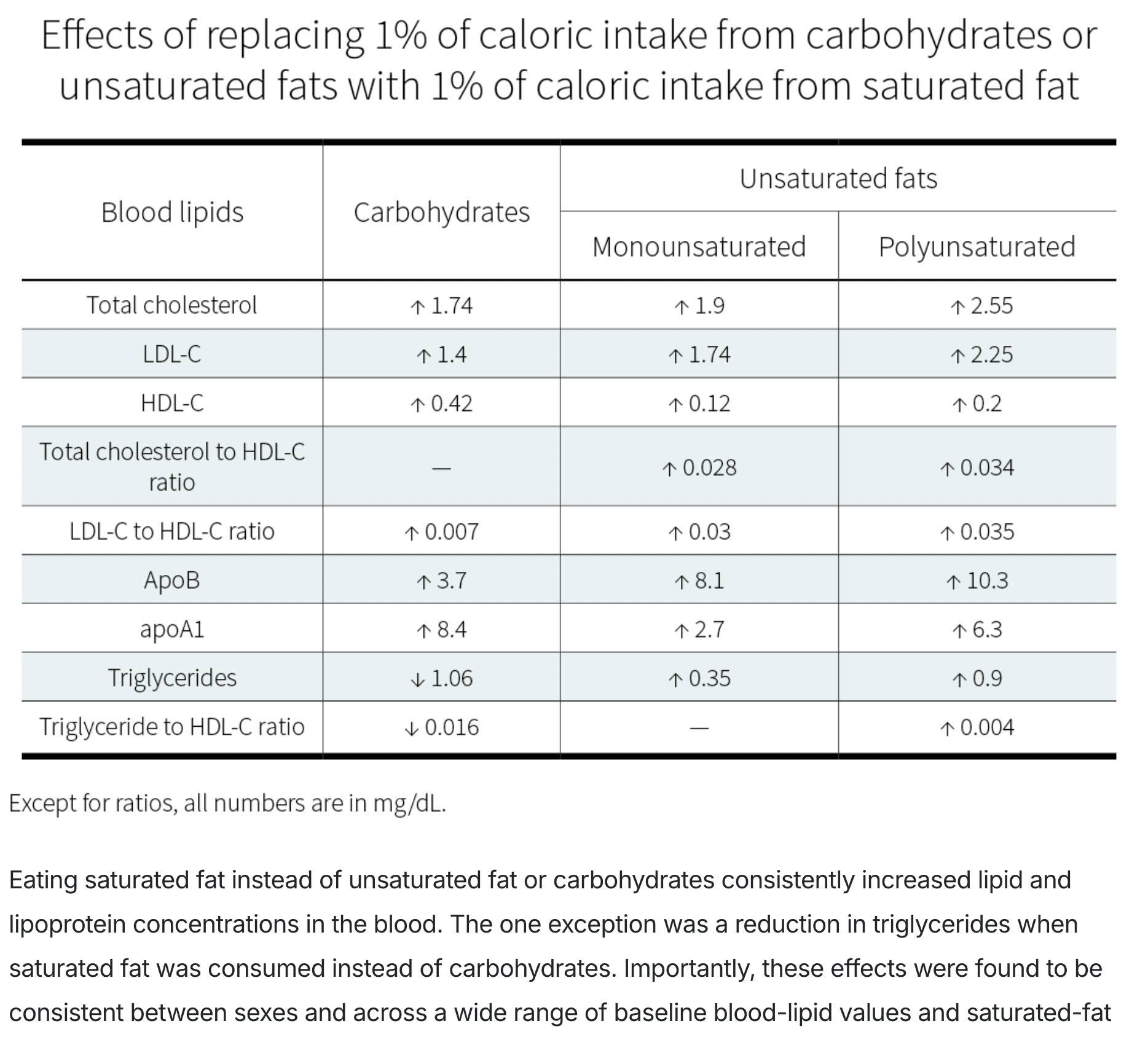
Effects on Blood Lipids: A 2016 World Health Organization (WHO) meta-analysis of 84 randomized controlled trials (RCTs) with 2,353 healthy adults examined the effects of replacing 1% of calories from carbohydrates or unsaturated fats with 1% from saturated fat. Key findings included: See the table.
These effects were consistent across sexes, baseline blood lipid values, and saturated fat intake levels (1.6-24.4% of calories).
The article explains that while LDL cholesterol (LDL-C) is often used as a marker of heart disease risk, the number of LDL particles (LDL-P) is actually more predictive. Apolipoprotein B (apoB) provides a good estimate of LDL-P. The WHO meta-analysis found that replacing unsaturated fat with saturated fat increased apoB concentrations, suggesting an increase in heart disease risk.
For HDL cholesterol, while saturated fat did increase levels compared to unsaturated fat, the increase was only about one-tenth that of LDL-C. This resulted in an overall increase in the ratio of LDL-C to HDL-C, which is associated with increased heart disease risk.
The triglyceride to HDL-C ratio is another predictor of heart disease risk when LDL-C is below 160 mg/dL. The WHO analysis found that replacing 10% of calories from saturated fat with polyunsaturated fat decreased this ratio by only 0.04, while replacing it with carbohydrates increased it by 0.16. The article notes these changes are likely not clinically significant.
Effects on Inflammation: The article reports that saturated fat may worsen systemic inflammation by increasing absorption of bacterial endotoxins called lipopolysaccharides (LPS). Even very small amounts of LPS in the blood can trigger an inflammatory response. However, a systematic review found no consistent associations between saturated fat intake and various inflammatory biomarkers.
One RCT found that compared to saturated fat, monounsaturated fat decreased LDL oxidation, omega-6 polyunsaturated fat increased it, and omega-3 polyunsaturated fat had no effect. The researchers attributed this to differences in the fatty acid composition of LDL particles.
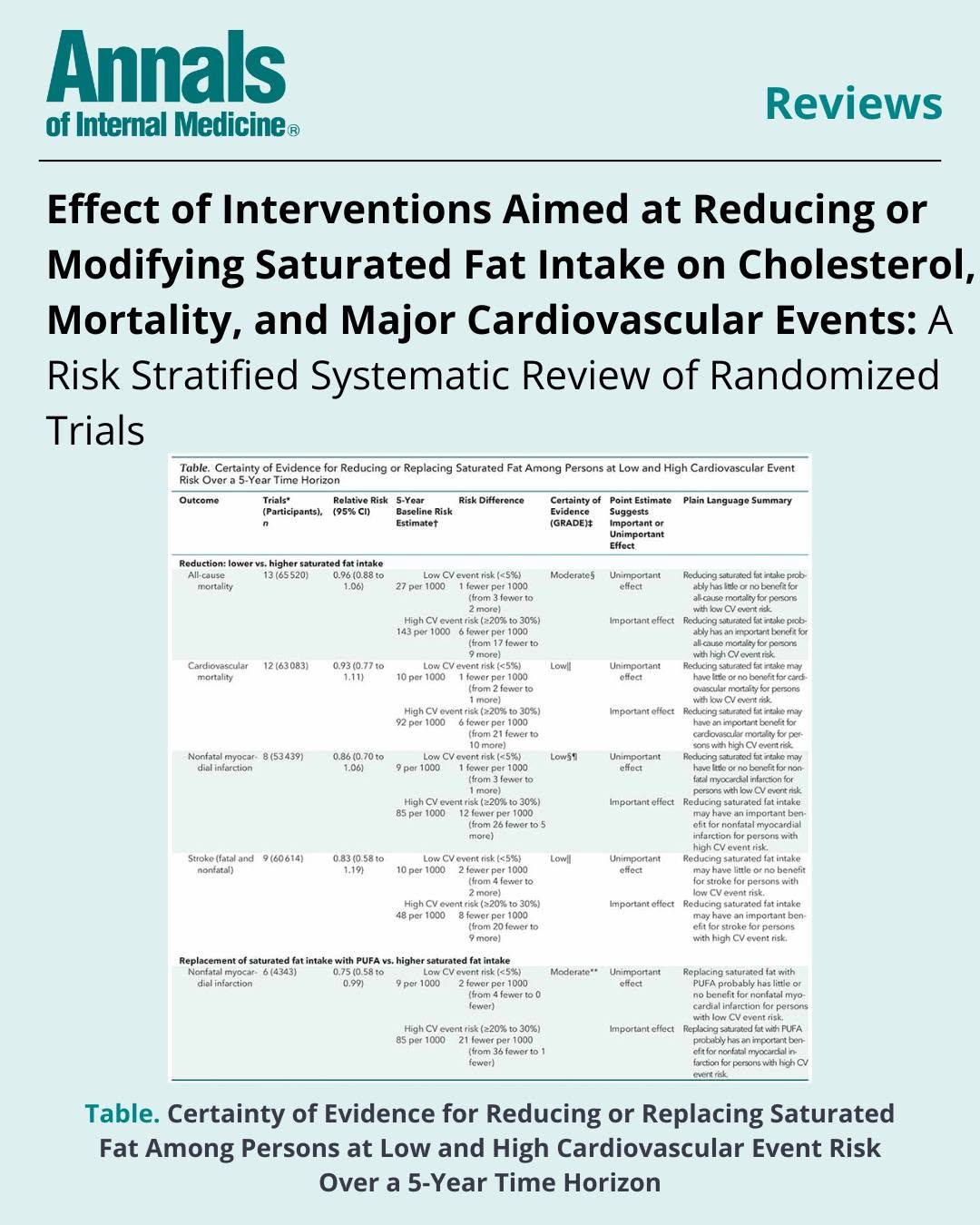
Effects on Heart Disease Outcomes: Despite the theoretical framework linking saturated fat to atherosclerosis, the article notes that meta-analyses of observational studies have not found consistently strong associations between saturated fat intake and risk of coronary heart disease, stroke, or cardiovascular disease in general.
Even long-term RCTs examining hard endpoints like heart attacks or cardiovascular mortality have shown inconsistent results. One meta-analysis reported that every 5% reduction in calories from saturated fat (replaced by polyunsaturated fat) reduced heart disease risk by about 10%. However, another meta-analysis found replacing saturated fat with omega-6 polyunsaturated fat alone tended to increase heart disease risk.
The article suggests these discrepancies may be due to the failure of many studies to isolate the effects of altering saturated fat intake. When looking only at trials that minimized confounding factors, replacing saturated fat with primarily omega-6 polyunsaturated fat had no effect on heart disease risk or mortality.
Importance of Food Sources and Overall Diet
The article emphasizes that the health effects of saturated fat likely depend on the specific food sources and what it's replacing in the diet. For example:
- Dairy fat is about 70% saturated fat, but studies on dairy products and blood lipids have been inconclusive. Different dairy foods like butter and cheese appear to have different metabolic effects due to their food matrices.
- A meta-analysis found no significant associations between heart disease mortality and high intakes of meat or dairy products overall. However, processed meats were associated with increased heart disease risk, likely due to other compounds they contain.
- Replacing saturated fat with whole grain carbohydrates is associated with reduced heart disease risk, but replacing it with refined grain carbohydrates is not.
- Replacing saturated fat with plant-based monounsaturated fat is associated with reduced heart disease risk, but replacing it with animal-based monounsaturated fat is not.
The article concludes that focusing on saturated fat alone misses the bigger picture of overall diet quality and lifestyle factors that influence heart disease risk.
Saturated Fat and Brain Health
The article reports that animal and in vitro studies generally suggest diets high in saturated fat may have detrimental effects on brain development and cognitive function compared to diets high in monounsaturated or omega-3 polyunsaturated fats. However, human studies are limited.
One study found eating a high saturated fat diet (from palm oil) increased self-reported anger (4.7 vs 2.2 out of 5 points) and overall mood disturbances (13 vs 7 out of 20 points) compared to a high monounsaturated fat diet (from hazelnut oil). Other studies have shown saturated fat alters brain activation during cognitive tests, but the implications are unclear.
Saturated Fat and Body Weight
The article examines how saturated fat may influence body weight through effects on appetite, thermogenesis, and activity levels:
Appetite: A review of 24 studies found different types of fat affect short-term subjective appetite similarly, despite saturated fat having greater effects on satiety hormones than unsaturated fat. However, study differences make it difficult to draw firm conclusions.
Thermogenesis: Compared to unsaturated fat, meals high in saturated fat tend to result in lower post-meal energy expenditure and fat oxidation. Studies using isotope tracers indicate the body preferentially uses unsaturated fats for energy over saturated fats. However, long-term studies show inconsistent results.
Activity: One study found that eating more monounsaturated fat in place of saturated fat appeared to spontaneously increase physical activity levels.
Saturated Fat and Hormones
The article reviews several RCTs examining how dietary fat intake affects testosterone levels in men:
- Two large, well-controlled studies found that low-fat diets (14-19% of calories) reduced total testosterone levels compared to high-fat diets (33-40% of calories), but did not alter free or bioavailable testosterone levels.
- Two smaller, less controlled studies reported reductions in both total and free testosterone.
The article notes that while low-fat diets may reduce total testosterone by 10-15% in healthy men, levels remained within the normal range. The biologically active free testosterone appeared unaffected, but the clinical significance is unknown.
Conclusions
The article concludes that compared to monounsaturated and omega-6 polyunsaturated fats, saturated fat does increase several risk factors for heart disease. However, saturated fat and omega-6 polyunsaturated fat appear to have relatively equal effects on some risk factors. Monounsaturated fat seems to have the most favorable impact on heart disease risk factors overall.
There is some evidence that saturated fat may negatively affect cognition, appetite, and energy expenditure compared to monounsaturated fat, but more research is needed.
The article emphasizes that rather than focusing on single nutrients like saturated fat, it's important to consider a person's overall diet and lifestyle. The health effects of saturated fat likely depend on the specific food sources and what it's replacing in the diet.
While saturated fat may increase certain risk factors, studies have not consistently found strong links between saturated fat intake and actual rates of heart disease or mortality. This highlights the complexity of nutrition research and the importance of looking beyond individual nutrients to overall dietary patterns and lifestyle factors that influence long-term health outcomes.
examine.comIs saturated fat bad for your health? - Examineexamine.com