Does saturated fat raise LDL and heart disease risk, and what should replace it? In the view the group's admins keep returning to, yes: saturated fat reliably raises LDL cholesterol and apoB in controlled trials, and the best long-term evidence suggests it is better to replace much of it with unsaturated fat from olive oil, nuts, seeds, fish and avocados12.
The picture is not completely black and white. Saturated fat is not one substance but a family of fatty acids, and the food it comes in matters. Fermented dairy such as yogurt and cheese, and cocoa butter in dark chocolate, appear to behave differently from butter, cream, coconut oil or fatty red meat34. Louis Nervegna summarizes it this way: saturated fat as a whole is not as bad as once thought, but there are better ways to spend your calories if the goal is to minimize cardiovascular risk3.
This article walks through what saturated fat does to blood lipids, what randomized trials and large cohorts show, where the evidence is mixed, and what the admins suggest in practice. It is a summary of group discussion, not medical advice, and anyone with high cholesterol or heart disease should talk to their doctor.
What saturated fat is and why it matters
Dietary fats are usually grouped as saturated (butter, cream, lard, tallow, coconut oil, much red meat), monounsaturated (olive oil, nuts, avocado) and polyunsaturated (seed oils, nuts, seeds, fish). Trans fats, found in partially hydrogenated oils, are a separate and clearly harmful group1213.
LDL cholesterol (LDL-C) is the cholesterol carried by LDL particles. ApoB is a protein found on each LDL particle and other atherogenic particles, so it roughly counts the number of particles that can enter artery walls; the group tends to treat it as an even better marker of risk than LDL-C714. One post shared in the group states that LDL-C is a causal driver of atherosclerotic cardiovascular disease and that risk tracks lifetime LDL exposure1.
Saturated fat matters because of how consistently it pushes these numbers up:
- A WHO meta-analysis of 84 randomized trials in 2,353 healthy adults, summarized by Gokhan Can from Examine, found that replacing unsaturated fat with saturated fat raised LDL-C and apoB. HDL rose too, but only about one-tenth as much as LDL-C, so the LDL-to-HDL ratio worsened7.
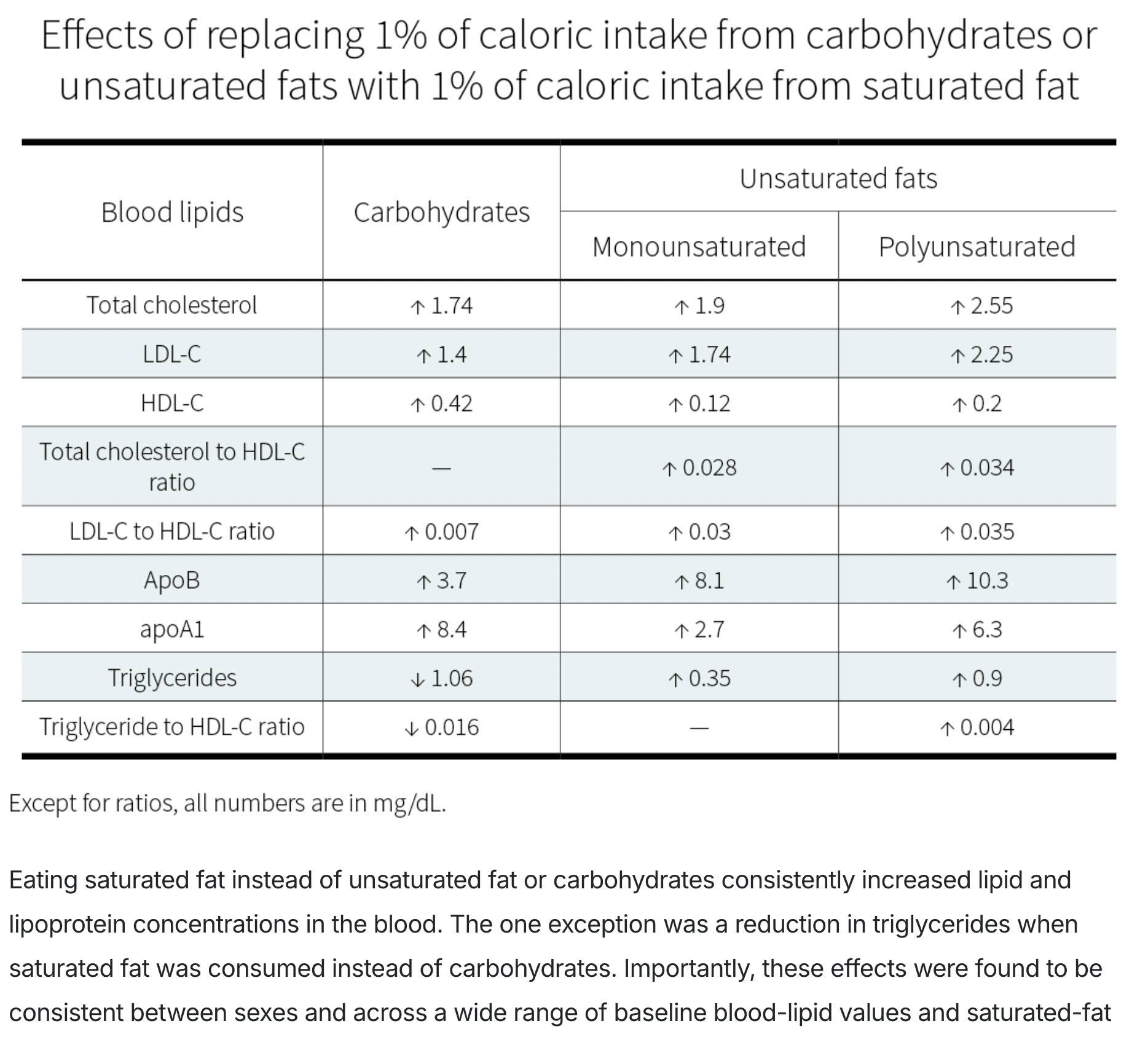
- A meta-analysis of 60 controlled feeding trials found that replacing just 1% of calories from carbohydrate with monounsaturated or polyunsaturated fat lowers LDL-C, while saturated fat raises it. The largest benefit was seen with polyunsaturated fat, and results for apoB were similar to LDL-C14.
- Gokhan notes that very low saturated-fat diets are said to lower LDL by 10-20%. He personally found a very low-fat week left him irritable and hungry and he prefers a slightly higher LDL that his statin controls, an individual experience rather than evidence15.
The group also points to a quieter effect on the liver and blood sugar, discussed below, which is one reason the admins prefer not just lowering saturated fat but swapping it for something specific.
What the evidence shows
Randomized trials with hard outcomes
The strongest evidence for replacement comes from randomized trials that followed heart attacks, strokes and deaths rather than just cholesterol numbers.
- Annals of Internal Medicine systematic review (2026). It pooled 17 randomized trials. Louis reports that replacing saturated fat with polyunsaturated fat lowered non-fatal heart attacks by 25% over about 5 years in people at higher baseline risk, a benefit he compares to that of a lower-dose statin. When saturated fat was replaced by the general background diet, trends toward fewer deaths and strokes did not reach full statistical significance; the polyunsaturated replacement did5.
- Older meta-analyses. A post quoting a longer list of references cites a roughly 19% reduction in coronary heart disease events when saturated fat is swapped for polyunsaturated fat in randomized trials, and a Cochrane review of long-term trials finding fewer combined cardiovascular events when people cut saturated fat116.
- Strict-criteria trials. Louis argues that when you restrict to trials with no trans fats, supplied food, at least 2 years of intake, biomarker-verified adherence and validated events, replacing saturated with polyunsaturated fat cuts heart disease events by 29% in aggregate. He says the Minnesota Coronary Experiment, Sydney Diet Heart Study and Rose Corn Oil Trial, sometimes cited as contrary evidence, fail several of these criteria: the first two used trans-fat-containing partially hydrogenated oils, and in Minnesota 75% dropped out in the first year with an average duration of just 384 days17.
- Lyon Diet Heart Study. In people who had already had a heart attack, a Mediterranean-style diet with olive and canola oils and a canola margarine in place of butter cut cardiovascular events and all-cause death by about 70% over 2.5 years, according to Louis18.
- PREDIMED. A Mediterranean diet supplemented with extra-virgin olive oil or nuts reduced major cardiovascular events over 4.8 years, as summarized from Harvard's Nutrition Source19.
Layne Norton, quoted by Louis, makes the point that he knows of no hard-outcome data showing saturated fat to be healthier than polyunsaturated fat from seed oils when swapped one for one20.
Large cohort studies
Cohort studies follow many people over time and look for associations. They cannot prove cause, but they add long-term, real-world data.
- Butter versus plant oils. Harvard and Brigham and Women's researchers analyzed 221,054 adults in the Nurses' Health Study, Nurses' Health Study II and Health Professionals Follow-Up Study over more than 30 years (JAMA Internal Medicine, 2025). The highest butter intake was linked to 15% higher all-cause mortality; the highest plant-oil intake to 16% lower. Each extra 10 g/day of butter was linked to 12% higher cancer mortality, and each extra 10 g/day of plant oil to 11% lower cancer death and 6% lower cardiovascular death. Modeling a swap of 10 g/day of butter for plant oils gave a 17% lower risk of all-cause and cancer death, with the largest benefits from olive, canola and soybean oils621222324. Norton noted that the result held even when olive oil was excluded from the plant-oil total20. Louis said the size of the effect surprised him22. A separate video review discusses the study's strengths and weaknesses25.
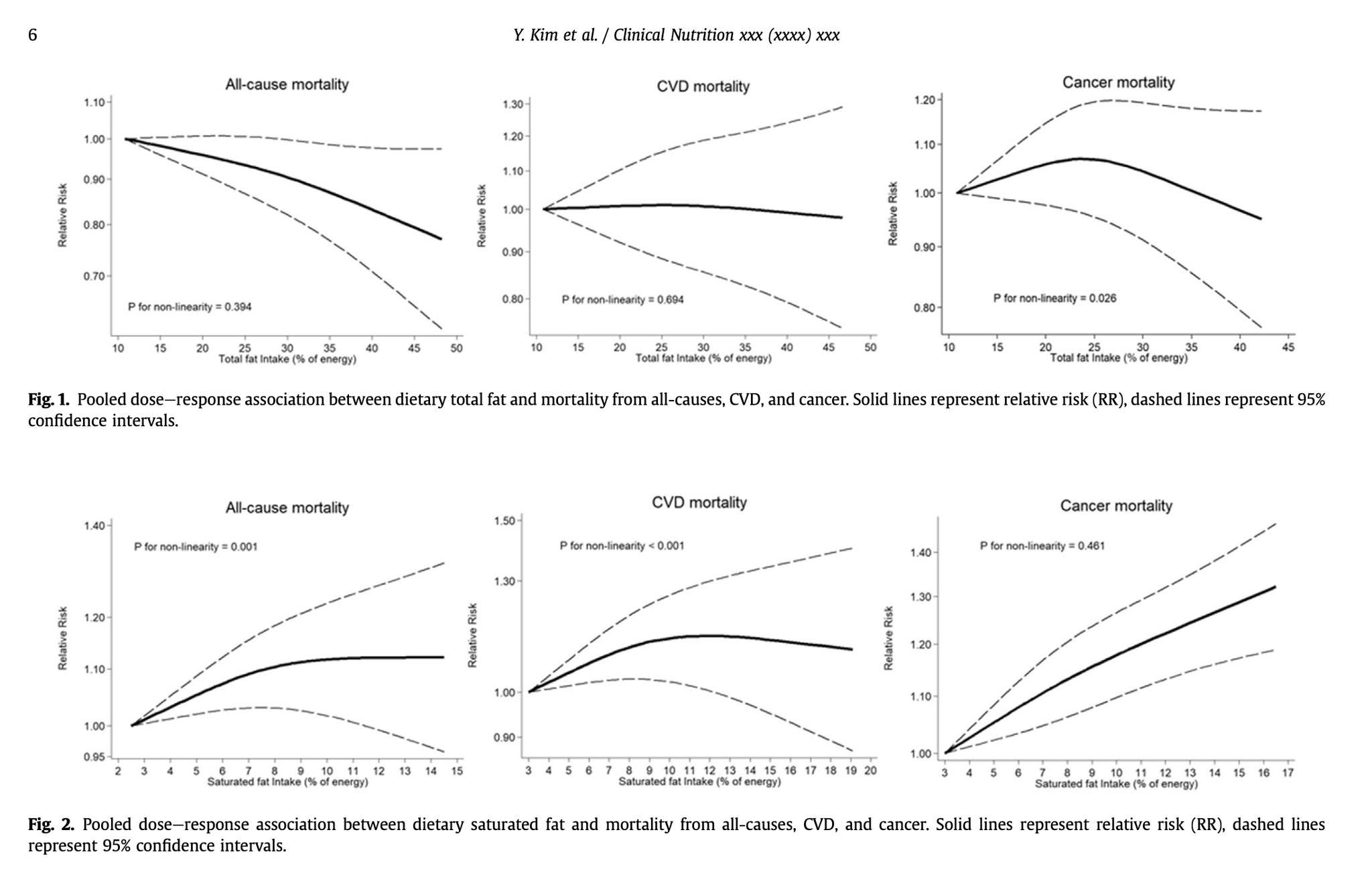
- Fat type and mortality. A 2020 Clinical Nutrition meta-analysis of 19 prospective cohorts (1,013,273 participants, 195,515 deaths) found that each 5% of energy from polyunsaturated fat was associated with 7% lower all-cause, 5% lower cardiovascular and 4% lower cancer mortality, while each 1% of energy from trans fat was linked to 6% higher all-cause and cardiovascular mortality. For saturated fat, each 5% of energy was linked to 3% higher cardiovascular and 4% higher cancer mortality, and all-cause risk rose up to about 11% of energy before plateauing1213. Gokhan's own caveat is that data can guide but should not be taken as a prescription for every individual13.
- Substitution analyses. A Harvard analysis cited in the group found that replacing saturated fat with polyunsaturated fat, mostly from vegetable oils, nuts and seeds, lowered coronary heart disease risk more than replacing it with whole-grain carbohydrate26.
- Walter Willett's view. In an interview shared by Louis, the Harvard researcher says his group's data showed total fat was irrelevant, trans fats were very bad, and saturated fat compared with refined carbohydrate was only weakly related to heart disease or mortality, while unsaturated fat was linked to substantially lower rates of heart disease and death9. This is an important nuance: what replaces saturated fat decides the result.
- Dementia. A prospective cohort in adults averaging 68 years found no link between total fat and dementia, but higher saturated fat was associated with higher risk. Louis notes this is observational but recurs across large cohorts27.
Population-level evidence
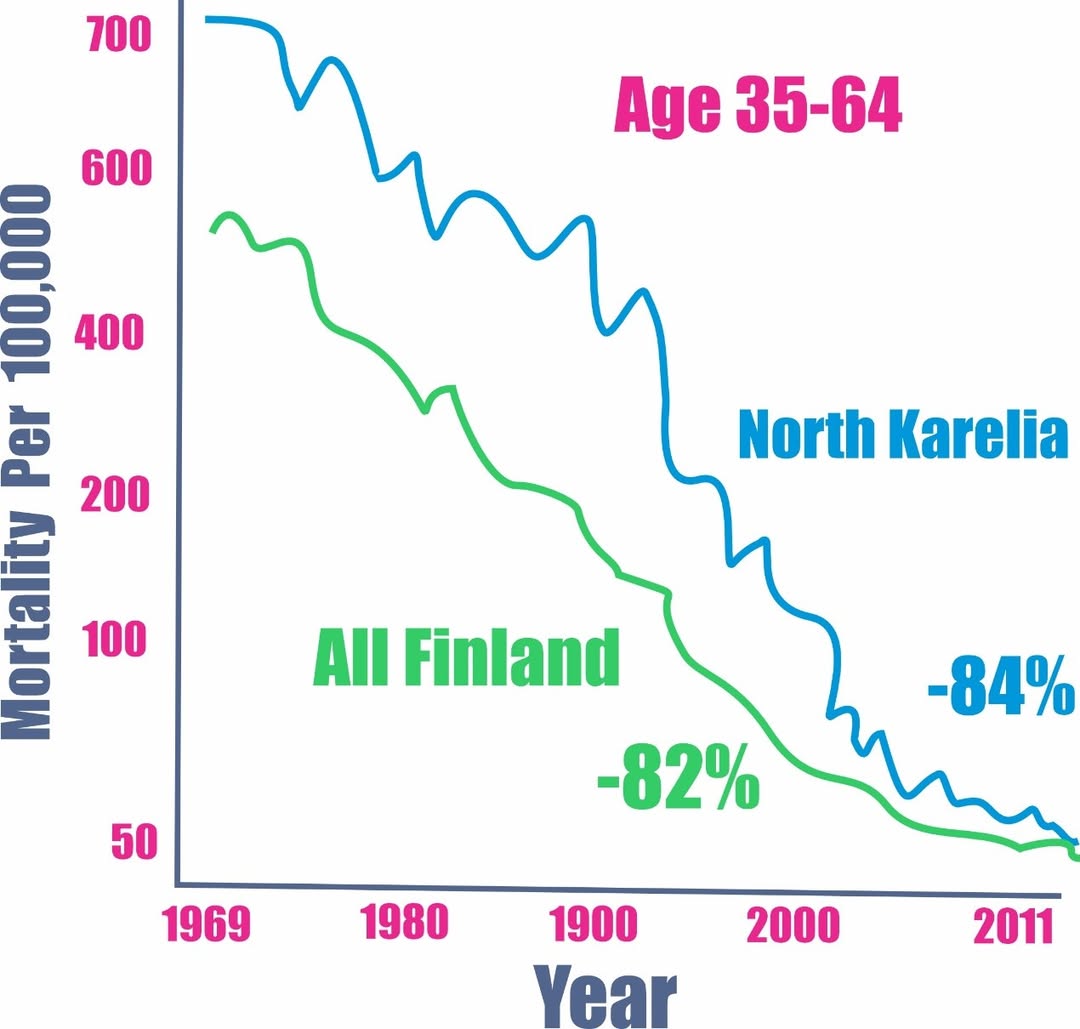
Louis shares material on Finland's North Karelia Project, where in the early 1970s men had some of the world's highest coronary mortality and average cholesterol often exceeded 270-280 mg/dL. The population cut saturated fat, moved from butter to vegetable oils and margarines, and serum cholesterol fell about 15-20% while coronary mortality in working-age men fell nearly 80%. The shared posts acknowledge that falling smoking and better blood pressure control also contributed2829. This is an uncontrolled, real-world change rather than a trial.
He also points out that since 1950 vegetable oil consumption rose about 5-fold, butter and lard fell 2-3-fold, and US heart disease death rates fell more than 4-fold. He presents this raw correlation as evidence against claims that seed oils drive heart disease, though it is an ecological correlation and many other factors changed3031.
Metabolic effects: liver fat and insulin resistance
- Overfeeding trial. In a randomized trial published in Diabetes Care (2018), 38 overweight adults were overfed 1,000 extra kcal per day for 3 weeks. Liver fat rose 55% with mostly saturated fat (butter and dairy), 33% with simple sugars and 15% with unsaturated fat (olive oil and nuts). Saturated fat also increased insulin resistance and plasma ceramides8.
- Ghee swapped for rapeseed oil. In a 12-week randomized trial in 110 people with fatty liver disease, replacing ghee with the same amount of rapeseed (canola) oil reduced liver fat and improved insulin resistance markers32. A secondary analysis of another 12-week trial linked higher plasma saturated fat to less liver fat loss and higher polyunsaturated fat to more33.
- Glucose-insulin meta-analysis. A PLoS Medicine meta-analysis of 102 randomized feeding trials found polyunsaturated fat gave the most consistent benefits for fasting glucose, HbA1c, insulin resistance and insulin secretion; monounsaturated fat did well but less so; and swapping carbohydrate for saturated fat did not appreciably change glucose control343536. Louis repeats that over 100 trials show this in aggregate323738.
- Palmitic versus oleic acid. A review by Manuel Vazquez-Carrera, reported in the news, concludes that palmitic acid, the most common saturated fat in American foods, promotes inflammation and insulin resistance, while oleic acid from olive oil, nuts and avocados counteracts those effects39.
Nuances, controversies and misconceptions
"Saturated fat studies show no harm"
Louis's central rebuttal is "in comparison to what?" Studies finding no increased cardiovascular risk usually substitute saturated fat for a sample of the standard Western diet, in which more than 40% of calories come from refined starch and sugar. When saturated fat is compared with fruit, vegetables, legumes, whole grains, olive oil, nuts, seafood, yogurt or unsaturated fat, he says it consistently raises risk310. Willett's remark that saturated fat versus refined carbohydrate was only weakly related to disease fits this reading9.
Dairy: butter versus yogurt and cheese
Several posts argue the "food matrix" changes how dairy fat is absorbed:
- In a 4-week randomized crossover trial, low-fat yogurt plus 10-15 g of butter raised apoB by 10 mg/dL, while full-fat yogurt with matched saturated fat lowered it by 4 mg/dL. The authors attribute this to the milk fat globule membrane (MFGM), which stays intact in yogurt but is lost when butter is churned404142.
- In a randomized trial, full-fat cheese lowered LDL more than reduced-fat cheese with added butter at similar saturated fat, and cheese eaters excreted more fat in stool. The shared summary says results are not perfectly consistent and benefits may level off around 50 g per day4344.
- An umbrella review of 54 meta-analyses linked cheese to modestly lower risk of all-cause mortality (RR 0.95), cardiovascular disease (0.92), stroke (0.93) and type 2 diabetes (0.93), with moderate evidence quality. Gokhan flags it as interesting given the group's usual caution, and adds that people whose LDL rises should eat it sparingly45.
- Gokhan's opinion is that butter and cream, with free saturated fat, are best avoided, while whole-fat cheese and yogurt look more benign if they do not raise your cholesterol much11.
- Louis cautions about a new observational study linking full-fat cheese and cream to lower dementia risk. It is the first to report the effect, and long-running cohorts such as the Nurses' Health Study have not reported it4. He adds that cheese is still high in calories and salt44.
Louis summarizes that fermentation appears to blunt some of the harm of dairy saturated fat, but the topic is still debated242.
Show data
| Relative risk (log scale) | 95% CI | |
|---|---|---|
| All-cause mortality | 0.95 | – |
| Cardiovascular death | 0.93 | – |
| Cardiovascular disease | 0.92 | – |
| Coronary heart disease | 0.92 | – |
| Stroke | 0.93 | – |
| Type 2 diabetes | 0.93 | – |
Different saturated fats
There are over a dozen kinds of saturated fat3. Cocoa butter is about a third stearic acid, which has a largely neutral effect on LDL, so it raises LDL much less than milk fat, which is rich in palmitic and myristic acid. Louis therefore suggests avoiding chocolate with added milk fat; the post notes it was written with AI assistance46.
Coconut oil is 80-90% saturated fat and raises LDL and apoB, though less than butter. Louis notes there are no long-term hard-outcome studies on it, that its HDL rise is not considered protective, and that plain MCT oil is a cleaner option if you want medium-chain fats4748. A video the group shared recommends cutting coconut oil and butter in favor of healthy oils to lower LDL49.
Dietary cholesterol versus saturated fat
A trial in 61 adults separated the two. Two eggs a day within a low saturated-fat diet did not raise LDL, whereas the high saturated-fat diets did50.
Seed oils as a replacement
Some social media claims treat seed oils as harmful. The group's admins disagree and cite: a meta-analysis of 30 randomized trials (1,377 people) finding that higher linoleic acid intake did not significantly change inflammatory markers1651; a systematic review of 42 trials finding no significant effect of canola oil on inflammation52; and comments from nutrition researchers Martha Belury and Christopher Gardner5354. One shared source adds that repeatedly reheated oil can form harmful oxidation products, and the same applies to beef tallow37. Others note that cooking with these oils was associated with lower mortality than butter in cohorts5556.
Keto and individual variation
Gokhan argues that keto diets that raise LDL through saturated fat are not heart healthy, citing a recent keto plaque-progression study, and suggests tracking LDL and using a nut-, fish- and olive-oil-heavy version57. This is an admin opinion.
What this means for you
The admins' common suggestions, which are worth discussing with your own doctor:
- Think in terms of replacement. The benefit comes from swapping saturated fat for unsaturated fat, not from adding refined starch or sugar5910.
- Favor unsaturated fats: olive oil, nuts, seeds, avocados and fish258. Replacing under a tablespoon of butter daily with plant oil was linked to a 17% lower risk in the Harvard cohorts6.
- Minimize butter, cream and pure saturated fats, a point in the Mediterranean-diet do's and don'ts the group shares1158.
- Treat dairy case by case. Full-fat yogurt and cheese in moderation look more benign than butter, but check whether your own LDL or apoB rises1145.
- Skip coconut oil as a heart-health food, and prefer MCT oil if you want medium-chain fats47.
- Check labels for added milk fat in chocolate46.
- Track your numbers. Gokhan urges never ignoring LDL, especially on low-carbohydrate diets57.
Frequently asked questions
Is butter a health food?
Louis does not think so. A shared summary says the butter literature shows neutral to slightly higher all-cause mortality and no cardiovascular protection, though butter can fit into a balanced diet1. He adds that he wishes butter were a health food but the long-term evidence suggests otherwise23.
Is full-fat dairy fine?
It depends on the product. Yogurt and cheese appear to affect LDL and apoB less than butter and cream, and cohort data look favorable, but some of the evidence is observational and the topic is still debated24245.
Do eggs raise LDL because of their cholesterol?
In the 61-adult trial, eggs eaten within a low saturated-fat diet did not raise LDL; saturated fat was the driver50.
Does lowering saturated fat help beyond cholesterol?
The group points to liver fat, insulin resistance and dementia associations, though the dementia data are observational82734.
Can I use olive oil in place of seed oils or butter?
The Harvard cohort found the biggest benefits from olive, canola and soybean oils relative to butter21, and Louis expects olive oil to give effects similar to canola on liver fat32.