A standard lipid panel reports total cholesterol, LDL, HDL and triglycerides. People often divide triglycerides by HDL to get a single "TG/HDL" number and treat a low result as good news. The group's admins mostly read these numbers differently: as signals of how well your body handles energy, not as direct causes of artery disease.12
In short: a high TG/HDL ratio mainly points to insulin resistance and excess visceral fat, especially in the liver.2 HDL cholesterol itself is probably not a cause of protection: drugs that raised it repeatedly failed.34 Triglycerides do matter, but mostly because the VLDL particles that carry them are apoB-tagged and atherogenic, which is why measuring apoB captures that risk.56
The players on a lipid panel
- Triglycerides are a type of fat carried in the blood. Most triglyceride is carried by VLDL (very low-density lipoprotein), a particle that carries an apoB tag, so triglycerides largely reflect your VLDL.513
- ApoB is a protein tag on LDL, VLDL and Lp(a) particles. An apoB test counts the total number of these potentially atherogenic particles; LDL and Lp(a) particles carry mainly cholesterol, while VLDL carries mainly triglyceride.14
- VLDL cholesterol can be roughly estimated by dividing triglycerides by 5 (150 mg/dL gives 30; 250 gives 50). This is most accurate when triglycerides are under 400 mg/dL, and it includes the cholesterol of VLDL remnants, which are also described as atherogenic. A normal VLDL is below 30 mg/dL, corresponding to triglycerides below 150 mg/dL, though optimal is likely lower in high-risk people.10
- Remnants are partly broken-down triglyceride-rich particles. Standard panels do not show them directly; Louis shared an explainer noting that hidden particles such as Lp(a), remnants and other apoB-rich particles are invisible on standard tests.15
- HDL is the "good cholesterol" of popular belief; its main protein is apoA-I.8
- TG/HDL is triglycerides divided by HDL. A variant, the atherogenic index of plasma (AIP), is the base-10 logarithm of TG/HDL.16
What the TG/HDL ratio actually measures
A marker of insulin resistance and visceral fat
Louis describes TG/HDL as mainly an indirect marker of insulin sensitivity and metabolic health. It tends to track visceral fat, particularly fat in the liver, which he calls the main cause of insulin resistance.211 He argues that "any diet that gets rid of visceral fat will dramatically improve TG/HDL", as well as improving insulin sensitivity and glycemic control, though he offers this as opinion without a cited study.1 Another post names waist-to-height ratio, adiponectin and TG/HDL as three simple metabolic health markers.17
The group's reshared guide on metabolic syndrome lists five criteria, of which three qualify as a diagnosis: blood pressure of 130/85 or more, fasting glucose of 100 mg/dL or more, HDL below 40 mg/dL in men or below 50 in women, fasting triglycerides of 150 mg/dL or more, and a large waist. Two of these are the triglyceride and HDL values.11 Stanford's Christopher Gardner, in a video Louis shared, explains how insulin resistance and visceral fat lead to high triglycerides, a classic sign of insulin resistance, and the nutritional remedy he describes is to lose weight and stop eating refined starch and sugar.18
Why does insulin resistance also lower HDL? Louis summarized six mechanisms: impaired HDL maturation (lower LCAT activity), reduced apoA-I production, faster HDL breakdown (hepatic lipase and CETP), altered HDL composition and function, higher triglycerides producing smaller dense HDL, and inflammation and oxidative stress.19
Does the ratio predict plaque?
An analysis from the PARADIGM study found that the atherogenic index of plasma was associated with rapid plaque progression. Over a median 3.4 years, rapid progression occurred in 26.1% of participants. After adjustment, each 0.1-unit increase in AIP was associated with an odds ratio of 1.07 (95% CI 1.01-1.13) for rapid progression in non-diabetic subjects, but not in diabetic subjects (OR 1.04, 95% CI 0.95-1.14).16
Show data
| Odds ratio per 0.1-unit AIP (log scale) | 95% CI | |
|---|---|---|
| No diabetes | 1.07 | 1.01–1.13 |
| Diabetes | 1.04 | 0.95–1.14 |
Louis stresses this is an association. In his view AIP and TG/HDL can help assess risk but are probably not causal; they are a crude proxy for insulin sensitivity and metabolic health, which can be measured more accurately by tests such as an oral glucose tolerance test with insulin.16 He also notes that higher TG/HDL predicts smaller LDL particles, but particle size loses its predictive value once the total particle number (for example apoB) is accounted for, so TG/HDL is effectively predicting higher apoB.16
A low ratio is not a free pass
Insulin resistance and LDL are described as independent causal risk factors, so both need attention. Louis shared an interview with William Cromwell making that point, and his takeaway was that neither is "the true cause".220
Several posts push back on the idea that a good ratio cancels LDL risk:
- Statin benefit and TG/HDL. Louis used an AI fact-check to examine the claim that statin trials show no benefit when TG/HDL is below 1. The conclusion was that this is inaccurate as a categorical rule: a low ratio may mean lower baseline risk, but it does not nullify the benefit of lowering particle number. This is a Gemini-generated analysis shared as a check, not a trial result.21
- Keto-CTA. Louis describes the Keto-CTA study as testing whether good metabolic health protects against very high apoB and LDL. Lean, metabolically healthy participants with very low TG/HDL and an average LDL of about 254 mg/dL showed rapid plaque progression, which he reports as roughly 3x to 3.8x worse than a comparison group (Nature-CT) with worse metabolic health but normal LDL, in two separate posts.1222 The paper itself drew criticism of its write-up, and Louis argued it should not be retracted because its dataset is valuable and its methodology sound; it remains, in his words, the only CT-angiography study of lean, metabolically healthy people on keto or carnivore diets.23
- Case example. In a story Gokhan Can shared, a man whose TG/HDL later fell below 1 had needed a stent for a 90% blockage at age 71 and had post-load glucose spikes above 200 despite normal fasting glucose and A1c. It is an anecdote, not evidence.24
Triglycerides: causal, a marker, or both?
The posts give a nuanced, and partly layered, answer.
Louis states that high triglycerides are causal in cardiovascular disease because they are a major contributor to high apoB, and these apoB-tagged particles are directly atherogenic. They are also an indirect marker of excess liver fat and insulin resistance, which also causes disease.26 He finds it odd to accept Lp(a) and triglycerides as causal while denying that LDL is, since all are apoB particles.13
The nuance is that triglycerides are "already counted" in apoB. When someone asked why triglycerides below 400 mg/dL are said not to matter once apoB and Lp(a) are known, Louis answered that they do still matter below 400 mg/dL when carried by VLDL, but measuring apoB already accounts for them, and adding triglycerides on top double-counts the risk.5
What happened when triglycerides were lowered
Olezarsen, which targets APOC3, lowered triglycerides dramatically in imaging studies. In the ESSENCE-TIMI 73b imaging study, triglycerides fell about 64%, remnant cholesterol about 72% and apoB about 16%, with LDL-C unchanged, yet 12-month coronary CT angiography showed no difference in non-calcified, low-attenuation or total plaque (primary endpoint p = 0.36), and 97% of participants were already on therapy.7 Gokhan quoted Ethan Weiss calling it "one of the most interesting null results I have seen in a long time".25 A separate post describing BRIDGE-TIMI 73a reported olezarsen lowering triglycerides 64% with plaque volume unchanged.26
Interpretations differ:
- Louis reads these results as showing that lowering triglycerides without treating the underlying insulin resistance does not slow plaque.7
- The same posts note possible explanations: the apoB reduction was modest (about 16%), patients were already aggressively treated, and follow-up may be too short for structural change. A cardiologist's post carries these caveats and says the study has methodological flaws in his opinion.7
- A comment on the BRIDGE post says that unless triglycerides exceed about 400-500 mg/dL, drug-lowering them makes little difference to plaque progression or hard outcomes, and that triglycerides act mainly as a proxy for metabolic health, with VLDL risk captured by apoB. Severe hypertriglyceridemia still raises pancreatitis risk.26
Fibrates
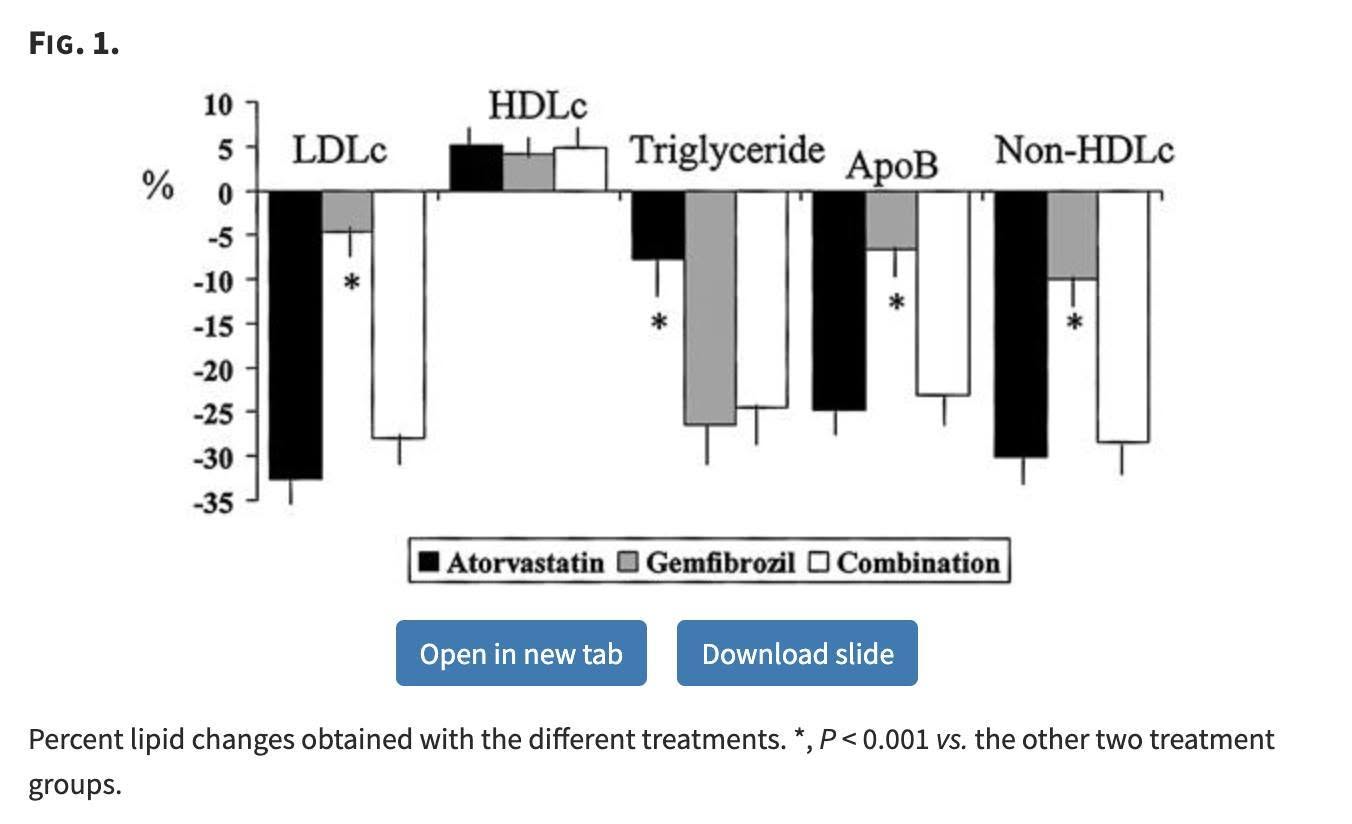
Gokhan shared an overview of fibrates (fenofibrate, gemfibrozil), which lower triglycerides and raise HDL. A 2020 review concluded that benefit seems concentrated in people with metabolic syndrome, high triglycerides and low HDL, based on subgroup analyses, meta-analyses and real-world studies. It also noted that several randomized trials did not show clear benefit overall.27 Ezetimibe, used mainly for LDL, also modestly lowers triglycerides and slightly raises HDL.28
HDL: a marker, not a target
For decades, higher HDL meant lower risk, and that association is real. Louis acknowledges dozens of observational studies linking higher HDL to lower risk at any given LDL or apoB, including a recent UK Biobank analysis in which the effect size was larger than in many earlier studies.29 The question is whether HDL itself causes the protection.
The drug trials
Louis summarizes the failures:
- ILLUMINATE (torcetrapib): raised HDL (by 72%, per a later post) but was terminated early because of more cardiovascular events and deaths.38
- dal-OUTCOMES (dalcetrapib): raised HDL and apoA-I by about 30% with no reduction in cardiovascular death, heart attack or stroke.8
- ACCELERATE (evacetrapib): raised apoA-I by over 100% (HDL by 130%) with no significant reduction in major adverse cardiovascular events; the trial was stopped early.38
- AIM-HIGH (niacin): HDL rose 25% with no fewer events and the trial was stopped early for futility; HPS2-THRIVE (niacin plus laropiprant) raised HDL but did not reduce major vascular events and increased serious adverse events.3
- Fibrate and niacin add-on trials and CSL112, an infusion of native apoA-I isolated from human plasma, also failed.8 Louis says the top-line failure of the AEGIS-II phase 3 trial of CSL112 shows apoA-I is not directly causal.30
Mendelian randomization points the same way, according to Louis: genes that predispose to higher HDL or apoA-I, without better insulin sensitivity, do not lower lifetime risk.829 His summary is that HDL is "basically useless as an intervention target in CVD, except as a crude marker of insulin resistance", and that if you improve insulin sensitivity HDL will likely rise as a side effect.4 The one scenario in which risk goes down is when HDL rises as a side effect of improved insulin sensitivity, in which case the improved insulin sensitivity, not HDL, is lowering risk.3
Caveats and disagreement
- Subfractions. Louis allows that some HDL subfractions might be protective and says there is research interest, but calls HDL as a whole a probable dead end.329 He also notes that very high HDL has been associated with higher risk in some studies.29
- Small HDL. A paper he highlighted in the International Journal of Cardiology associated small HDL particles with prediabetes, diabetes and coronary calcification, and suggested lipid-lowering drugs might offset up to 40% of the calcification linked to high small HDL. Louis concludes high HDL is not always good, and the study is cross-sectional.31
- A genetic study pointing the other way. A Mendelian randomization study of 46 modifiable factors found higher genetically predicted HDL associated with greater odds of reaching age 90 or beyond (and 99 or beyond), while higher LDL, BMI, blood pressure and type 2 diabetes lowered the odds. This is a longevity outcome rather than heart attacks, and it is in tension with the view that HDL is non-causal; the posts do not reconcile the two.32
- Plaque regression targets. A meta-analysis of 31 imaging studies (4,997 patients) linked LDL below 80 mg/dL and HDL above 45 mg/dL with maximal regression, an association rather than proof that raising HDL helps.33
- Low HDL in practice. Louis says some people simply have genetically low HDL; with good insulin sensitivity, good glycemic control and no metabolic syndrome, he thinks there is probably little to worry about. In a minority of cases very low HDL signals other health problems, so he advises talking to a doctor about unexplained very low HDL.34
- Raising HDL with food. Louis argues the HDL rise from coconut oil is unlikely to be protective, since coconut oil also raises LDL and apoB.35 In a WHO meta-analysis of 84 trials, saturated fat raised HDL only about one-tenth as much as LDL-C while raising apoB.36
ApoB and non-HDL: the number that sums the risk
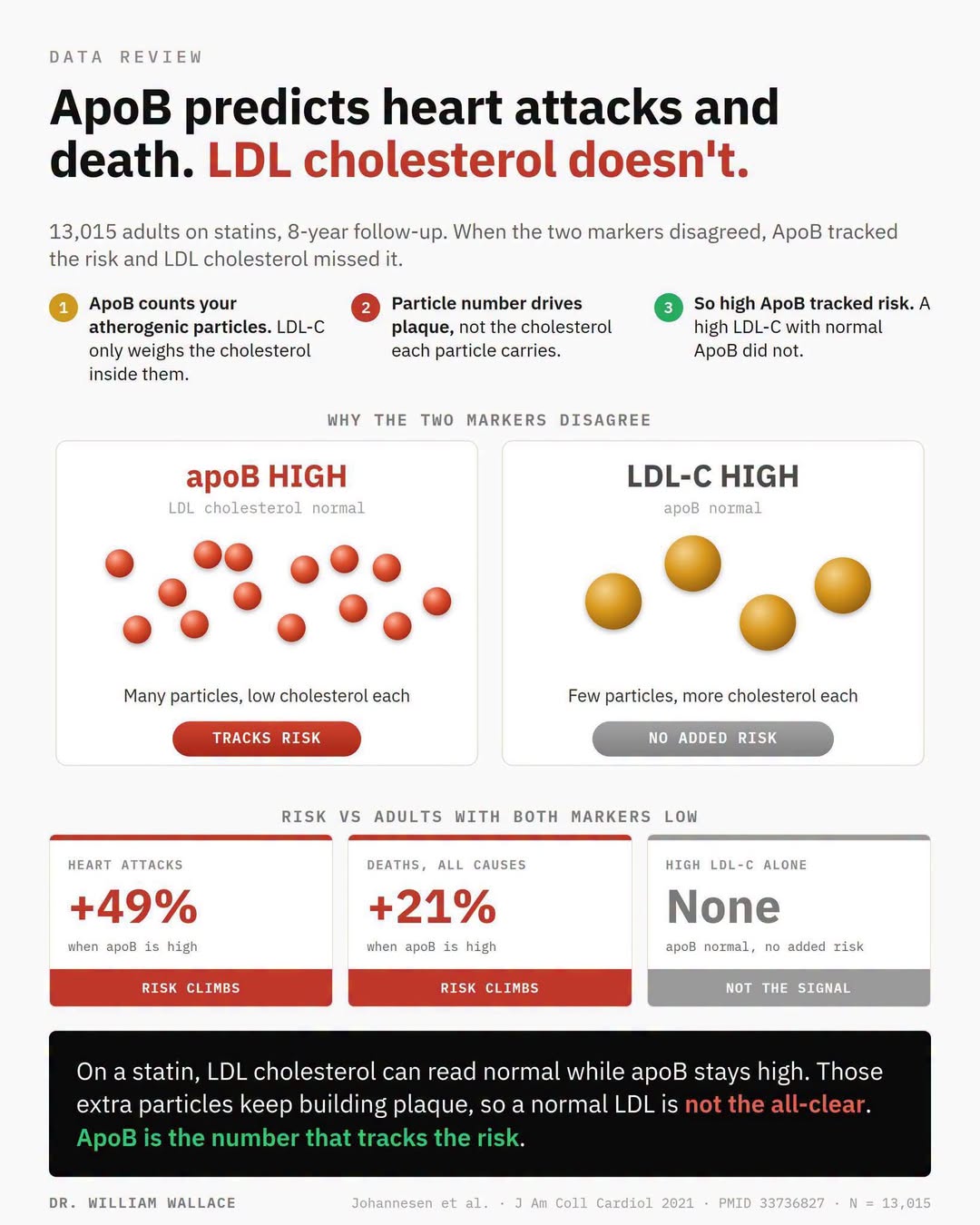
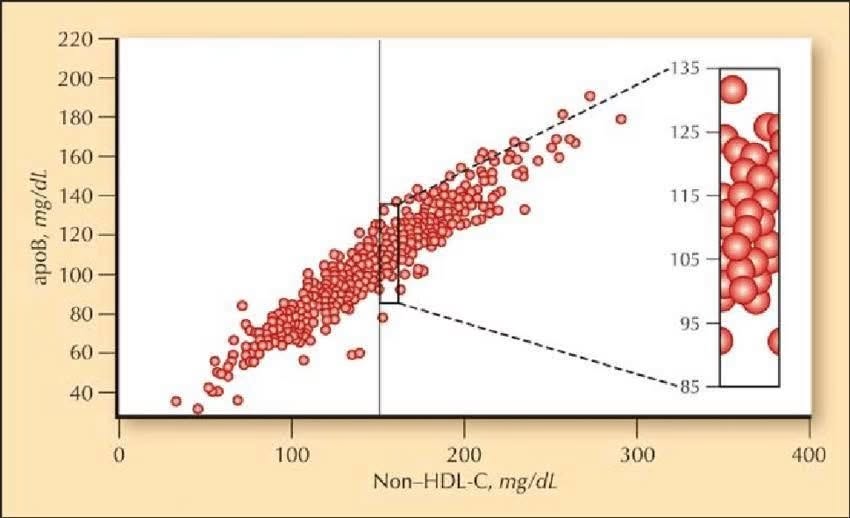
Because triglyceride-rich and cholesterol-rich particles all carry apoB, many of the group's posts end up at the same recommendation: look at apoB. A video Louis shared explains why apoB is a better marker than LDL-C and why the two can disagree.37 In the Copenhagen General Population Study, among 13,015 people on statins followed a median 8 years, those with high apoB but normal LDL-C had a 49% higher rate of heart attack and 21% higher all-cause death; high LDL-C with normal apoB showed no excess risk, and non-HDL cholesterol behaved like apoB.9
If you only have a standard panel, apoB cannot be calculated exactly. Non-HDL cholesterol (total cholesterol minus HDL) is a rough proxy, as it covers mostly LDL plus some VLDL and a little IDL, but it measures the amount of cholesterol, not the number of particles.38 Louis offers a crude formula, apoB is roughly 0.7 x (LDL + TG/5), as a way to see whether your apoB is driven mainly by LDL or by triglycerides (VLDL).39 The 2026 ACC/AHA lipid guideline, as summarized by Louis, says apoB may be used to assess residual risk and guide treatment in people with cardiovascular-kidney-metabolic syndrome, type 2 diabetes, high triglycerides or known cardiovascular disease who have reached their LDL-C and non-HDL-C goals, since apoB may be more accurate than LDL-C in these groups.40
The rough estimates from a standard panel, side by side:
| Estimate | How to calculate | What to keep in mind |
|---|---|---|
| VLDL cholesterol | Triglycerides ÷ 5 | Most accurate with triglycerides under 400 mg/dL; normal is below 30 mg/dL10 |
| Non-HDL cholesterol | Total cholesterol − HDL | Counts cholesterol in LDL, VLDL and IDL, not the number of particles38 |
| ApoB (crude) | 0.7 × (LDL + TG/5) | Shows whether apoB is driven mainly by LDL or by triglycerides (VLDL)39 |
How people try to improve triglycerides and HDL
Louis's ordering is: first lose visceral fat, particularly liver and pancreatic fat; second, stop eating refined starch, refined sugar and white potatoes.11
- Fat loss, whatever the route. Louis uses the "Twinkie diet" case (27 lb lost in 10 weeks at 1,800 kcal/day, with LDL down 20%, HDL up 20% and triglycerides down 39%) to argue that metabolic gains follow liver and visceral fat loss, while explicitly not recommending such a diet. This is a single case report.41 A 6-month intermittent fasting RCT shared in the group produced about 8% weight loss, about 16% body fat loss, triglycerides down about 23% and non-HDL cholesterol down about 11%, although glucose, insulin resistance, blood pressure and inflammation did not change significantly.42
- Visceral fat matters beyond lipids. In a cross-sectional proteomics analysis of 896 adults, visceral fat was associated with 221 circulating proteins, more than blood pressure, HDL, triglycerides or insulin resistance. This cannot prove causation.43
- Replacing refined carbohydrate with healthy fat. Louis says replacing refined carbohydrate with healthy fat raises HDL, which he says a traditional Mediterranean diet does, and that replacing saturated with unsaturated fat removes liver fat and improves insulin sensitivity.34 Walter Willett, in an interview shared by Louis, says unsaturated fats can lower LDL without raising triglycerides or lowering HDL and that polyunsaturated fats help reduce insulin resistance.44
- Nuts. A meta-analysis of randomized trials found nuts (about 120 kcal/day) did not change weight, and were associated with small reductions in total cholesterol, LDL and triglycerides, with no significant effect on HDL; the triglyceride finding was very uncertain.45
- Berberine. A meta-analysis of 18 trials (1,788 adults, about 900-1,500 mg/day) found small reductions in LDL, triglycerides and apoB; no outcome data exist.46
- Medications. Fibrates may help in high-triglyceride, low-HDL metabolic syndrome, but evidence is mixed.27 Statins are the first-line drug for high-risk people per a guideline summary Gokhan shared, with ezetimibe or PCSK9 inhibitors added if goals are missed.47
Why LDL still comes first
None of this lowers the importance of LDL. Gokhan summarized guideline goals: LDL-C below 70 mg/dL with at least a 50% reduction for high-risk people and below 55 for very-high-risk people.47 The 2026 ACC/AHA guideline keeps risk-scaled LDL targets: below 100 mg/dL for borderline or intermediate risk, below 70 for high risk, and below 55 for very-high-risk secondary prevention.40 Louis shared a graph suggesting a 39 mg/dL LDL reduction is associated with over 20% lower heart attack risk at 5 years (trials), over 30% at 12 years (cohorts) and over 50% across a lifetime (Mendelian randomization).48
What this means for you
These are ideas drawn from the group's admins and posts, not individual advice; the group's admins recommend discussing them with your doctor.
- Treat TG/HDL as a signal about insulin resistance and visceral fat, not as a stand-alone verdict on heart risk.216
- If you want to know your insulin sensitivity directly, Louis suggests an oral glucose tolerance test with insulin rather than relying on proxies such as HDL.429
- Do not try to "raise HDL" with drugs or supplements for its own sake; focus on improving insulin sensitivity and let HDL follow.34
- Check apoB (or at least non-HDL cholesterol), because triglyceride-rich VLDL and remnants are counted there; do not add triglycerides on top of apoB when estimating risk.538
- Do not assume a low TG/HDL cancels a high LDL or apoB.1221
- Triglycerides below 150 mg/dL count as normal, though optimal is likely lower in high-risk people.10
- If triglycerides are very high, discuss it with a doctor, since severe hypertriglyceridemia raises pancreatitis risk.26
Frequently asked questions
Is a TG/HDL under 1 a sign I am safe from heart disease?
Not on its own. It suggests good insulin sensitivity, and a ratio below 1 may reflect larger LDL particles, but risk still depends on total particle number (apoB). Keto-CTA participants with very low TG/HDL and very high LDL still progressed plaque.2122
Does raising HDL protect my heart?
The trial evidence says drugs that raise HDL have not reduced heart attacks or strokes, and genetic studies of HDL-raising variants have not shown lifelong benefit according to Louis.329 Higher HDL still tracks with better outcomes as a marker of metabolic health.29
Are triglycerides dangerous?
Both views are in the posts. Louis says they are causal through apoB-tagged VLDL and also a marker of liver fat and insulin resistance.6 Another post argues they are mostly a proxy for metabolic health, with VLDL risk already in apoB, and that drug-lowering below 400-500 mg/dL changes little.26
What is remnant cholesterol, and can I see it on my labs?
Remnants are triglyceride-rich particles left after VLDL is partly broken down. They are not reported on a standard panel, but the VLDL estimate (triglycerides divided by 5) includes the cholesterol of VLDL remnants.1015 In the olezarsen trial, remnant cholesterol fell about 72% without a plaque benefit at 12 months.7
What is the single best thing to do for both triglycerides and HDL?
The group's admins point to losing visceral and liver fat, then cutting refined starch and sugar.111