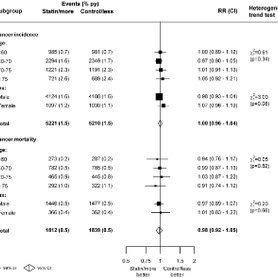
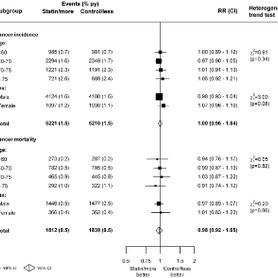
Statins have shown some promise in preventing and treating cancer, or at least a neutral effect.
Below is a small sampling of some of this research.
——-
Note that RCT’s and prospective cohort studies are at the very top of the evidence hierarchy in medicine.
↪ Check where a study sits on the evidence hierarchy before citing it
——-
RCT’s have consistently found no increased risk in cancer from statins.
Quoted (2023):
“This meta-analysis comprised thirty-five randomized controlled studies. Twenty-eight included studies reported cancer incidence, and eighteen reported cancer mortality. The pooled results indicated no reduction in cancer incidence with statins compared to placebo [OR = 0.99, 95% CI (0.95, 1.03)]. In addition, statins did not decrease cancer mortality [OR = 0.99, 95% CI (0.91, 1.07)]. This study also performed a number of subgroup analyses, which showed no effect of statins on cancer subtypes such as genitourinary and breast cancer. Neither the type of statin nor long-term treatment with statins had an effect on cancer incidence and mortality.”
.
Paper · Lipids Health Dis · 2023The association of statin therapy and cancer: a meta-analysis.Conclusion: Through comprehensive analysis, we found that statin therapy does not reduce cancer incidence or mortality while protecting the cardiovascular system.pmc.ncbi.nlm.nih.govQuoted (2012):
“In 27 randomised trials, a median of five years of statin therapy had no effect on the incidence of, or mortality from, any type of cancer (or the aggregate of all cancer).”
Paper · PLoS One · 2012Lack of effect of lowering LDL cholesterol on cancer: meta-analysis of individual data from 175,000 people in 27 randomised trials of statin therapy.Conclusion: In 27 randomised trials, a median of five years of statin therapy had no effect on the incidence of, or mortality from, any type of cancer (or the aggregate of all cancer).journals.plos.orgQuoted (2006):
“Statins have a neutral effect on cancer and cancer death risk in randomized controlled trials. We found that no type of cancer was affected by statin use and no subtype of statin affected the risk of cancer.”
.
pubmed.ncbi.nlm.nih.govLink to pubmed.ncbi.nlm.nih.govpubmed.ncbi.nlm.nih.govQuoted (2017):
“Out of 676 retrieved articles, a total of 21 RDBPCTs with 65,196 participants (32,618 in the statin group and 32,578 in the placebo group) were included in the meta-analysis. Overall, we found that there was no significant association between the use of statins and the risk of cancer (relative risk 0.97, 95% confidence interval 0.92–1.02, I2 = 0.0%) in a fixed-effect meta-analysis. In addition, in the subgroup meta-analyses, no beneficial effect of statins was observed when analyzed by statin type, country, follow-up period, methodological quality, underlying diseases/population, and type of cancer.”
 OvidStatins and risk of cancer: A meta-analysis of... : Indian Journal of CancerPURPOSE:Several meta-analyses of randomized controlled trials (RCTs) reported no association between the use of statins and the risk of cancer....ovid.com
——-
Many prospective cohort studies have associated statin use with either neutral risk or reduction in risk of cancer.
The advantage of prospective cohort studies is that they run for much longer periods of time than RCT’s, often decades. Statin RCT’s usually run for about 5 years. The disadvantage of prospective cohort studies is that they cannot show causality.
Quoted (2022):
“Men using cholesterol-lowering statin medications have been found to have lower risks of both advanced and fatal prostate cancer in multiple registry-based studies and prospective cohort studies. Statin use has also been associated with longer survival among men already diagnosed with prostate cancer. Mechanisms responsible for purported anti-cancer effects of statins are not well understood but may offer insight into prostate cancer biology.”
.
Paper · Prostate Cancer Prostatic Dis · 2022Statins and prostate cancer—hype or hope? The epidemiological perspectiveBackground Men using cholesterol-lowering statin medications have been found to have lower risks of both advanced and fatal prostate cancer in multiple registry-based studies and prospective cohort studies. Statin use has also been associated with longer survival among men already diagnosed with prostate cancer. Mechanisms responsible for purported anti-cancer effects of statins are not well understood but may offer…nature.comQuoted (2021):
“However, the results of a population-based epidemiologic study showed that the use of statins was not associated with overall prostate cancer risk [67], although the credibility of the results of the study are open to question due to the relatively small sample size and the existence of potential selection and recall biases. In gastric cancer, a recent nationwide cohort study suggested that the use of statins is related to a decrease in gastric cancer mortality in the general population, but has no correlation with the incidence of gastric cancer [30]. A recent prospective observational study of ovarian cancer patients conducted in Australia suggested that the increase in patient survival is related to the use of lipophilic statins, but not to hydrophilic statins [59]. In a large-scale population study of 4,913 patients with diffuse large B-cell lymphoma, statins improved the survival rate in a dose-dependent manner [39]. A study of 999 colon cancer patients showed that the use of statins after diagnosis was significantly associated with a lower risk of death from any cause (adjusted RR, 0.67; 95% CI, 0.51–0.87) and a lower risk of cancer death (adjusted RR, 0.66; 95% CI, 0.49–0.89) [31].”
%20%5B31%5D.
jeccr.biomedcentral.comLink to jeccr.biomedcentral.comjeccr.biomedcentral.comQuoted (2023):
“In this cohort study of Asian patients with breast cancer, statin use was associated with a reduced risk of cancer-associated death rather than cardiovascular death. Our findings provide evidence to support the use of statins in patients with breast cancer; however, randomized studies are necessary.”
.
Paper · JAMA Network OpenJAMA Network Open articlejamanetwork.comQuoted (2011):
“However, one of these large cohort studies by Cauley and colleagues found statin use was associated with an 18% lower risk of breast cancer when statin use was limited to hydrophobic statin users.[51] Other observational studies reported modest to large statistically significant reductions in the risk of breast cancer (30–74%) associated with overall use of statins.[38–40,42] Of the studies that evaluated duration of use, only two studies found a reduced risk with long term statin use (at least 4–5 years) compared to non-users[38,39] and three studies found no dose response with duration of statin use.[43,47,52]”
pmc.ncbi.nlm.nih.govLink to pmc.ncbi.nlm.nih.govpmc.ncbi.nlm.nih.gov——-
Statins have been associated with lower cancer grade and stage at diagnosis.
Statins have been associated with reduced cancer recurrence and cancer-specific mortality.
Quoted (2023):
“Despite some inconsistent results possibly due to cohort diversity and differences in follow-up design, observational studies in the last decade have suggested overall positive impact of statins on clinical outcomes in an array of cancers, including but not limited to colorectal, gastric, breast, lung, liver and kidney cancers (Table 1) (Rosch and McCully, 2013; Wang et al., 2016; Mei et al., 2017; Liu et al., 2019; Tamburrino et al., 2020; Zeng et al., 2023). In a meta-analysis of over 1 million cancer patients, statins use reduces all-cause mortality and cancer-specific mortality by 30% and 40%, respectively (Mei et al., 2017). A recent meta-analysis involving 59,073 patients with hepatocellular carcinoma (HCC) shows that statins use is significantly associated with a reduced risk of HCC development (risk ratio, 0.54; 95% CI: 0.47–0.61) (Islam et al., 2020a). Large-scale observational studies also uncover significant correlation of statins with lower risks of several cancer types including prostate cancer and lymphoma (Table 1) (Graaf et al., 2004; Nielsen et al., 2012; Ren et al., 2021). These results warrant further randomized clinical trials to evaluate subtype-specific effects of statins in cancer prevention and treatment for certain cohorts.”
.
pmc.ncbi.nlm.nih.govLink to pmc.ncbi.nlm.nih.govpmc.ncbi.nlm.nih.govQuoted (2020):
“Statins are widely prescribed cholesterol-lowering drugs that inhibit HMG-CoA reductase (HMGCR), the rate-limiting enzyme of the mevalonate metabolic pathway. Multiple lines of evidence indicate that certain cancers depend on the mevalonate pathway for growth and survival, and, therefore, are vulnerable to statin therapy. However, these immediately available, well-tolerated, and inexpensive drugs have yet to be successfully repurposed and integrated into cancer patient care. In this review, we highlight recent advances and outline important considerations for advancing statins to clinical trials in oncology.”
aacrjournals.orgStatins as Anticancer Agents in the Era ofaacrjournals.orgQuoted (2023):
“Further, statins have been utilized in combination with other chemotherapeutic medications to impede cell proliferation and trigger apoptosis. Moreover, many in vivo studies have demonstrated the anticancer therapeutic impact of statins by suppressing the tumor size and inhibiting migration and proliferation. Advanced clinical trials are currently being conducted with numerous encouraging in vitro and in vivo results on the effectiveness of statin therapy in several cancer types. These studies have found that statin use is associated with a decreased risk of cancer formation, a lower cancer grade at diagnosis, and a lower risk of cancer recurrence and death [4]. The discovery of novel anticancer drugs is progressing, but rising medical costs associated with drug research have evolved into a significant obstacle. Statins, which are widely available, affordable, and well tolerated, have yet to be successfully repurposed for cancer treatment [5]. In this article, we reviewed the potential anticancer mechanisms of statins and their clinical implications in cancer therapy.”
.
pmc.ncbi.nlm.nih.govLink to pmc.ncbi.nlm.nih.govpmc.ncbi.nlm.nih.gov——-
Statins may enhance the sensitivity of head and neck cancer to radiation and other conventional therapies.
Quoted (2023):
“Statins, a class of HMG-CoA reductase inhibitors best known for their cholesterol-reducing and cardiovascular protective activity, have also demonstrated promise in cancer prevention and treatment. This review focuses on their potential applications in head and neck cancer (HNC), a common malignancy for which established treatment often fails despite incurring debilitating adverse effects. Preclinical and clinical studies have suggested that statins may enhance HNC sensitivity to radiation and other conventional therapies while protecting normal tissue, but the underlying mechanisms remain poorly defined, likely involving both cholesterol-dependent and -independent effects on diverse cancer-related pathways. This review brings together recent discoveries concerning the anticancer activity of statins relevant to HNC, highlighting their anti-inflammatory activity and impacts on DNA-damage response. We also explore molecular targets and mechanisms and discuss the potential to integrate statins into conventional HNC treatment regimens to improve patient outcomes.”
.
pmc.ncbi.nlm.nih.govLink to pmc.ncbi.nlm.nih.govpmc.ncbi.nlm.nih.gov——-
Statins may block pathways that leads to the development of cancer in the context of chronic inflammation.
Quoted (2024):
“A team led by investigators from Mass General Cancer Center found that statins—commonly used cholesterol-lowering drugs—may block a pathway that leads to the development of cancer in the context of chronic inflammation.
The team’s experiments showed that environmental toxins, such as those caused by exposure to allergens and chemical irritants, create a cascade effect that stimulates inflammation in the skin and pancreas that can lead to cancer. Their findings suggest that using statins to suppress this pathway may have a protective effect against the development of cancer that results from chronic inflammation.
BOSTON, MA (May 30, 2024) — A new study led by investigators from Mass General Cancer Center, a founding member of the Mass General Brigham healthcare system, reveals that statins—commonly used cholesterol-lowering drugs—may block a particular pathway involved in the development of cancer that results from chronic inflammation.”
.
massgeneral.orgStatins chronic inflammatory cancermassgeneral.org——-
Statins may starve cancer cells to death.
Quoted (2020):
“More than 35 million Americans take statin drugs daily to lower their blood cholesterol levels. Now, in experiments with human cells in the laboratory, researchers at Johns Hopkins Medicine have added to growing evidence that the ubiquitous drug may kill cancer cells and have uncovered clues to how they do it.
The findings, say the researchers, enhance previous evidence that statins could be valuable in combating some forms of cancer. In unrelated studies, other Johns Hopkins Medicine researchers have studied how statins may cut the risk for aggressive prostate cancer.
“There have been epidemiological indications that people who take statins long term have fewer and less aggressive cancers, and that statins can kill cancer cells in the laboratory, but our research was not initially designed to investigate possible biological causes of these observations,” says Peter Devreotes, Ph.D., Issac Morris and Lucille Elizabeth Hay Professor of Cell Biology.”
hopkinsmedicine.orgStatins starve cancer cells to deathhopkinsmedicine.org