Lack of Effect of Lowering LDL Cholesterol on Cancer: Meta-Analysis of RCTs (2012)
Statin therapy reduces the risk of occlusive vascular events, but uncertainty remains about potential effects on cancer.
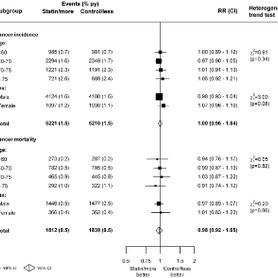
Individual records of 134,537 participants in 22 randomised trials of statin versus control (median duration 4.8 years). Reducing LDL-C with a statin for about 5 years had no effect on newly diagnosed cancer or on death from such cancers in the trials of statin versus control (cancer incidence: 3755 [1.4% per year [py]] versus 3738 [1.4% py], RR 1.00 [95% CI 0.96-1.05]; cancer mortality: 1365 [0.5% py] versus 1358 [0.5% py], RR 1.00 [95% CI 0.93–1.08])
In large-scale trials of statins to reduce the risk of cardiovascular disease among persons without cancer, statin use did not influence the incidence of cancer or related mortality.
Paper · PLoS One · 2012Lack of effect of lowering LDL cholesterol on cancer: meta-analysis of individual data from 175,000 people in 27 randomised trials of statin therapy.Conclusion: In 27 randomised trials, a median of five years of statin therapy had no effect on the incidence of, or mortality from, any type of cancer (or the aggregate of all cancer).journals.plos.orgStatin Use for the Primary Prevention of Cardiovascular Disease in Adults (2022)
Statins were significantly associated with decreased risk of all-cause mortality (risk ratio [RR], 0.92 [95% CI, 0.87 to 0.98]; stroke (RR, 0.78 [95% CI, 0.68 to 0.90]; , myocardial infarction (RR, 0.67 [95% CI, 0.60 to 0.75]; , and composite cardiovascular outcomes (RR, 0.72 [95% CI, 0.64 to 0.81].
Statin therapy was not significantly associated with increased diabetes risk overall (RR, 1.04 [95% CI, 0.92 to 1.19]), although 1 trial found high-intensity statin therapy was significantly associated with increased risk (RR, 1.25 [95% CI, 1.05 to 1.49]).
In adults at increased CVD risk but without prior CVD events, statin therapy for primary prevention of CVD was associated with reduced risk of all-cause mortality and CVD events. Benefits of statin therapy appear to be present across diverse demographic and clinical populations, with consistent relative benefits in groups defined by demographic and clinical characteristics.
Paper · JAMAJAMA articlejamanetwork.com