(no text — see the shared post below)
Alcohol has become a controversial topic in regards to CVD.
————-
We will finally see a large long-running randomized controlled that directly tests alcohol (red wine) verses cardiovascular disease.
The study will run for 5 years, and also report on secondary endpoints of cancer and all-cause mortality. And it will be run in the same style as the famous PREDIMED trial that tested a Mediterranean diet vs CVD. In fact, it will be run by the same principle investigator as PREDIMED.
Given the people involved, this should be a very high quality trial. It will finally give us the truth on alcohol and health, whatever that may be.
↪ New 5-year RCT from the PREDIMED lead investigator will test red wine versus CVD
————-
In the meantime, I drink a glass of red wine several days per week.
Why do I do this?
Because there is now good evidence from the PREDIMED randomized controlled trial that mild red wine consumption enhances the cardio-protective effects of a traditional Mediterranean diet. People in PREDIMED with blood levels of a marker of red wine consumption reflective of mild to moderate consumption had 50% less risk than people with near zero levels.
↪ PREDIMED follow-up: urinary tartaric acid links mild-moderate wine to HR 0.5 for CVD
In fact, almost all the high quality studies showing a protective effect of a traditional Mediterranean diet against CVD included mild consumption of red wine. The diet might not work as well without the wine.
↪ Four long-term RCTs show the Mediterranean diet cuts CVD death by 46% in aggregate
↪ Meta-analysis of 4 Mediterranean diet RCTs: MACE down 48%, CVD death down 46%
There are over 100 prospective studies that associate mild alcohol consumption with reduced risk of CVD. It is associated with a 25-40% risk reduction in aggregate from all these studies, which is very large. So while alcohol may have become controversial amongst influencers and clinicians, the best epidemiologists at the Harvard School of Public Health are still convinced that it likely reduces risk for CVD.
↪ Harvard: 100+ cohorts show 25-40% lower CVD risk with light-to-moderate alcohol
Red wine is probably the best choice.
↪ Harvard epidemiologists consider red wine the best choice if you drink moderately
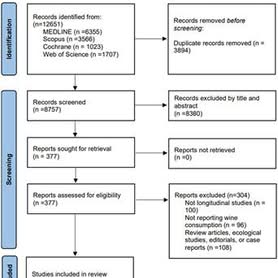
One reason why is because red wine does not seem to raise cancer risk as much as other types of alcohol, especially when consumed mildly. In fact, in mild amounts, it may not raise cancer risk at all, and might even be protective against some types of cancer. This evidence is observational, so it must be taken with a grain of salt— but it is the best that we have so far specifically on red wine.
↪ Meta-analysis of 76 studies finds no link between wine drinking and cancer risk
↪ Meta-analysis of 4.3 million: moderate wine not linked to higher overall cancer risk
The reason that alcohol has become controversial with regards to CVD is because of a couple recent Mendellian randomization studies which claim to show no protective effect. However, there are major problems with using Mendellian randomization to study alcohol and CVD, as explained in the paper below. The authors are faculty at Harvard Medical School and the Harvard School of Public Health.
Paper · Eur J Epidemiol · 2020Genetic instrumental variable analysis: time to call mendelian randomization what it is. The example of alcohol and cardiovascular diseaselink.springer.com
For those of you who put a lot of weight on lifespan studies in mice: Alcohol (light to moderate amounts) extends lifespan in mice in multiple studies.
This is not surprising, given that it is a potent inhibitor of mTOR and an activator of FOXO3.
PaperScienceDirect articlesciencedirect.com
↪ New 5-year RCT from the PREDIMED lead investigator will test red wine versus CVD