(no text — see the shared post below)
People with high Lp(a)— who also have a large amount of visceral fat— appear to be at much higher risk of ASCVD than those with high Lp(a) but with little visceral fat.
This is the latest result from the on-going MESA prospective cohort study.
Waist-to-hip ratio (WHR) is a good measure of visceral fat, and a decent proxy for liver fat.
People with Lp(a) > 50 mg/dL and WHR > 90th-percentile were at a whopping 2.34x greater risk of ASCVD than people with Lp(a) < 50 mg/dL and WHR < 90th percentile.
People with Lp(a) > 50 mg/dL and WHR > 66th-percentile were at 1.6x greater risk.
This increased risk mostly disappeared when WHR was low.
If you have high Lp(a), one of the most important things you can do is lose visceral fat, and clear the fat from your liver.
Losing visceral fat likely reduces the risk of heart attack and stroke in people with high Lp(a). The resulting reduction in risk may be large, as these latest results from the MESA study suggest.
Please remember that MESA is a prospective cohort study and not a randomized controlled trial. You cannot draw causality from this. Well done prospective cohort studies like MESA can only hint at causality, when interpreted in the context of the overall existing body of past research as a whole. They cannot prove causality.
Quoted:
“In MESA, WHR [Waist to Hip Ratio] significantly modifies the risk of ASCVD associated with Lp(a). On the contrary, BMI did not modify the Lp(a)-associated ASCVD risk. Measures of abdominal adiposity, such as WHR, rather than general adiposity, may further refine the cardiovascular risk in individuals with elevated Lp(a). Further studies are needed to explore this interrelationship and validate these findings.”
“In contrast, the combination of elevated Lp(a) ≥50 mg/dl and WHR ≥90th pct was associated with ASCVD risk (HR, 2.34, 95 % CI: 1.61–3.40). Lp(a) ≥50 mg/dl was not significantly associated with ASCVD risk in the 1st and 2nd tertile of WHR (HR, 1.06, 95 % CI: 0.72–1.48 and HR, 1.08, 95 % CI: 0.79–1.48, respectively). However, Lp(a) ≥50 mg/dl was significantly associated with ASCVD risk in the highest tertile of WHR (HR, 1.60, 95 % CI: 1.23–2.09).”
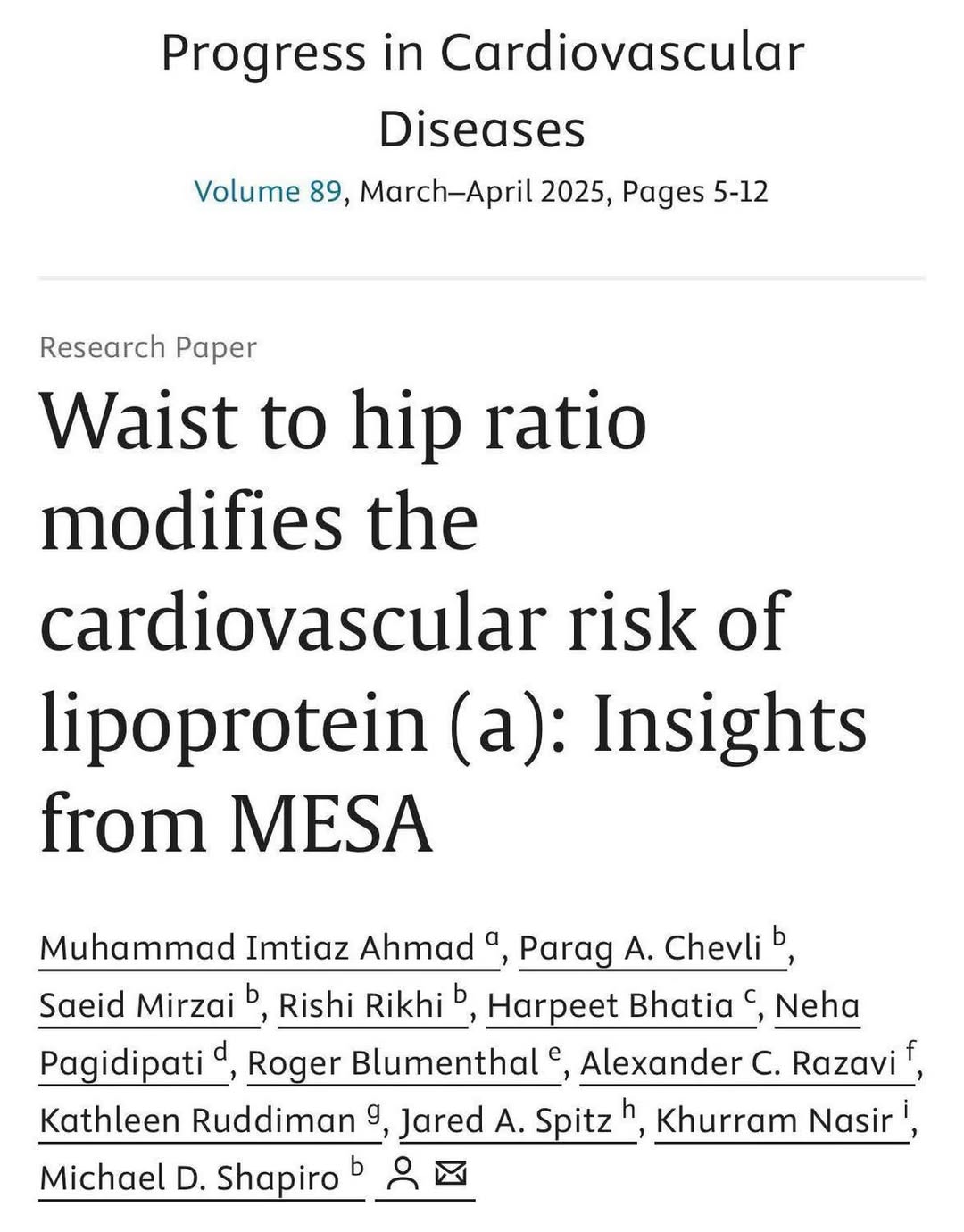
Paper · Progress in Cardiovascular Diseases · 2025Waist to hip ratio modifies the cardiovascular risk of lipoprotein (a): Insights from MESAsciencedirect.com
#mesaHD #lpaHD #visceralfatHD #liverfatHD #liverfatsummaryHD