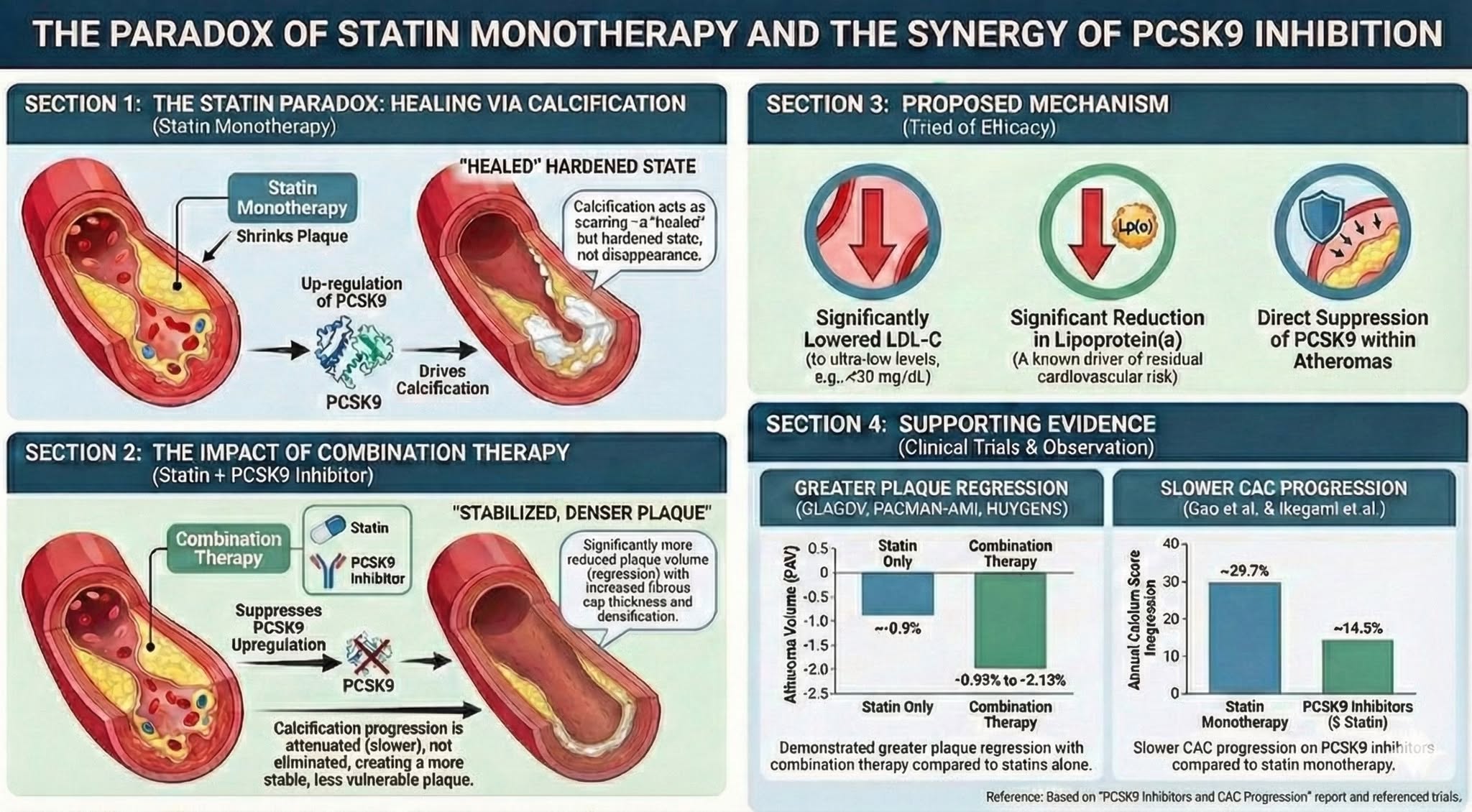
Statins and Arterial Calcification
Results of the recent CCTA PARADIGM study
With statins, there is a shift toward denser, more-calcified plaque on CT (which is lower risk), as well as a decrease in soft fibro-fatty and low-attenuation plaque (which is higher risk).
Please note that at least 6 randomized controlled trials have shown that statins decrease TOTAL plaque volume (soft+hard), even though they may be increasing calcified plaque in the short to medium term: ↪ Six statin trials cut total plaque volume 5-17%, with reversal below LDL-C of ~90 mg/dL.
Quoted:
Statin therapy in patients with atherosclerotic cardiovascular disease (ASCVD) is associated with positive changes in the phenotype of coronary lesions, with data from a new study showing there is a shift towards more-stable, calcified lesions and less higher-risk plaque.
In an analysis of patients undergoing serial coronary CT angiography (CTA), there were larger decreases in the amount of low-attenuation and fibro-fatty plaques, which are associated with adverse outcomes, with versus without statin use, as well as larger increases in dense and very dense calcified plaques.
What is evident in the statin-treated patients, said lead investigator Alexander van Rosendael, MD (Leiden University Medical Center, the Netherlands), is a “more-rapid transformation of soft plaque into the very dense calcium” and a lower progression of coronary plaque with increasing density.
Stephen Nicholls, MD, PhD (Monash University, Melbourne, Australia), who has studied the regression of coronary plaques on IVUS, praised the new analysis, stating that it clearly shows statins promote the stabilization of coronary plaque. “They do that not only by shrinking plaques, but by promoting an increase in calcification,” said Nicholls. “They have nicely shown how that progresses from a density perspective. It extends the observations made with IVUS, but we never had the ability to look at calcium in the way that CT can and that is an important advance.”
Quoted:
Past studies have shown that the burden of atherosclerosis in the coronary tree is a strong predictor of future coronary events, said van Rosendael, but refining the risks associated with different components of coronary plaque is currently an important area of research. “We know that there are different compositions of the plaque,” he said. “There is calcified and noncalcified plaque, and it looks like the calcified part of the plaque does have less prognostic value than the noncalcified plaque.”
For example, studies have shown that low-attenuation plaque on CTA strongly predicts future events, such as MI. In SCOT-HEART, low-attenuation plaque was a better predictor of future events than other commonly used measures, such as a cardiovascular risk score, coronary artery calcium (CAC), Agatston units, and presence of obstructive coronary artery disease. On the flip side, van Rosendael previously showed that the presence of very dense coronary plaque, dubbed 1K plaque (> 1,000 Hounsfield units), was associated with a lower risk of ACS.
“As it becomes denser and denser, this type of plaque carries less risk,” said van Rosendael. “We know that statins reduce the risk of heart attacks—that’s been proven many, many times—so we wanted to know whether statins increase the good plaque, the very dense calcium, and decrease the very-high-risk plaque.”
Quoted:
If we look at the lesions not treated with statins, we see that all six components of the coronary plaque increase,” he said, referring to low-attenuation, fibro-fatty, fibrous, and low-, high-, and very-high-density calcium (1K) plaque components. On the other hand, there was a bit of a “seesaw” effect seen in the statin-treated patients, whereby the decreases in low-attenuation and fibro-fatty plaque were offset by increases in high-density and 1K plaque.
That seesaw-like transformation isn’t one to one, said van Rosendael, because the overall plaque progression is slower in the statin-treated patients. For patients treated with statins and those who were not, coronary lesions with a higher proportion of calcium showed less overall plaque progression (β -0.003; P < 0.001 for both groups).
“If the plaque is mainly composed of very dense calcium, then it’ll progress less in total volume,” said van Rosendael. “If it’s 90% dense calcium, for example, it doesn’t progress on the next CT scan. It’s like a rock that doesn’t grow.”
Quoted:
For patients undergoing CAC screening, the new data can help refine how best to assess patient risk.
In patients treated with statin therapy, or other lipid-lowering agents, serially measuring CAC might reveal evidence of calcified plaque progression which does not reflect increased patient risk but rather a stabilization of the coronary plaque.
 TCTMD.comStatins Positively Alter Coronary Plaque CompositionWith statins, there is a shift toward denser, more-calcified plaque on CT, as well as less fibro-fatty and low-attenuation plaque.tctmd.com
#statinreverseHD #statinscacHD #statinsHD #cacHD #paradigmHD