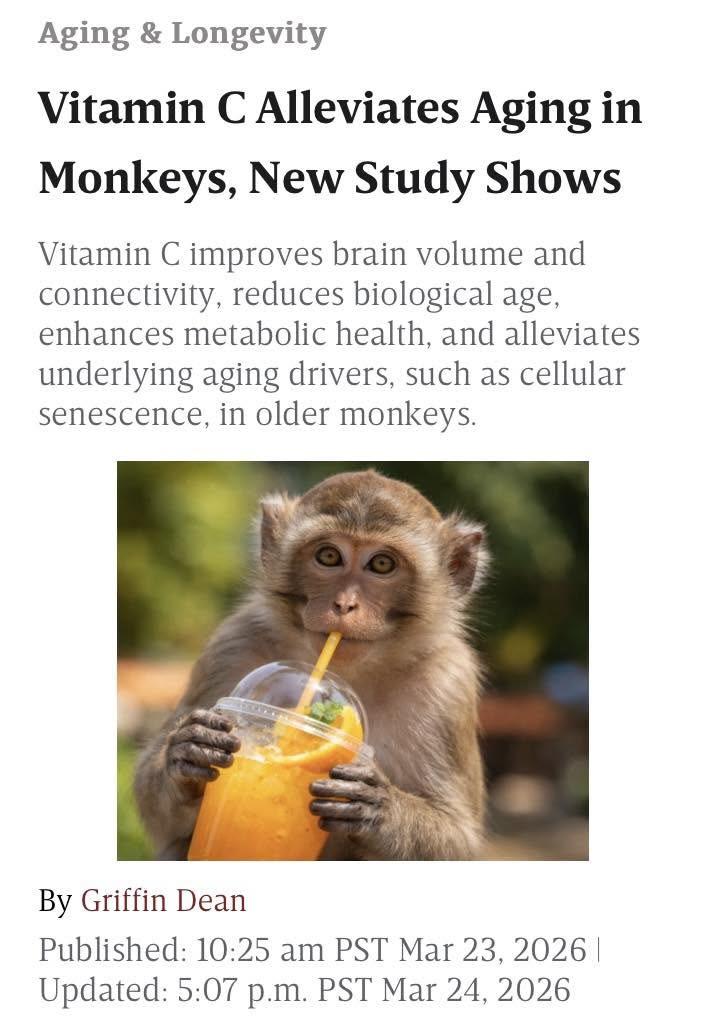
Vitamin C supplementation slows aging of bone marrow stem cells in primates.
This 3+ year trial in aged cynomolgus monkeys was just published:
Paper · Cell Stem Cell · 2026Vitamin C attenuates primate bone marrow aging at the molecular and progenitor levelsciencedirect.comAs we’ve talked about before, decline in function of hematopoietic and mesenchymal stem cells in the bone marrow with advancing age plays an important role in the etiology of multiple diseases, including heart disease, and the aging process itself.
Quoted:
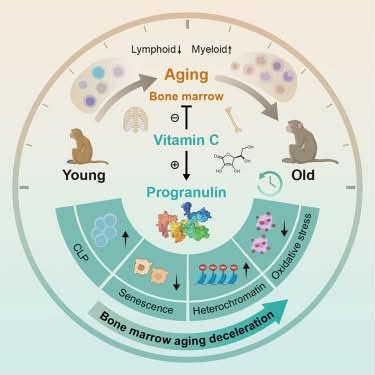
“Bone marrow aging compromises hematopoiesis and immunity, yet whether these processes are modifiable in primates remains unexplored. Here, we map the single-cell transcriptomic landscape of primate bone marrow aging and demonstrate that long-term oral vitamin C (VC) supplementation attenuates selected molecular and progenitor-level decline. Aging drives severe common lymphoid progenitor (CLP) depletion, myeloid-biased hematopoietic stem and progenitor cell (HSPC) output, and anatomical site-specific molecular adaptations. VC administration partially offsets these phenotypes, expanding the CLP pool and rebalancing lineage commitment trajectories. This aligns with a ∼4-year reduction in transcriptomic age estimates, cross-validated by an epigenetic clock.”
“Highlights: Multi-site single-cell mapping reveals conserved and site-specific primate bone marrow aging. VC [vitamin C] restores CLP pools and corrects myeloid bias in aged primate bone marrow. VC reduces the transcriptomic and epigenetic age of bone marrow. Progranulin mediates VC’s protective effects against hematopoietic aging.”
“Identifying strategies to mitigate bone marrow aging is therefore a critical priority for healthy longevity. Vitamin C (VC, L-ascorbic acid), an essential micronutrient, functions as a cofactor for dioxygenase enzymes, including the TET family of epigenetic regulators [71,72,73,74,75,76]. Notably, systemic VC levels tend to decline with age. In humans, although a plasma VC concentration of ≥0.4 mg/dL is clinically considered the normal threshold [77], many elderly individuals fall below this level due to reduced dietary intake, impaired absorption, or increased metabolic demand under chronic inflammation [78,79,80]. Because humans and non-human primates cannot synthesize VC endogenously [71,81], non-human primates represent suitable preclinical models for evaluating VC's potential effects on the hematopoietic system [31,82,83,84,85]. Parallel advances in biological age clocks, which integrate molecular profiles to estimate biological aging, offer valuable tools for evaluating tissue-specific aging rates and intervention-associated changes [86,87,88,89]. Yet, fundamental questions persist. Can long-term VC supplementation attenuate molecular aging in distinct primate bone marrow niches? What are the underlying mechanisms? And can a molecular clock quantify such effects?
To address these questions, we conducted a 3.3-year longitudinal study of oral VC intervention in aged cynomolgus monkeys, comparing rib and femur marrow to capture site-specific dynamics. We profiled molecular and progenitor-level alterations across skeletal compartments and examined the effects of VC intervention. Our findings indicate that prolonged oral VC supplementation attenuates age-associated molecular and progenitor-level decline in HSPCs, partially offsets lineage-differentiation bias, and modifies regulatory networks and intercellular communication.”
“Here, we combined a prolonged oral VC [vitamin C] regimen in non-human primates with deep single-cell transcriptomic mapping of anatomically distinct bone marrow compartments to investigate aging-related molecular adaptations. We observed that VC supplementation was characterized by a partial mitigation of aging-associated compositional dysregulation, including higher observed CLP frequencies, and correlated with lowered biological age predictions at both transcriptomic and epigenetic levels.”
#vitamincHD #stemcellsHD #hematopoiesisHD #hscHD #mscHD #agingHD #longevityHD