I’ve written about Lp-Pla2 and MPO before, and about issues with using hsCRP to measure inflammation.
See these posts:
↪ hsCRP is not artery-specific: aging skin and visceral fat drive it in older people
↪ Eight facts about CRP and hs-CRP: systemic inflammation, repeat testing needed
The problem with hsCRP is that it is very noisy, and it is not specific to arteries alone. Even so, it is a good predictor of risk if you take multiple measurements over a longer period of time and average them. This averages out the noise.
In principle, Lp-Pla2 and MPO give an indication of inflammation specifically inside arteries. The problem (as Dayspring notes below) is that they are not very good at predicting risk.
GlycA might end up being the most useful inflammation marker of them all… because it predicts risk very well, but does not require averaging like hsCRP.
For those who are unfamiliar:
GlycA stands for Glycoprotein Acetylation. When your body has ongoing inflammation, your immune system produces more of these specific sugar-coated proteins.
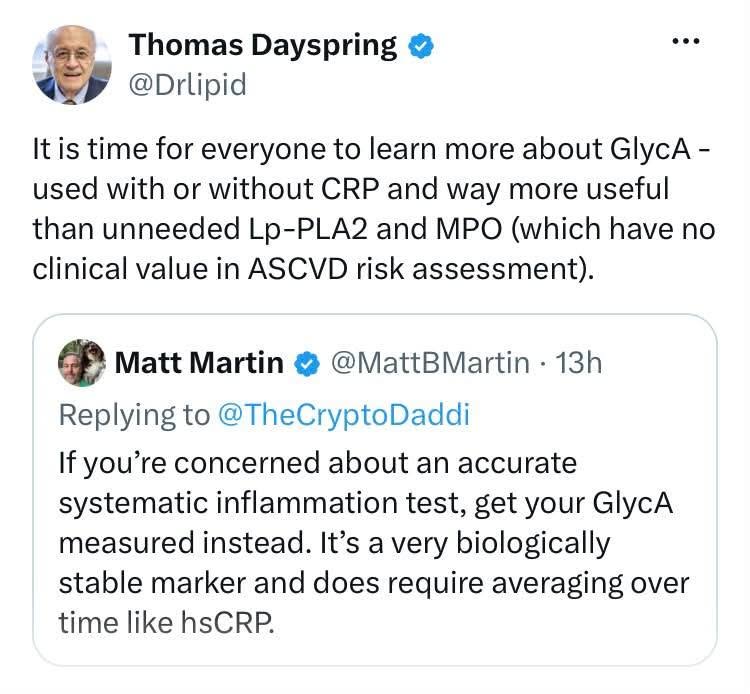
GlycA is an inflammatory blood marker that acts like a dashboard, summarizing multiple inflammatory signals in the body at once, rather than just looking at a single marker like hsCRP. It uses nuclear magnetic resonance (NMR) technology to measure a composite signal of inflammatory proteins in the bloodstream. Unlike hsCRP, which fluctuates wildly from minor things like a hard workout or a cold, GlycA is very stable over time. This means a single GlycA test provides an accurate, low-noise picture of your chronic inflammatory-driven cardiovascular risk without requiring you to repeat and average multiple blood draws.
Link to Tom Dayspring’s original tweet:
Post on X · Thomas DayspringThomas Dayspring on XIt is time for everyone to learn more about GlycA - used with or without CRP and way more useful than unneeded Lp-PLA2 and MPO (which have no clinical value in ASCVD risk assessment). https://t.co/axsppC3bnix.com#inflammationHD #hscrpHD #lppla2HD #mpoHD #glycaHD #dayspringHD