A standard lipid panel reports total cholesterol, LDL cholesterol, HDL cholesterol and triglycerides. It is the cornerstone of heart disease risk assessment, but the group's admins argue it is only the starting point.1 Gokhan Can's own baseline list adds ApoB, Lp(a), hsCRP, glucose and insulin markers, a basic metabolic panel, a complete blood count, thyroid, vitamin D and hormones, and he stresses that it is "not meant to be exhaustive."1
The most commonly recommended additions are ApoB (a count of the dangerous cholesterol-carrying particles), Lp(a) (an inherited particle that standard panels miss), hsCRP (a marker of low-grade inflammation) and a set of tests for insulin resistance.12 Gokhan says his own doctors rarely order tests such as hsCRP, ApoB, insulin and cystatin C, so he orders them himself.3
This summary explains what each test measures, the ranges the group quotes, the limits of each, and a few tests the admins consider poor value. It is educational, not medical advice. The group's admins recommend discussing which tests make sense for you with your own doctor.
The main tests at a glance, with the ranges quoted in the group:
| Test | What it measures | Ranges quoted | Watch out for |
|---|---|---|---|
| ApoB | Number of atherogenic particles (LDL, VLDL, Lp(a))9 | under 100 mg/dL if healthy, under 80 at higher risk2 | Not required for everyone; most useful for borderline-risk statin decisions and intensifying treatment10 |
| Lp(a) | An inherited, about 90% genetic particle2 | generally under 75 nmol/L; test once2 | Units differ (nmol/L, mg/dL), so check your report211 |
| hsCRP | Low-grade inflammation, made by the liver in response to IL-612 | under 1 mg/L lower, 1 to 3 average, over 3 higher relative risk5 | Not specific to arteries; colds, vaccines and hard exercise raise it712 |
| HbA1c | Average blood sugar over about three months2 | under 5.7%; a creep from 5.1 to 5.5 is a red flag2 | Stays normal for years while insulin resistance builds13 |
| Fasting insulin and HOMA-IR | Insulin resistance; HOMA-IR is calculated from fasting glucose and insulin2 | HOMA-IR under 1.0 ideal, over 2.0 resistance, over 3.0 frank resistance2 | An OGTT with insulin is the other early test13 |
| VLDL cholesterol (estimated) | Triglycerides divided by 514 | normal below 30 mg/dL14 | Rough estimate, most accurate when triglycerides are below 400 mg/dL14 |
Start with what the standard lipid panel does and does not tell you
Gokhan's list describes the lipid panel as the measure of the different types of cholesterol and fats in the blood, with high LDL and triglycerides and low HDL as the major risk factors.1 Two details help in reading it.
First, the LDL cholesterol (LDL-C) figure on a lab report is the amount of cholesterol, not the number of particles. Louis Nervegna uses a "boats and cargo" analogy: lipoprotein particles are the boats and cholesterol is the cargo. LDL particles and Lp(a) particles both carry LDL cholesterol, so the LDL-C on your report includes cholesterol carried by Lp(a). In people with very high Lp(a), a significant part of reported LDL-C actually comes from Lp(a).1516
Second, triglycerides are worth a close look even when LDL is low. Louis explains that VLDL cholesterol can be roughly estimated by dividing triglycerides by 5 (so triglycerides of 150 mg/dL give a VLDL of about 30 mg/dL), that a normal VLDL is below 30 mg/dL, and that the estimate is most accurate when triglycerides are below 400 mg/dL. He argues VLDL may be even more atherogenic than LDL, so someone with low LDL but high VLDL may still be at risk.14 Direct measurement is the most accurate way to learn VLDL, and the triglyceride-based estimate is a rough approximation.14
ApoB: counting particles instead of weighing cholesterol
What it is
ApoB is a protein "tag" on the particles that can deposit cholesterol in artery walls. LDL, VLDL and Lp(a) particles each carry one, so an ApoB test gives the total number of these atherogenic particles. Louis describes ApoB as a sign on the boat, not the boat or the cargo.9 Dr. Gil Carvalho, in a video Gokhan summarized, calls ApoB the "gold standard" for heart disease risk: LDL-C measures the weight of cholesterol, whereas ApoB measures the number of dangerous particles, so a low LDL can sometimes hide a high particle count.2
Ranges and when to test
The ranges quoted in that video are an ApoB under 100 mg/dL for healthy people and under 80 mg/dL for higher-risk people.2 Gokhan reports his own ApoB of 58 mg/dL alongside an LDL of 61 mg/dL on 5 mg of rosuvastatin.17
Gokhan also shared a summary of the National Lipid Association's Expert Clinical Consensus on ApoB testing. It describes ApoB as a more accurate predictor than LDL-C when the two diverge, particularly after statin treatment. It suggests testing for two situations: borderline-risk patients deciding whether to start a statin, and people already on treatment who are considering intensifying it. The consensus gives ApoB thresholds matching established LDL-C goals, and it says routine ApoB for everyone is not required and remains a matter of clinical judgment.10 Gokhan's list likewise says ApoB may be particularly useful in metabolic syndrome or diabetes, and describes the evidence only as "some studies suggest" it beats LDL-C.1
Can I calculate it from my lipid panel?
Louis says technically no. Non-HDL cholesterol (total cholesterol minus HDL) accounts for most ApoB-tagged particles, but it measures the amount of cholesterol rather than the number of particles. He gives a crude rule of thumb, ApoB roughly 0.7 times non-HDL cholesterol, and says a direct ApoB test is more accurate and also captures particles non-HDL misses.18
Cost
Louis points out that ApoB tests can be inexpensive if you shop around, citing one direct-to-consumer listing at $17.20 out of pocket.4
An example of why it matters
Two shared personal accounts from people on a ketogenic diet describe markers moving in different directions. One reports lower blood pressure, triglycerides, HbA1c, insulin and hsCRP over 15 years of keto, but LDL and ApoB that "skyrocketed" until ezetimibe was added.19 A second well-known low-carb figure described a panel with elevated ApoB and Lp(a) and very high LDL, with plaque on CT angiography.20 Both are anecdotes, but they show why tracking cholesterol markers alongside metabolic ones matters.
Lipoprotein(a): test it once
Lp(a) is a genetic variant of an LDL-like particle. The group's summaries say it is about 90% determined by genetics, barely changes with diet, and is high in about one in five people. A high level raises heart attack and stroke risk even when other cholesterol numbers look perfect. Carvalho's video says you typically need to test it only once in your life, and suggests a level generally under 75 nmol/L.2 Gokhan's list stresses that it is especially important for people with a family history of early heart disease.1 A promotional explainer shared in the group repeats the "20% of people" figure but offers no studies for it.21
For a test that standard panels rarely include, access can be a hurdle. Louis shared a non-profit that says it will send a free at-home Lp(a) test after an online form, though availability was not verified.22
How to read it
Lp(a) is reported in different units in different sources (nmol/L in the video, mg/dL in the MESA analysis and ng/mL in a ginger trial), so check the unit on your report before comparing with any threshold.21123
Louis highlights MESA findings suggesting that context matters. Over 13.6 years of follow-up and 684 cardiovascular events, high Lp(a) conferred no significant extra risk when hsCRP was below 2 mg/L. With hsCRP of 2 mg/L or higher, an Lp(a) of 50 to 99.9 mg/dL had a hazard ratio of 1.36 and 100 mg/dL or more had 2.09. The authors suggested that when either Lp(a) or hsCRP is high it is reasonable to check the other. Louis cautions that participants were lower-risk people with an average age of 62, so it is unclear whether this applies to younger or higher-risk people.11 He later summarized the same cohort's message as three things that seem to protect people with high Lp(a): a coronary artery calcium (CAC) score below 100, hsCRP below 2 mg/L and low visceral fat, with the warning that MESA is observational and "can NOT prove causality."242526
Show data
| Hazard ratio (log scale) | 95% CI | |
|---|---|---|
| Lp(a) 50–99.9 mg/dL | 1.36 | – |
| *Lp(a) 100 mg/dL or more | 2.09 | – |
One other warning concerns apparent changes in the number. Louis shared a member's very large Lp(a) drop after lifestyle changes but cautioned that such drops are rare and could simply be a lab error.27 A small ginger trial in 57 men with atherosclerosis reported an average Lp(a) fall of about 5 ng/mL from a low baseline of about 27, and Louis himself called the drop small.23
hsCRP: a useful but blunt inflammation marker
What it measures
C-reactive protein (CRP) is made by the liver in response to the signaling molecule interleukin-6 (IL-6). Louis explains that CRP and hsCRP are the same marker, with hsCRP simply more sensitive to the low levels relevant to heart disease.712 A 2025 American College of Cardiology scientific statement, as summarized in the group, calls hsCRP the most practical and best-validated inflammation marker and gives these bands: below 1 mg/L lower relative risk, 1 to 3 mg/L average, above 3 mg/L higher.5 It also recommends universal hsCRP screening alongside cholesterol assessment in primary and secondary prevention, notes that IL-6 and fibrinogen also predict risk, and says a CT-based perivascular fat attenuation index is promising but not yet routine.5
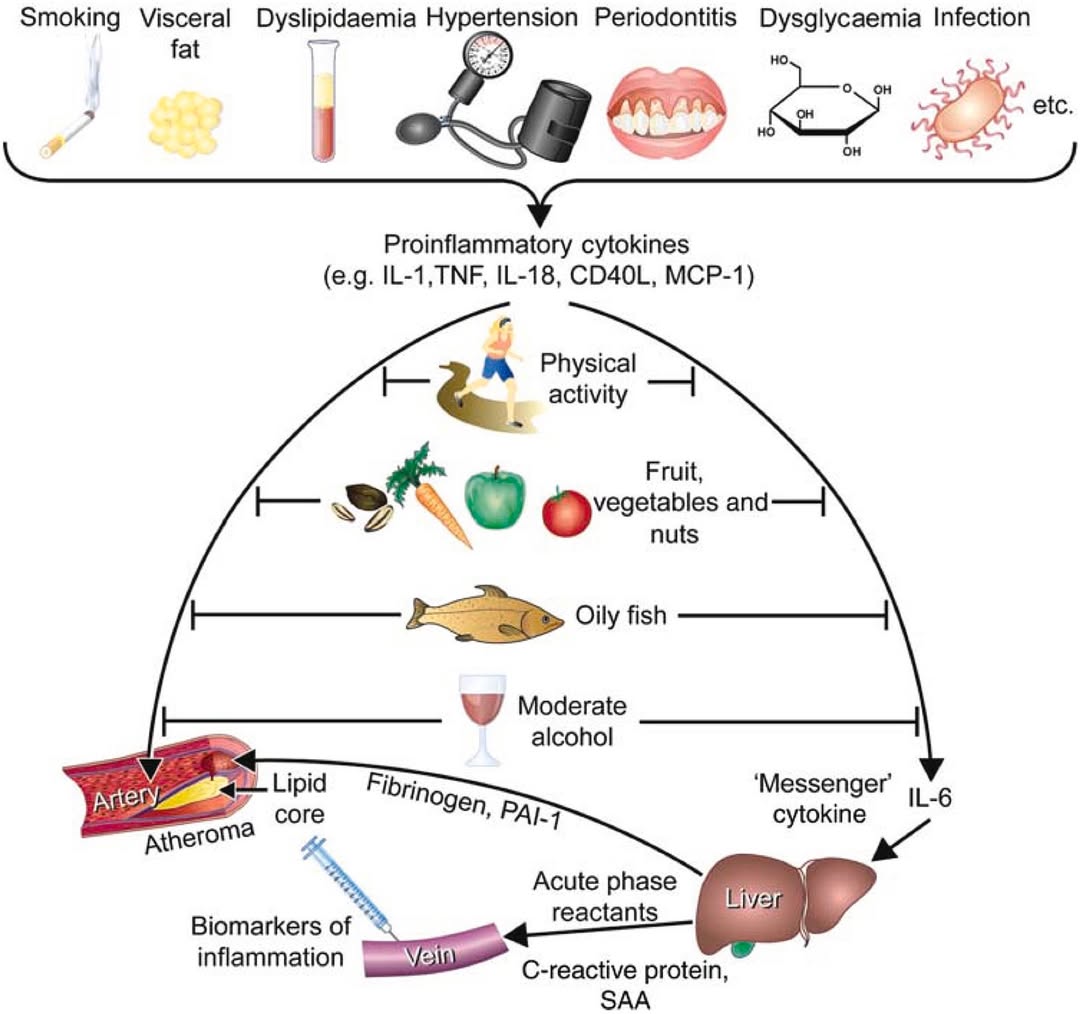
Evidence quoted in the same summary includes a prospective study of nearly 28,000 women in which a single baseline hsCRP separated risk more widely than LDL-C or Lp(a), and a meta-analysis of over 160,000 people in which each one standard deviation rise in hsCRP went with 37% higher coronary heart disease risk and 55% higher cardiovascular death risk.5 The statement also says hsCRP in patients with known cardiovascular disease is at least as predictive as LDL cholesterol, even on statin therapy.28 Louis quotes Paul Ridker making a similar point: people on a statin with low LDL "may still have inflammatory risk."29 Louis shared news coverage of the ACC recommendations too, with the line "Ask your doctor to be tested for this."30
Why one reading is not enough
hsCRP is a smoke detector, not a fire locator. Louis stresses several limits:
- It is not specific to the arteries. Hidden infection, a hard workout the day before or an arthritis flare can raise it as readily as a cardiovascular problem.7
- Colds, vaccinations, injuries, surgery, allergic reactions and intense exercise temporarily raise it, so he advises not testing during those periods, and he notes that day-to-day variation means a single value should not be relied upon.12
- In older people, aging skin and visceral (deep abdominal) fat are described as major drivers of "inflamm-aging." Louis notes this post was written with help from an AI tool.7
- Big drops in hsCRP after switching to carnivore, keto or vegan diets mostly reflect weight loss and loss of liver fat, in Louis's view, since opposite diets give the same drop when people lose weight.31
Can anything measure arterial inflammation specifically?
Louis says no commercial test isolates vascular-only inflammation. Lp-PLA2 and myeloperoxidase (MPO) can hint at it but are far from perfect and are not very good at predicting risk alone.712 He describes Lp-PLA2 as a marker of inflammation inside plaque, which several statins lower, with ezetimibe added lowering it further.32 MPO is an enzyme he says is released by immune cells in visceral fat and that commercial tests now exist for it.33 These are best seen as optional extras.
What lowers hsCRP
Louis shares meta-analysis data on average hsCRP reductions: statins 17.3%, bempedoic acid 20%, fibrates 10.3%, ezetimibe 3.2% and fish oil about 12.8%; he also lists PCSK9 inhibitors at 6%. The paper's own illustration, shared in the same post, shows PCSK9 inhibitors slightly raising hsCRP (about +6%) rather than lowering it, and the fibrate reduction as not statistically significant.34 A 2022 meta-analysis of 26 randomized trials found statins lowered hsCRP by about 0.97 mg/L in people with cardiovascular disease.35 In a bempedoic acid trial in statin-intolerant people, hsCRP fell 21.5%.36 The ACC statement also highlights lifestyle measures: at least 150 minutes a week of exercise, a Mediterranean or DASH diet and two to three fish meals a week.28 In the COSMOS trial's blood-marker analysis of 598 participants, cocoa extract lowered hsCRP by 8.4% per year compared with placebo.37
A caution about chasing the number
Louis previewed two trials that failed on outcomes. In ZEUS, a drug lowered IL-6 and hsCRP in people with cardiovascular and kidney disease but did not significantly reduce heart attack, stroke or cardiovascular death. The accompanying message was to want more than improved bloodwork before calling a treatment a success.8
Insulin resistance and blood sugar markers
Why fasting glucose is not enough
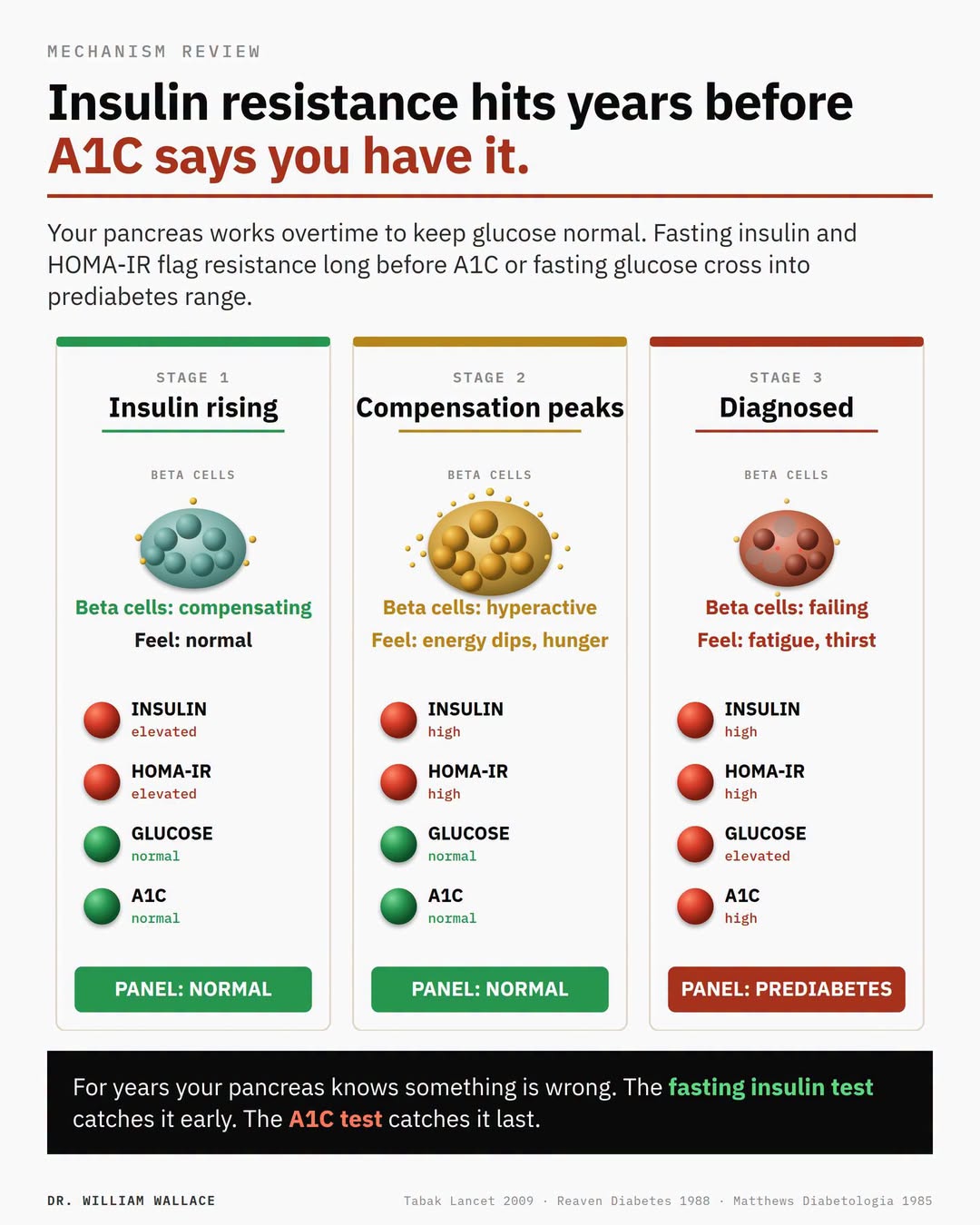
Louis shared an analysis of the Whitehall II cohort (6,538 civil servants, of whom 505 developed type 2 diabetes). HOMA insulin sensitivity was about 34% lower in the eventual cases across the entire 13-year window, while fasting glucose rose linearly from 13 to 3 years before diagnosis and then accelerated. The explanation given is that muscle, liver and fat lose insulin sensitivity and the pancreas compensates with extra insulin, so glucose and A1C stay normal for years.13 Carvalho's video makes the same point, saying the body can keep blood sugar "normal" for 10 to 15 years by overproducing insulin.2
The tests
- HbA1c reflects average blood sugar over about three months. Carvalho suggests under 5.7%, and says even a creep from 5.1 to 5.5 is a red flag within the "normal" range.2
- Fasting insulin and HOMA-IR. HOMA-IR is not a separate blood draw but a calculation from fasting glucose and fasting insulin. The video's ranges are ideally under 1.0, over 2.0 for insulin resistance and over 3.0 for frank resistance.2 Gokhan lists all of these together and notes some people get an oral glucose tolerance test instead of fasting insulin.1
- Two-hour OGTT with insulin. Louis names fasting insulin and a 2-hour oral glucose tolerance test with insulin at 30, 60, 90 and 120 minutes as the two tests that catch insulin resistance earliest.13
In his own story, Gokhan at 45 describes tracking a glucose target under 90 mg/dL and notes that he often has high fasting insulin and HOMA-IR despite good fasting glucose, which shows the two can diverge.38
Do not use a CGM as an A1C stand-in
Louis highlighted a study in which 153 children and adults without diabetes wore a masked continuous glucose monitor (CGM) for 10 days. The CGM-derived estimate (glucose management indicator) averaged 0.59% higher than lab HbA1c, enough to turn 5.1% into an apparent 5.7%. The authors said it should not substitute for HbA1c in people without diabetes.6
Kidney, blood count and other add-ons
Gokhan's baseline list includes a basic metabolic panel (kidney and liver function and electrolytes), a complete blood count, thyroid-stimulating hormone, vitamin D, and total testosterone and other relevant hormones.1 Gokhan's later labs show why a second kidney marker helps: his eGFR estimated from creatinine alone was near 100, but a combined creatinine-and-cystatin C estimate came out at 86.17 He lists cystatin C among the tests he orders himself.3 A promotional explainer shared in the group also lists UACR (a urine albumin-to-creatinine test) for early kidney changes, though it gave no studies.21
Charles Grashow's shared lab list shows what an enthusiast tracks: lipids, liver enzymes, glucose, insulin, A1C, uric acid, ferritin, hsCRP and 25-hydroxy vitamin D, plus clotting tests (INR, prothrombin time, aPTT) because he takes high-dose nattokinase.39 That is an individual's protocol, not a general recommendation.
Ferritin deserves a note. Louis advises that low-normal ferritin without symptoms is a reason to see a doctor to look for a source of iron loss, and that true iron deficiency or anemia should be corrected, but that in otherwise healthy, asymptomatic people he thinks extra iron is generally a bad idea.40
Imaging belongs on the list, too
Gokhan's list pairs the blood tests with one imaging study: a coronary artery calcium (CAC) CT scan or a carotid ultrasound for plaque, with "just one of the following" being sufficient.1 One keto practitioner's account describes choosing a radiation-free carotid intima-media thickness (CIMT) test as a baseline, noting that it needs a highly trained operator.19
Tests the admins consider poor value
- Desmosterol (Boston Heart). Louis argues it is a marker of cholesterol production being marketed to predict statin response and, wrongly, Alzheimer's risk. He says you can learn whether you respond to a statin simply by trying one, and that the literature suggests high, not low, desmosterol goes with greater dementia risk in healthy people.4142
- Commercial blood microplastics tests. Louis says they mostly measure contamination from the blood draw, transport and processing, because single-digit particle counts in 100 microliters would require a cleanroom and plastic-minimized lab.43
Interpreting and tracking your results
Beware "U-shaped" observational curves
Louis warns that observational charts often show a U-shape, where very low cholesterol, BMI, A1C or blood pressure seems to carry higher risk, and says the consensus explanation is reverse causality (illness itself lowers the number).44
Keep a log
Gokhan recommends putting all results in a dated spreadsheet, marking out-of-range values, and adding drugs and supplements and their doses to spot correlations.1 He shares his own markers at a high-risk baseline: LDL 70, HDL 45, triglycerides 79, total cholesterol 131 mg/dL, and hsCRP down from about 1.2 to 0.2.38
What this means for you
- Ask your doctor whether ApoB makes sense in your situation. The NLA consensus favors it for borderline-risk decisions about statins and for deciding whether to intensify treatment, but not routinely for everyone.10
- If you have never had Lp(a) measured, the group's usual advice is a one-time test, with extra importance for a family history of early heart disease.12
- If you test hsCRP, avoid doing so during an infection, after a vaccination, or after hard exercise, and consider repeating a high value.12
- If your fasting glucose and A1C are normal but you have risk factors, ask about fasting insulin, HOMA-IR or an OGTT with insulin.13
- Keep results in a dated spreadsheet and record your medications and supplements next to them.1
- Treat unproven or marketing-driven tests with skepticism, and judge treatments by outcomes, not by a single biomarker.84143
Frequently asked questions
Do I need all of these tests?
No. Gokhan describes his list as what he personally gets, not an exhaustive or required list.1 The ApoB consensus likewise says routine testing for everyone is not required.10
Is ApoB better than LDL cholesterol?
The group's sources say it can be more accurate, especially when ApoB and LDL-C disagree after statin treatment. They also say ApoB roughly tracks non-HDL cholesterol, so the two usually point the same way.1018
Why is my doctor not ordering hsCRP, ApoB or Lp(a)?
Gokhan says his doctors rarely do, which is why he orders them himself.3 The 2025 ACC statement, however, as summarized by Gokhan, recommends universal hsCRP screening.5 Bring the topic up with your doctor.
Can a high hsCRP tell me I have artery disease?
No. Louis says it flags inflammation anywhere in the body, and it can reflect infection, exercise, arthritis, skin aging or visceral fat.712
My HbA1c is normal. Am I in the clear on insulin resistance?
Not necessarily. In Whitehall II, insulin sensitivity was already lower many years before diagnosis while glucose and A1C looked normal.13
Can I rely on my smartwatch or CGM for these numbers?
For HbA1c, a study Louis shared found CGM estimates ran about 0.6% above lab values in people without diabetes.6