Spermidine Impacts Health and Longevity
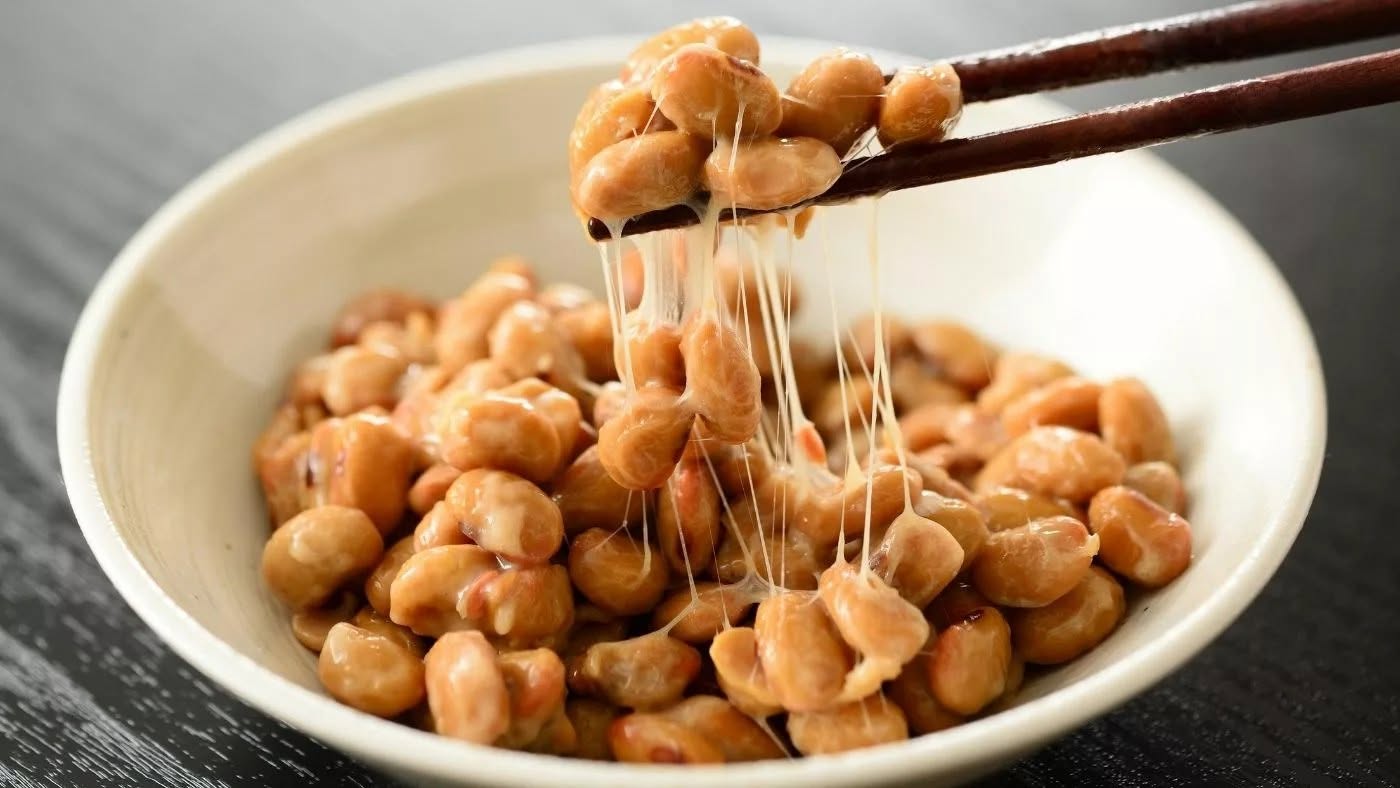
(You can eat Natto daily or consider a spermidine supplement like Double Wood)
These studies provide strong evidence that higher dietary intake of spermidine, a natural autophagy-inducing polyamine found in various plant and animal foods, is associated with reduced all-cause mortality and cognitive decline in humans, and extends lifespan and healthspan in animal models through enhancement of autophagy and mitochondrial function. Spermidine supplementation appears safe and well-tolerated in older adults. Certain foods like wheat germ, mushrooms, soy products and aged cheeses are among the richest dietary sources of spermidine.
- Mice age-associated drop in spermidine levels: Nishimura et al, 2006 found that tissue spermidine levels declined with age from 3 to 26 weeks in most organs of female mice, but were maintained in the pancreas, brain and uterus. They identified several polyamine-rich food sources including wheat germ, rice bran, black rice, green pepper, pumpkin, nuts, fermented foods, and organs/roe of certain animals.
- Mice lifespan increase: Soda et al, 2009 found that feeding aged mice chow with high polyamine content, especially spermidine, significantly extended median lifespan compared to those fed normal or low polyamine chow. Spermidine levels were 3.5-fold higher in the high vs normal polyamine chow. After 26 weeks, blood spermidine was ~50% higher in the high polyamine diet group. The high polyamine diet also reduced incidence of glomerulosclerosis and increased expression of the anti-aging protein SMP30.
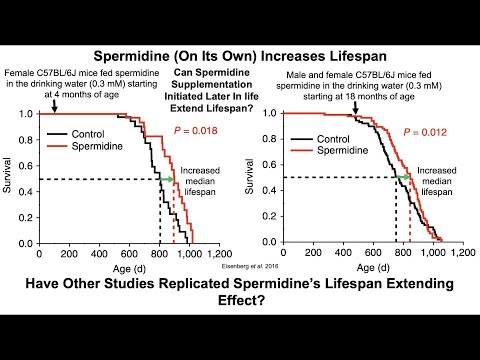
- Mice lifespan increase:Eisenberg et al, 2016 found that oral spermidine supplementation extended median lifespan and exerted cardioprotective effects in aged mice, reducing cardiac hypertrophy and preserving diastolic function. Spermidine enhanced cardiac autophagy, mitophagy, mitochondrial respiration, and improved cardiomyocyte mechano-elastical properties. In salt-sensitive rats prone to congestive heart failure, spermidine reduced blood pressure, increased titin phosphorylation, and delayed progression to heart failure.
- Mice lifespan increase: Yue et al, 2017 reported that lifelong spermidine supplementation in drinking water from birth extended median lifespan by ~25% in mice and reduced liver fibrosis and hepatocellular carcinoma induced by chemical insults in a MAP1S-mediated autophagy-dependent manner.
- Rats healthspan improvement: Filfan et al, 2020 reported that long-term spermidine supplementation in the drinking water of middle-aged male rats did not extend median or maximum lifespan, but had beneficial effects on body weight, kidney tubules, liver, heart morphology, reduced anxiety, enhanced curiosity and exploratory behavior, increased brain autophagy, and decreased inflammatory markers in the brain.
- Human reduced-mortality association: Kiechl et al, 2018 found that in a prospective population-based study of 829 individuals aged 45-84 years, higher dietary spermidine intake was associated with lower all-cause mortality over 20 years of follow-up. All-cause mortality rates across increasing spermidine intake tertiles were 40.5, 23.7 and 15.1 deaths per 1000 person-years. Each 1-SD higher spermidine intake was associated with a 24-26% reduction in all-cause mortality risk. The highest vs lowest tertile of spermidine intake was equivalent to a 5.7 year younger age. Higher spermidine intake was also associated with a ~70% reduced risk of future cognitive impairment.
- Human reduced-cognitive impairment association: Schroeder et al, 2021 showed that dietary spermidine passes the blood-brain barrier in mice and improves spatial learning and hippocampal mitochondrial respiration. In a Drosophila aging model, spermidine's cognitive benefits required Pink1 and parkin-mediated mitophagy. Large-scale prospective data linked higher spermidine intake with reduced risk of cognitive impairment in humans.
- Human dementia reduction (RCT): Pekar et al, 2020 found in a 3-month RCT of 85 nursing home residents aged 60-96 with dementia that wheat germ-enriched bread providing ~1 mg/day extra spermidine increased blood spermidine by 40% and improved cognitive performance, with MMSE scores increasing by 2.23 points in mild dementia subjects.
- Human dementia reduction (RCT): Wirth et al, 2018 reported in a 3-month RCT of 30 cognitively intact older adults with subjective cognitive decline that 1.2 mg/day spermidine supplementation moderately enhanced memory performance with medium effect sizes compared to placebo.
- Human safety (RCT):Schwarz et al, 2018 showed that 3 months of 1.2 mg/day spermidine supplementation was safe and well-tolerated in older adults with subjective cognitive decline, with no differences in vital signs, weight, clinical chemistry, hematology or self-reported health status compared to placebo. 28-day toxicity studies in mice found no morbidities, behavioral changes, or increases in tumorigenic or fibrotic events with spermidine supplementation.
- Best food sources: Kalac & Krausová, 2005 reviewed that the highest food sources of polyamines, especially spermidine, include wheat germ, soybean, natto, mushrooms, certain fruits and vegetables, aged cheeses, and meat products. Foods of plant origin typically have more spermidine than spermine, while the reverse is true for animal-derived foods. Polyamine contents can vary widely within food categories.
 ▶