How does dietary protein at midlife affect the odds of aging in a healthy way into old age?
A recent paper from the Harvard Nurses Study examined this question.
This is the first long term study to rigorously examine how protein consumption in middle age affects disease risk late in life.
Quoted:
“Consumption of total and animal protein was inversely (unfavorably) associated with the development of several chronic diseases, whereas the consumption of dairy and plant protein was favorably associated with this domain. Furthermore, we observed a modest favorable association between animal protein intake with the absence of physical function limitations, whereas the respective associations for plant protein were stronger and consistent across all statistical models. Additionally, plant protein intake was favorably associated with mental health status later in life. In our substitution analyses, we observed that animal protein intake was unfavorably associated with the incidence of chronic diseases when compared with calories primarily from carbohydrates (total, refined, or whole grain) or from total fat, SFA, MUFA, or PUFA. In contrast, isocaloric substitution of plant protein for animal or dairy protein, total or refined carbohydrate, total fat, or SFA were favorably associated with the odds of healthy aging, absence of chronic disease, good physical function, and good mental status.”
Note carefully:
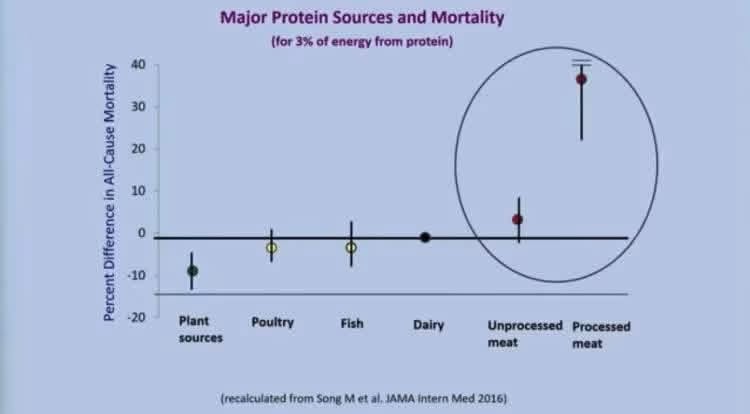
Consuming extra plant protein in midlife provided a very large benefit decades later. For every 3% increase of calories from plant protein which replaced either animal/dairy protein, fats, or carbohydrate, the odds of healthy aging increased by 22%-58%. (Note that the plant protein in this study came primarily from food, not protein powders/supplements.)
Quoted:
“In contrast, substituting 3% of plant protein energy was significantly associated with 22%–58% higher odds of healthy aging when replacing the equivalent calories from SFA, PUFA, MUFA, or animal or dairy protein (Figure 1 and Supplementary Table 4). Furthermore, isocaloric substitutions of plant protein for total carbohydrate, total fat, animal, or dairy protein were associated with higher odds of being free of chronic diseases.”
Paper · The American Journal of Clinical Nutrition · 2024Dietary protein intake in midlife in relation to healthy aging – results from the prospective Nurses’ Health Study cohortajcn.nutrition.org#proteinHD #animalproteinHD #plantproteinHD #hnsHD #agingHD #longevityHD #proteinsummaryHD #plantproteinsummaryHD