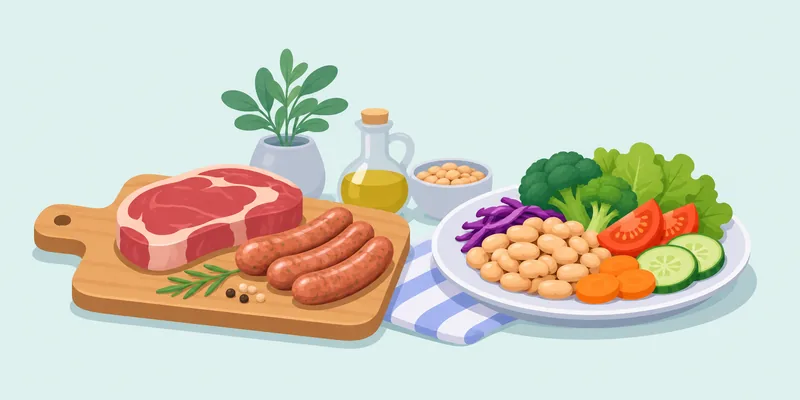
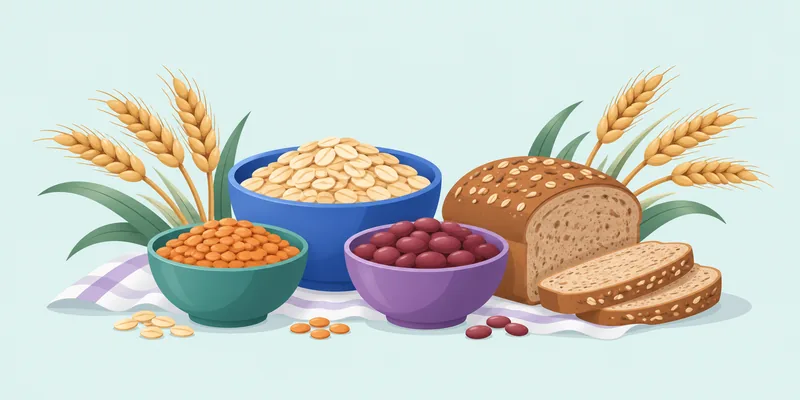
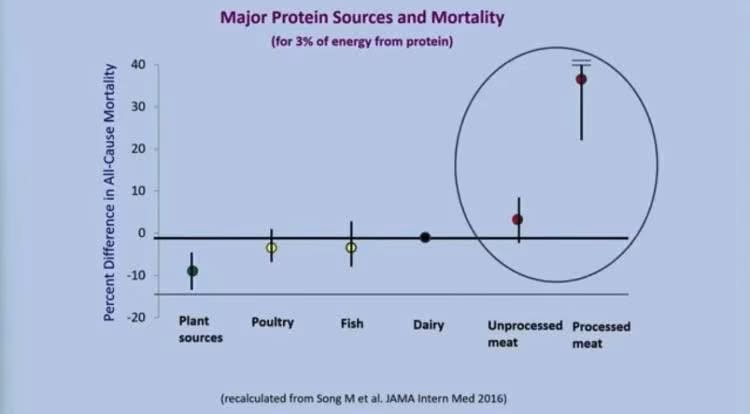
How much protein is optimal? Most of the group's evidence points to a surprising answer: for long-term health, which protein you eat matters more than how much. Large, long-running cohort studies find little relationship between total protein and mortality, but a clear split by source. Plant protein from whole foods looks protective, fish, poultry and fermented dairy are roughly neutral to slightly favorable, and red meat and especially processed meat look harmful.11011
The second half of the question is about insulin, IGF1 and aging. Protein is not "free" of insulin: some proteins, such as whey and beef, provoke a larger insulin response than some carbohydrates. Louis, one of the group's admins, argues that chronically high insulin, IGF1 and mTOR signaling may carry long-term costs, and that high-protein supplement trends are not backed by long-term outcome data. This is an inference from animal work and mechanisms, and other group posts disagree about how worried older adults should be.71012
Observational findings below show associations, not proven cause and effect.
What the long-term human studies show
Source beats amount
Louis's widely reshared summary of the Harvard Nurses' Health Study I and II and the Health Professionals Follow-up Study (nearly 300,000 people tracked prospectively for over 30 years, from midlife to old age) reads as follows:11516
- Plant protein is protective, with the largest benefit, coming mainly from legumes, nuts, seeds and whole grains rather than supplements.
- Fish and poultry confer a small benefit.
- Dairy and eggs are roughly neutral. Fermented dairy (yogurt, cheese) tends to show a small benefit and non-fermented dairy the opposite, so they cancel out.
- Unprocessed red meat modestly increases mortality; eating it once a week has little effect.
- Processed meat strongly increases mortality, worse than any other protein source. Louis notes that the plant protein benefit is nowhere near enough to cancel it out.
Louis notes that these results may not apply to protein powders or protein bars, because the plant protein in the studies came from whole foods.115 A related summary of over 200,000 people followed for about 30 years found the best heart outcomes in those with the highest plant-to-animal protein ratio, driven largely by replacing red and processed meat.17 Louis also says that among animal sources, seafood, poultry and fermented dairy have the lowest mortality and processed meat is worst by far.1118
Other cohorts and meta-analyses
- A 2020 BMJ systematic review and meta-analysis of 32 prospective cohorts (715,128 participants, 113,039 deaths) found higher total protein intake associated with slightly lower all-cause mortality (pooled effect 0.94). Plant protein was linked to lower all-cause mortality (0.92) and cardiovascular mortality (HR 0.88), and an extra 3% of energy from plant protein a day to 5% lower all-cause mortality. Total and animal protein were not significantly associated with CVD or cancer mortality, and the post notes the correlations overall were very weak.2
- A 2020 Rotterdam Study plus meta-analysis (European Journal of Epidemiology) found higher plant protein associated with lower all-cause (0.93) and CVD mortality (0.86) comparing highest to lowest intake. It concluded that total protein intake is positively associated with all-cause mortality, mainly because of a harmful association of animal protein with CVD mortality.18
- A 2026 large cohort in the European Journal of Nutrition reported 35% lower all-cause mortality with the highest plant protein intake, and no significant association for animal protein. The shared summary cautions that this likely reflects whole plant foods such as grains, legumes and vegetables rather than a special effect of plant protein itself.19
- In Nurses' Health Study analyses of midlife protein, plant protein was favorably associated with healthy aging. Replacing 3% of energy with plant protein from fats, carbohydrate, animal or dairy protein was linked to 22-58% higher odds of healthy aging, and the plant protein came mostly from food rather than powders.20
- In older women in the Nurses' Health Study, higher plant protein, but not animal or dairy protein, was linked to lower frailty. Replacing 5% of energy from animal, dairy or non-dairy animal protein with plant protein was associated with 38%, 32% and 42% lower frailty risk.2122
Show data
| Pooled hazard ratio / effect size (log scale) | 95% CI | |
|---|---|---|
| Total protein, all-cause death (BMJ) | 0.94 | 0.89–0.99 |
| *Plant protein, all-cause death (BMJ) | 0.92 | 0.87–0.97 |
| *Plant protein, cardiovascular death (BMJ) | 0.88 | 0.80–0.96 |
| Plant protein, all-cause death (Rotterdam meta-analysis) | 0.93 | 0.87–0.99 |
| Plant protein, cardiovascular death (Rotterdam meta-analysis) | 0.86 | 0.73–1.00 |
Why total protein looks neutral
Responding to a Stuart Phillips post that the human data show little link between total protein and mortality, Louis agreed but added that the neutral total hides two opposite effects: extra plant protein is linked to lower mortality and excess animal protein to higher mortality, so they cancel.10 Phillips's shared post goes further: across hundreds of thousands of people total protein shows basically no link to early death, and in adults over 65 eating too little protein is the real risk. It also points out that most "lives longer" results for protein restriction come from mice, rats and flies.10 The two views differ in emphasis but overlap on one point: the amount is not the main driver.
Harvard and official guidance
The Harvard Nutrition Source, quoted by Louis, says the protein "package" matters more than the amount. Replacing red and processed meat with beans, soy, nuts, fish or poultry seems to reduce the risk of heart disease and premature death, partly because plant proteins are more unsaturated and cholesterol-free.2324 Louis adds that poultry, eggs and some cheese are acceptable better choices, and that the US 2025-2030 guidelines committee is emphasizing plant protein, partly on the strength of the Nurses' Health Study papers.2325 A summary of an NYT article that Gokhan shared likewise advises prioritizing protein, especially from plants, while adding his caveat that reverse causality and confounding are ever present in observational diet studies.26
Willett himself, quoted in the Washington Post, says a total protein range of about 12 to 20 percent of calories is okay, that pushing higher, especially with supplements, is not necessary and has potential long-term hazards, and that protein helps if it replaces refined starch or sugar but not if it replaces whole grains and healthy fats.27
A 2026 cohort and the "protein craze"
A 2026 cohort study (Journal of Nutrition, Health and Aging) reported higher cardiac risk with high protein intake in adults over 55. Louis says that alone would not move him, but it matches the Harvard data in which more high-quality animal protein from midlife onward went with higher CVD risk. He points out that high animal-protein diets have never been properly tested as a treatment for CVD, whereas large randomized Mediterranean diet trials show a mostly plant-based pattern with some seafood and yogurt is safe for the heart.8 He also argues that the United States already eats the most high-quality protein of any major region, yet has high rates of heart disease, cancer, sarcopenia and frailty, so there is no "protein emergency" there. This is an ecological argument without cited studies.28
The insulin question
What the insulin studies show
Insulin is a hormone that moves nutrients into cells, and glucose is a sugar. A continuous glucose monitor (CGM) measures glucose only, so it says nothing directly about insulin.629 Louis stresses that protein also triggers insulin because insulin helps drive amino acids into muscle, just as it does glucose.2930
The studies he cites:
- The 1997 insulin index paper compared insulin responses to 1000-kJ (240 kcal) portions of 38 common foods. Louis highlights that beef raised insulin more than equal calories of white pasta or oatmeal.531
- A 2012 Nutrition & Metabolism study found whey raised insulin more than equal calories of white bread or pure glucose, apparently by raising certain amino acids, GIP and GLP-1. Louis describes roughly twice the insulin response of glucose or white bread in that study.530
- Nilsson 2004 (12 healthy volunteers, carbohydrate-matched meals) found whey produced a 90% higher insulin response but 57% lower glucose response than white bread, tracking plasma amino acids such as leucine, valine, lysine and isoleucine. This was shared by another member and cited by Louis.32
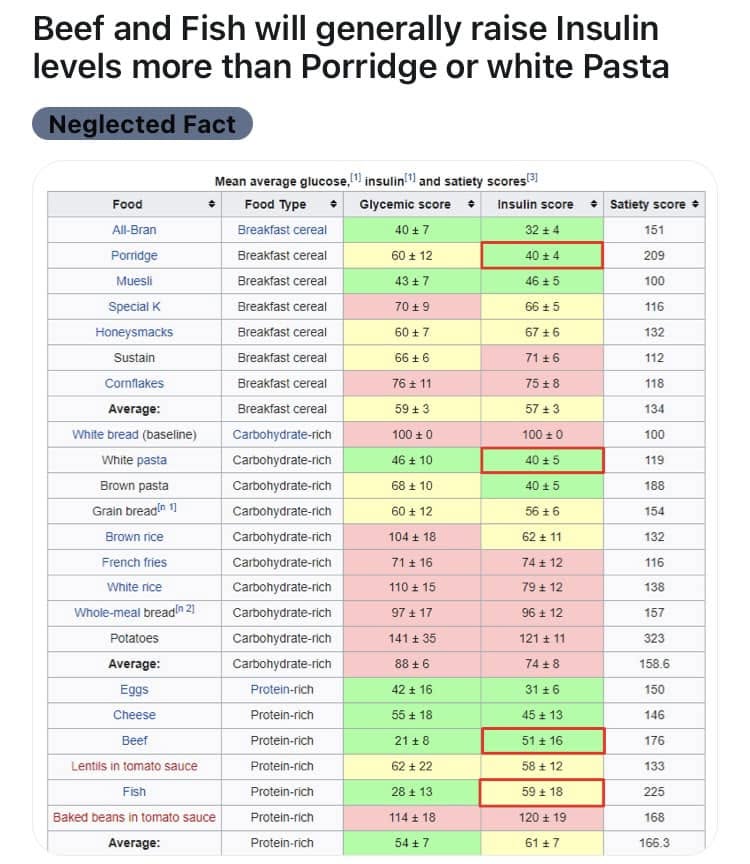
Louis draws a practical point: lowering a glucose spike by adding protein, for example whey with fruit, works because the pancreas makes more insulin, so a CGM-guided swap may raise insulin after meals.633 He adds that oatmeal has a lower insulin index than red meat or whey, and that fat is the only macronutrient that does not significantly raise insulin.343536 A related post notes that all macronutrients stimulate insulin, with carbohydrate usually producing the largest and fastest response.37
Why Louis considers it important
Louis argues that chronically elevated insulin promotes growth pathways (IGF1 and mTOR) linked to cancer, heart disease and faster aging, and that lowering insulin/IGF1 extends lifespan in animals. His human evidence is Laron syndrome, a genetic condition with very low IGF1, in which no cancer death has been documented, diabetes is almost absent and heart disease and Alzheimer's are lower.353839 He also argues insulin keeps liver cholesterol production active, one reason insulin resistance goes with high LDL, although he says protein also raises glucagon, which partly offsets this; the protein part of this argument is his inference.40 He agrees persistently high insulin is likely causal in CVD, and uses this to argue a small aspartame insulin effect in humans is less concerning than whey or red meat.41
Whey, supplements and IGF1
Louis says Willett shares his concern that processed whey and other powders may raise long-term cancer risk by raising insulin and IGF1. The quoted passages from Willett's 2017 book say protein supplements without exercise add little muscle, and that the branched-chain amino acids (leucine, isoleucine, valine) turn up IGF1, which in excess raises the risk of breast, prostate and probably other cancers.742 In the Washington Post, Willett said he is "particularly concerned about adding protein supplements, such as whey protein, which has a strong effect on cell multiplication."27
Louis is open about the limits. He says whey has short-term benefits (including a randomized trial in which 12 g of whey for six months added almost a centimeter to children's height), but there is virtually no long-term data on whey in large prospective cohorts, and the consequences of using it for decades are "completely unknown."732 He contrasts it with yogurt, which has consistent long-term epidemiology and was encouraged in the Lyon, PREDIMED and CORDIOPREV trials; if you include dairy protein, he says, science favors yogurt over other options.9
Counterpoints
Not every source treats high insulin from protein as dangerous. Sabatini, in an interview Louis summarized, thinks mTORC1 senses total daily insulin rather than spikes, that a diet of low-glycemic carbohydrate keeps both amino acids and insulin low, and that a little more protein is probably good for older people. He stresses nobody has all the answers.43 Another trial found that halving protein from 20% to 10% of calories for four weeks did not significantly increase autophagy in human immune cells, which suggests that protein restriction alone, without fasting or calorie restriction, may not switch on this pathway; it is a preprint, short, and measured only in blood cells.44
What animal studies suggest about aging
- Isoleucine: in a Cell Metabolism study from Dudley Lamming's group, cutting isoleucine by two-thirds extended male mouse lifespan by 33% and female lifespan by 7%, with leaner bodies, better blood sugar and less cancer. The mice ate more but stayed lean.4546 The researchers caution that eating less protein is not the answer, and humans have not been tested.4546
- Methionine and cysteine: cutting these sulfur amino acids raised calorie burning by 20% in mice, almost as strong as living at 5 degrees Celsius.47
- Leucine: a video review concluded that leucine-rich protein caused atherosclerosis in engineered mice fed 46% of calories from protein, but human relevance is unproven. Louis agrees.48
- A 2026 review from the Lamming lab concluded that restricting methionine, isoleucine and valine recapitulates many benefits of protein restriction.1149
Louis's practical reading is that whole plant foods are naturally lower in these amino acids than animal protein, so shifting protein toward them lowers intake of all three whether or not they matter in humans. He also notes that human data and animal data are consistent in pointing away from red and processed meat.104950 A group member, Mert Erogul MD, argues that genetics, IGF1 biomarkers, rodent studies, amino acid breakdown, short-term human trials and epidemiology converge on the same conclusion.1451 Louis adds that Valter Longo, a leading proponent of protein restriction, has acknowledged that higher whole-food plant protein is likely protective against heart disease.52
Louis states plainly that there is no good evidence yet that protein restriction slows aging in humans.11 A shared post also notes that calorie-restricted rhesus monkeys with lower anabolic nutrient signaling were protected against sarcopenia, arguing that the simple "more protein, more mTOR, more muscle" story is incomplete.53
How much protein, muscle and older age
The recommended range and the ceiling
The recommended daily allowance (RDA) is about 0.8 g/kg/day.313 Erogul's article suggests roughly 1.0 to 1.6 g/kg/day depending on activity, with the top of the range to support training, and says nothing suggests eating more protein than needed extends life.14 The group's shared Stuart Phillips posts argue that a ceiling of about 1.6 g/kg/day holds even in older adults and women.313
- A 2022 meta-analysis found possible lean mass gains at 1.2 to 1.59 g/kg/day in older adults, with no trials testing 1.6 g/kg/day or above.13
- In older men averaging 72, raising protein from about 0.8 to 1.3 g/kg/day raised muscle protein synthesis by about 9% with whey or pea protein, whereas collagen did nothing.313
- Resistance training provides roughly 85-90% of the muscle-building benefit in older adults, and a higher intake adds an incremental 10-15% above the RDA, most of it around 1.2-1.3 g/kg/day, especially in women.3
Protein alone does not build muscle
Louis argues that protein supplements without resistance training do nothing for muscle strength. In a 24-week randomized trial of healthy older adults (American Journal of Clinical Nutrition, 2026), raising protein from about 0.85 to 1.5 g/kg/day with whey, with or without potassium bicarbonate, did not improve muscle power, physical performance or mass, though circulating IGF1 rose.412 A commenter in the shared text notes the IGF1 rise may reflect 45-55 g/day of whey and that expecting gains without training is unrealistic.4 Other randomized trials cited by Luigi Fontana found small or no functional gains from protein supplements, with the benefit coming from resistance exercise: PROVIDE (380 people, 13 weeks) showed no difference in handgrip strength or a physical performance score, only 1.5 g/kg/day (not 1.2) beat 0.8 g/kg/day in a 120-person trial, and in a 62-person trial functional gains came from exercise rather than protein.54
Fontana's view is that frailty in Western older adults reflects decades of overnutrition and inactivity, not low protein.54 Louis cites Nurses' Health Study data in which animal protein did nothing to protect against frailty.21 In contrast, Erogul writes that after roughly 65-70, or when ill, injured or showing early sarcopenia, he would still err on the side of protein, with less confidence, and that restriction arguments do not apply to people who are pregnant, growing, ill, injured, frail or under-eating.14 Sabatini likewise thinks a little more protein is probably good for older people's muscle.43 The group's own sources therefore do not agree on older adults, and the admins suggest individual circumstances should be discussed with a doctor.
Other protein claims
- Satiety: Louis shares a post arguing protein is not inherently more satiating: a 30 g whey shake did not reduce buffet intake more than a calorie-free drink, and a meta-analysis in older adults found extra protein increased total energy intake.55
- Critical illness: a large ICU trial of 3,397 patients found no benefit from higher-protein tube feeding (100 g/L versus 63 g/L). The shared post also cites a 2020 review warning that excess protein may raise diabetes risk and accelerate aging.56
- Collagen: a review of 113 trials (7,983 people) found high-certainty benefits for skin and osteoarthritis symptoms, a small muscle benefit in older adults training, and notes that collagen is a poor muscle protein compared with whey.57
What this means for you
These points reflect the group's reading of the evidence, not individual medical advice. The admins suggest discussing protein targets with your doctor, especially if you are older, frail, ill or have kidney or heart disease.
- Get most of your protein from whole plant foods such as legumes, nuts, seeds and whole grains, with smaller amounts of seafood and yogurt, and perhaps some cheese, poultry and eggs in moderation.82325
- Minimize processed meat first; it has the worst mortality hazard of any protein source in the Harvard cohorts.115
- Do not expect beans to cancel out processed meat, since the plant protein benefit is smaller than the harm.1
- Keep total protein adequate rather than maximal; Erogul suggests about 1.0-1.6 g/kg/day, and Willett's range is about 12-20% of calories.1427
- Train with resistance exercise; most muscle benefit comes from it, not extra protein.354
- Treat powders with caution: whey has no long-term data, and Louis recommends eating whole legumes. If using a plant powder, Erogul advises checking for heavy metals.71458
- Do not rely on a CGM alone to judge your metabolic response to protein foods, since it does not measure insulin.2933
Frequently asked questions
Does protein raise insulin more than carbs?
Sometimes. Louis cites studies in which whey raised insulin more than equal calories of glucose or white bread, and beef more than pasta or oatmeal, while carbohydrate usually produces the fastest response overall.537 Whether those insulin responses harm long-term health is a hypothesis; no long-term trial in the posts tests it.7
Is animal protein always worse than plant protein?
No. In the Harvard cohorts, fish, poultry and fermented dairy were neutral to slightly favorable, while red and especially processed meat were harmful.11118 Louis describes the results for seafood and yogurt as relatively good.18
Should older adults eat less protein?
The posts conflict. Louis and Erogul stress source over amount and warn against excess, but Phillips and Sabatini argue older adults should not cut protein, and Erogul would err toward adequate protein with sarcopenia or illness.101443
Does eating less protein extend life in humans?
Not shown. Mouse studies are striking, such as 33% longer life in male mice with isoleucine restriction, but Louis says there is no good human evidence, and a four-week human trial found no autophagy increase from halving protein.114445
Is a protein shake bad for my heart?
The posts do not show harm from shakes in outcome studies; they show an absence of long-term data and a plausible concern about insulin and IGF1, voiced by Louis and Willett.727 In a 24-week trial in older adults, whey raised IGF1 without improving muscle.4