There’s been a lot of talk about the LMHR cross-sectional study on social media.
This cross-sectional study compared CT-angiogram scans of a group of LMHR people to a “matched” group from the Miami Heart Study, at one snapshot in time (the start of both studies).
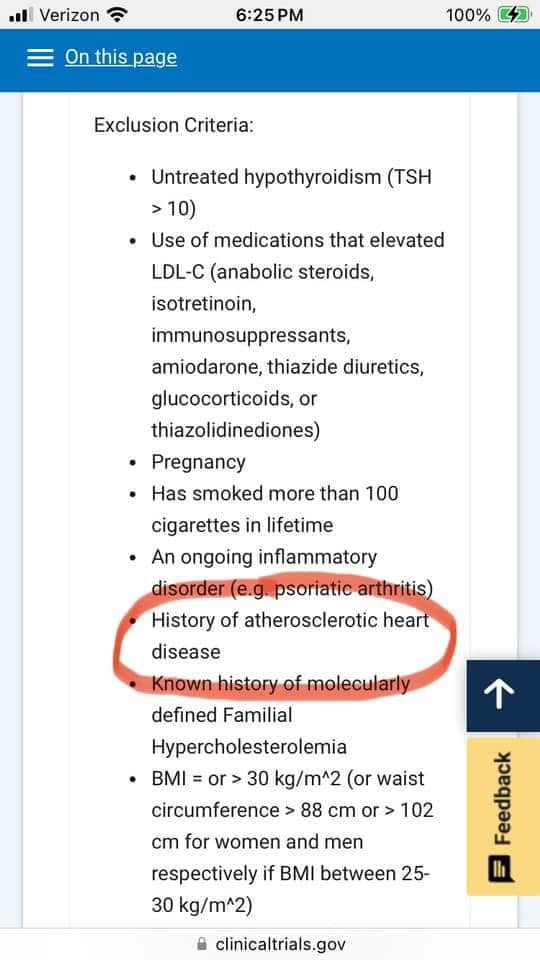
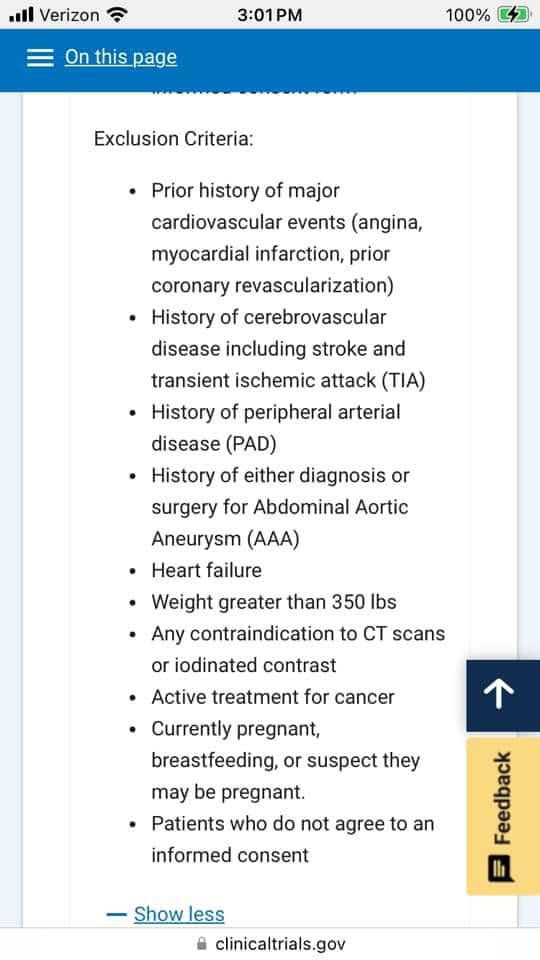
I went to clinicaltrials.gov and compared the official exclusion criteria for the LMHR study to the official exclusion criteria for the Miami Heart Study.
In the photos below:
LMHR is shown on the left.
Miami heart is shown on the right.
As you can see, the LMHR group was much healthier by design.
The official exclusion criteria for the Miami Heart Study allowed sick people in. LMHR did not.
For example, the LMHR Study officially excluded anyone with any history of atherosclerotic disease whatsoever. But the Miami Heart Study officially allowed those people in. Miami Heart only excluded very advanced cases, e.g. a prior heart attack or stroke.
Everyone in the LMHR study had a full CT angiogram scan prior to the start, so the researchers had a way to know ahead of time exactly which applicants had atherosclerotic disease and which did not before the study even began. They had a way to subjectively decide who they would let in and who they would not. Miami Heart on the other hand let everyone in except those with very advanced disease.
In addition, Miami let in current and former smokers, people who were obese, people with inflammatory disorders, and people with familial hypercholesterolemia. LMHR excluded all of these people.
This means that the Miami Heart population was likely considerably worse off to begin with, purely by the selection process.
The researchers seem to have done their best to try to match people across these studies on a 1-to-1 basis, but it’s impossible in principle to properly match a healthy group to an unhealthy one. As a result, there appears to be considerable selection bias in this cross-sectional study. Selection bias is a well-known problem with cross-sectional studies, and a major reason why they are so low on the evidence hierarchy.
LMHR exclusion criteria:
clinicaltrials.govClinicalTrials.govclinicaltrials.govMiami Heart exclusion criteria:
clinicaltrials.govClinicalTrials.govclinicaltrials.gov