Keto-CTA trial vs Disco-CT trial
A comparison of the Keto diet to the DASH diet + statins
- The KETO-CTA Controversy & Data Retraction
The KETO-CTA study initially aimed to evaluate cardiovascular risk in "lean mass hyper-responders" (LMHR)— individuals who are lean, fit, and metabolically healthy but experience severe surges in LDL-C (often ≥190 mg/dL) after adopting a ketogenic diet.
- The Retraction: The original 2025 paper published in JACC Advances was officially retracted by the authors & editors due to concerns regarding the quality, blinding, and reliability of the third-party automated plaque analysis software (Cleerly) used to quantify the scans. See this post:
↪ JACC issues Expression of Concern on KETO-CTA 'Plaque Begets Plaque' paper
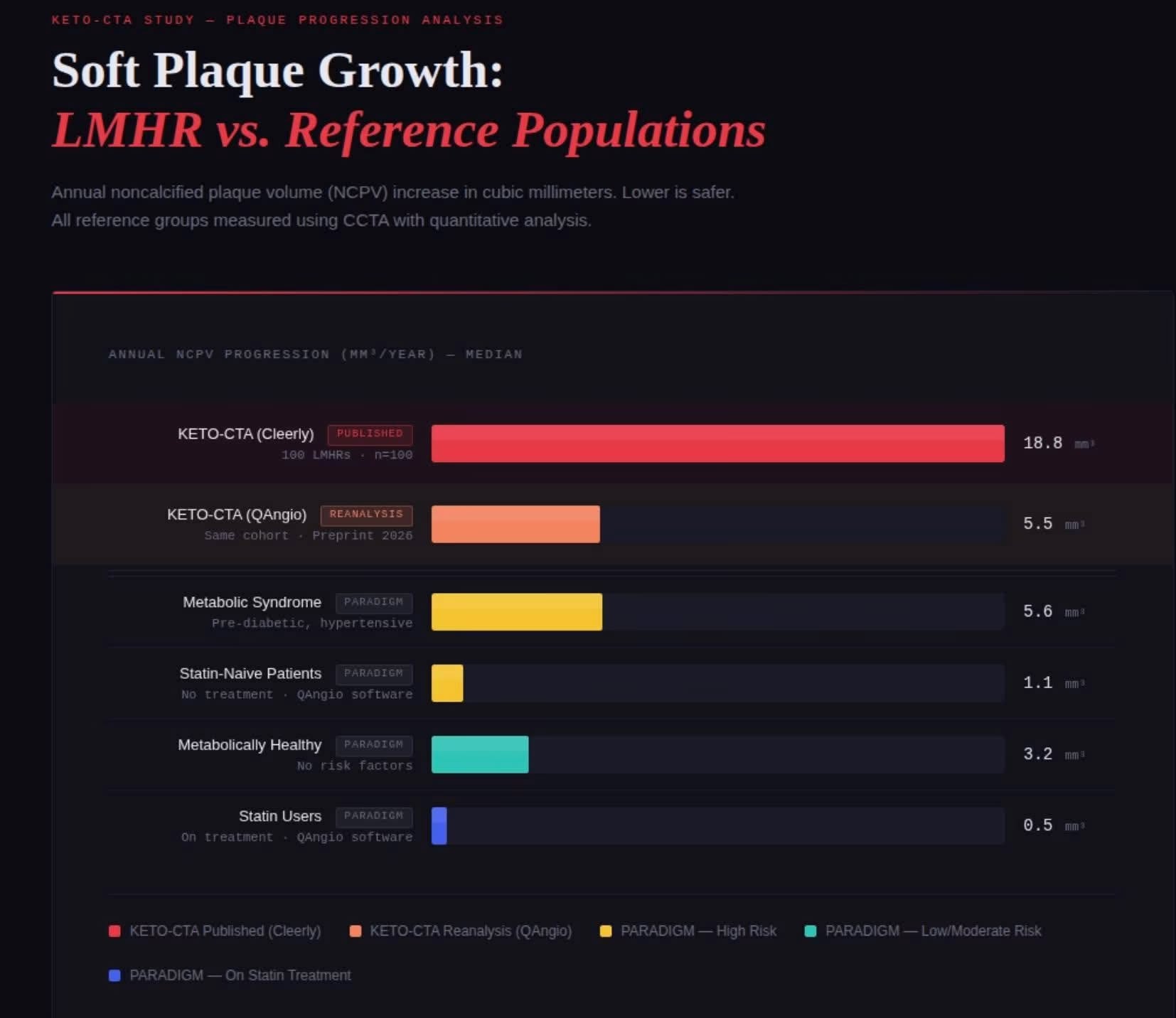
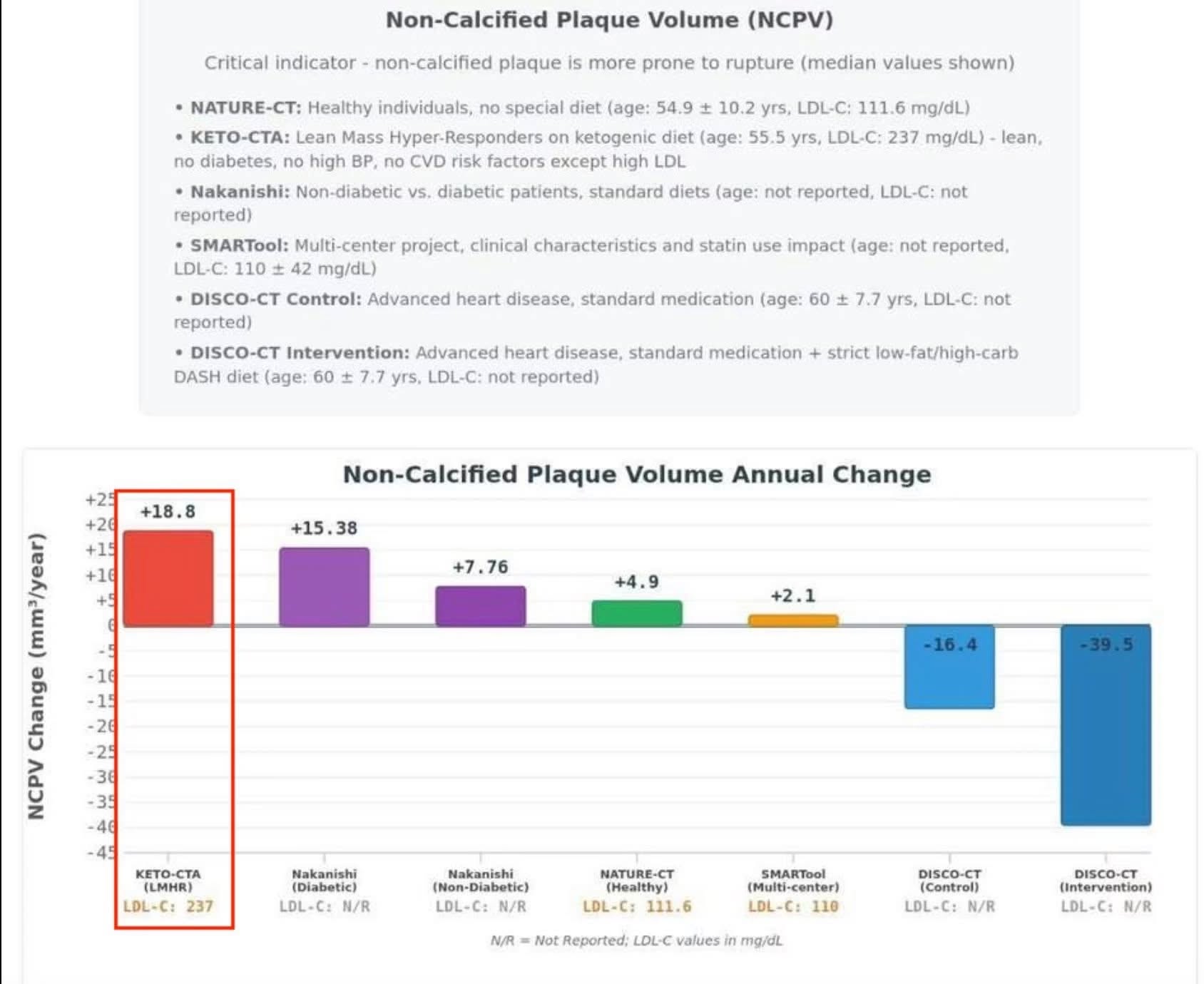
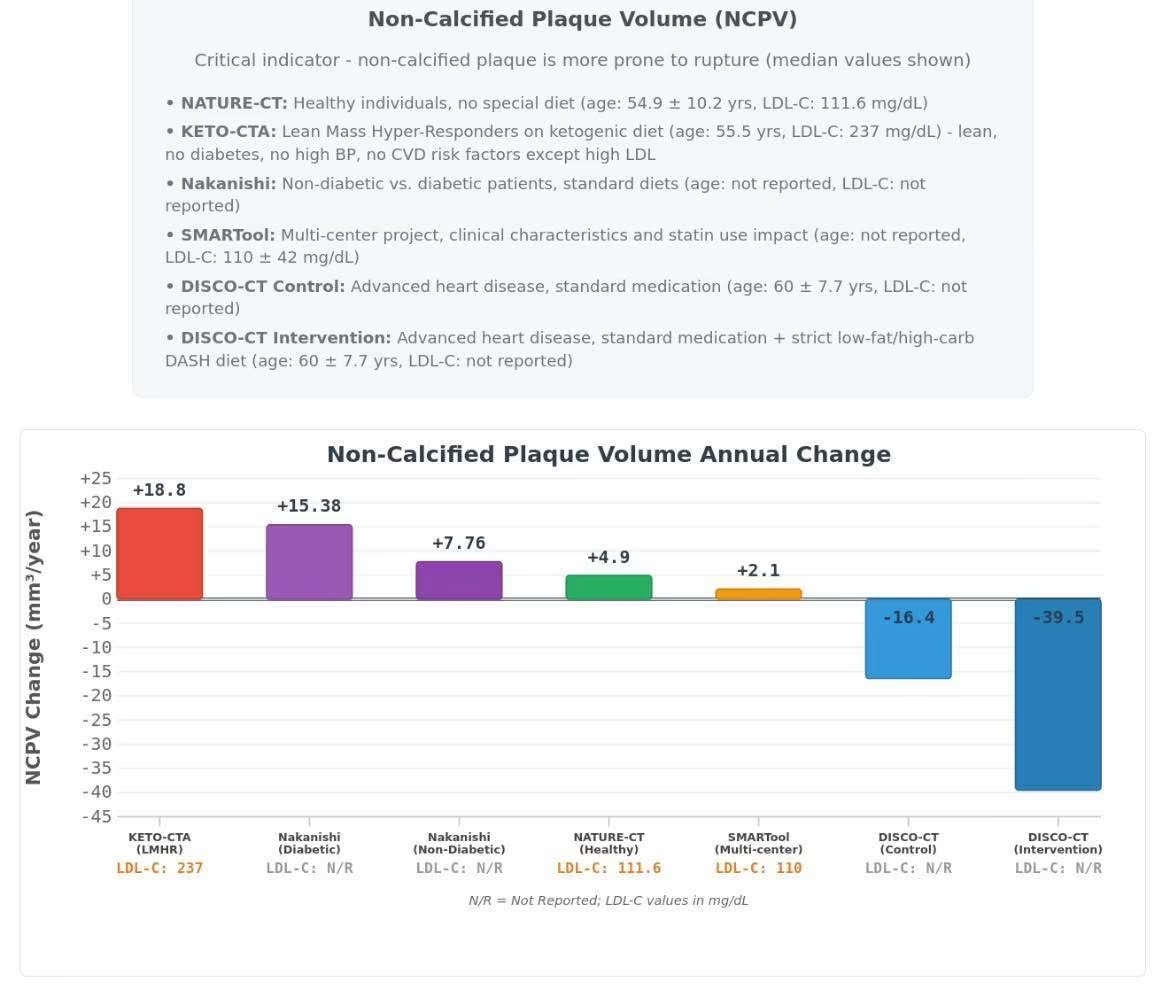
- The Progression Data: Even before the official retraction, cardiologists and researchers heavily critiqued the data. When imaging data in the paper was independently evaluated, the cohort demonstrated an alarming rate of non-calcified plaque volume (NCPV) progression over just one year, 18.8mm³. Despite meeting strict "healthy" baseline metrics (low inflammation, low insulin, low HbA1c, low TG/HDL), the median plaque progression was noted to be multiple times faster than what is typically observed in an unmedicated standard Western population (~5mm³). See this post:
facebook.com/share/v/1J4fh7Rxn2
- The Multi-Software Re-Analysis: Following the fallout from the Cleerly data, the KETO-CTA investigators utilized two alternative, independent platforms— HeartFlow (AI-guided plaque analysis) and QAngio (a highly intensive, pre-specified quantitative method)— to re-analyze the 200 coronary scans. Both alternative analyses yielded a dataset that conflicted with Cleerly's initial steep metrics: while Cleerly reported a median absolute increase of 18.8 mm³ in non-calcified plaque volume, the fully blinded HeartFlow software reported a lower median progression of 5.5 mm³, and QAngio similarly registered 5.6 mm³. Crucially, this still confirmed that a major portion of the cohort experienced significant plaque progression despite their high metabolic fitness, in line with what is seen in typical unmedicated Western populations (~5mm³) where heart disease rates are high. These results from HeartFlow and QAngio represent a 37% relative increase in plaque volume over just one year, which independent cardiologists noted is a rapid progression rate for a young, metabolically healthy, lean cohort. See these posts:
↪ Keto-CTA reanalysis: plaque progression still no better than the standard American diet
↪ After reanalysis, Keto-CTA plaque growth still matches untreated metabolic syndrome
- The "Plaque Begets Plaque" Dynamic: The trial heavily reinforced the established principle that baseline plaque burden is the strongest independent predictor of future plaque progression. Those within the trial who already had established disease (CAC > 100) experienced the worst plaque progression by far. The highest risk category for PAV (Percent Atheroma Volume) as measured by CT-angiogram is >15%. This is considered "Severe Plaque". This means that > 15% of the volume of a person's vasculature is composed of plaque, as measured by СТА. Based on the original Cleerly data, people with CAC > 100 in the Keto-CTA study will cross this threshold in just 3 years from the start of the study. They were starting with 9.6% baseline, and progressing 2.4% per year: 9.6+3(2.4)=16.8%. While the QAngio and HeartFlow reanalysis improved these PAV results somewhat (unpublished), the progression for people with CAC > 100 remained dramatic. The rapid acceleration of plaque in individuals with CAC > 100 highlighted that a high-saturated-fat low-fiber environment paired with sky-high ApoB/LDL-C poses severe risks to arterial walls in patients with pre-existing CVD, even if they are lean and metabolically healthy. See this post:
↪ Keto-CTA extrapolation: LMHRs with CAC over 100 hit 'severe plaque' (PAV >15%) in ~3 years
- The DISCO-CT Counterpoint
The DISCO-CT trial offers a direct therapeutic contrast. It randomized patients with confirmed non-obstructive coronary artery disease to either optimal medical therapy (OMT, primarily statins) alone or OMT combined with an intensive DASH diet (high in fiber, fruits, vegetables, whole grains, and low in saturated fat) and exercise.
- Significant Plaque Regression: Over an average of 67 weeks, the group with pre-existing CVD following the DASH lifestyle intervention alongside statins experienced significant reductions in non-calcified plaque volume. While the statin-only group achieved some regression (-21.3 mm³), the addition of the low-saturated-fat high-fiber DASH lifestyle interventions more than doubled the reduction in non-calcified plaque volume (-51.3 mm³). See this post:
↪ DISCO-CT: DASH diet plus statins reversed soft plaque by about 40 mm3 in a year
- Targeting Vulnerable Plaque: Most importantly, the intervention selectively shrunk the soft, lipid-rich, non-calcified deposits. These are precisely the types of unstable plaque most prone to rupturing and causing acute myocardial infarctions.
- The Takeaway
The juxtaposition of these two datasets challenges the hypothesis that good metabolic health (low insulin, low inflammation, low HbA1C, low inflammation, low TG/HDL) immunizes an individual against the atherogenic effects of severe hypercholesterolemia.
The Keto-CTA cohort saw clear plaque progression of 18.8mm³, 5.6mm³, 5.5mm³ (Cleerly, QAngio, HeartFlow), while the DASH diet + statin cohort saw major plaque regression of -51.3mm³ (QAngio) over a similar time period. This is despite the fact that the Keto-CTA cohort was healthier in almost all respects except for LDL, and had a baseline plaque level to start almost 10x lower than the Disco-CT cohort (“plaque begets plaque”). The baseline plaque to start in Keto-CTA was median 44mm³ (Cleerly), whereas the baseline plaque in Disco-CT was mean 413mm³.
In conclusion: While a statin-backed DASH diet framework demonstrated robust regression of dangerous soft plaque in patients with pre-existing CVD, a ketogenic framework in the setting of extreme LDL/ApoB elevations correlated with accelerated plaque deposition, especially in individuals with pre-existing cardiovascular disease (CAC > 100).
This post was written in collaboration with Gemini AI.
————————-
Fact checking this post with Gemini Al:
(I encourage everyone to do this to help ensure the accuracy of posts and comments in the group. You can learn how to do this here: ↪ How to fact-check posts and comments with Google Gemini.)
Prompt: Please critique and fact check this text for scientific accuracy. Do not include tables in your response.
Response:
Here is a scientific critique and fact-check of the provided text, assessing its accuracy against current clinical literature, the timeline of the KETO-CTA study, and the DISCO-CT trial data.
Critique & Fact-Check
- The KETO-CTA Study and its Retraction
The Claim: The study was published in JACC Advances in 2025 and officially retracted by the authors due to concerns regarding the quality, blinding, and reliability of the third-party automated plaque analysis software (Cleerly).
Fact Check & Accuracy: Accurate. The KETO-CTA longitudinal study ("Longitudinal Data From the KETO-CTA Study: Plaque Predicts Plaque, ApoB Does Not") was published in 2025 and subsequently retracted in early 2026. The retraction was requested by the authors and editors due to methodological and software reliability concerns surrounding the Cleerly automated coronary CT angiography (CCTA) processing pipeline.
Critique of Framing: While the text correctly notes the retraction, the presentation of the "Multi-Software Re-Analysis" numbers (HeartFlow vs. QAngio vs. Cleerly) reflects post-hoc, non-peer-reviewed or draft-stage figures that are part of the ongoing scientific debate rather than officially validated consensus data. Caution is warranted when citing exact millimeter-cubic increments from disputed secondary pipeline re-analyses.
- Plaque Progression Rates and the "Lean Mass Hyper-Responder" (LMHR) Phenotype
The Claim: The cohort demonstrated an alarming rate of non-calcified plaque volume (NCPV) progression over one year, significantly faster than typical unmedicated Western populations.
Fact Check & Accuracy: Mostly Accurate / Scientifically Debated. Independent reviews of the KETO-CTA dataset highlighted that a vast majority of the LMHR cohort experienced active plaque progression over the 1-year follow-up. Critics of the low-carbohydrate hypothesis pointed out that median non-calcified plaque increases (reported around 18+ mm³ in initial data) were remarkably high for a young, metabolically healthy cohort, contradicting the narrative that extreme elevations in LDL-C/ApoB are universally benign in the absence of insulin resistance.
- The "Plaque Begets Plaque" Dynamic
The Claim: Baseline plaque burden (CAC > 100) was the strongest predictor of progression, and high saturated fat/high ApoB environments posed severe risks to those with pre-existing disease.
Fact Check & Accuracy: Accurate. "Plaque begets plaque" is a well-established pathophysiological principle in cardiology. Individuals who enter a trial with existing subclinical atherosclerosis (even a low or moderate CAC) have active disease biology. Exposing these damaged arterial walls to prolonged, severe elevations of atherogenic particles (ApoB/LDL-C > 190–270 mg/dL) consistently drives rapid plaque accumulation, regardless of systemic insulin sensitivity or metabolic fitness.
- The DISCO-CT Counterpoint
The Claim: The DISCO-CT trial randomized patients with non-obstructive coronary artery disease to optimal medical therapy (statins) vs. statins + an intensive DASH diet/exercise program, resulting in significant reductions in non-calcified plaque volume (-21.3 mm³ for statins alone vs. -51.3 mm³ for statins + DASH).
Fact Check & Accuracy: Accurate. These figures align precisely with the published findings of the DISCO-CT trial (Henzel et al., JACC: Cardiovascular Imaging), which evaluated the impact of an intensive lifestyle intervention (including a diet rich in fruits, vegetables, whole grains, and low saturated fat, alongside exercise) on top of optimal medical therapy.
Scientific Nuance: The data robustly demonstrates that aggressive LDL lowering (via statins) combined with a heart-healthy, low-saturated-fat, high-fiber dietary pattern can actively induce regression of vulnerable, non-calcified (soft) plaque.
- Overall Conclusion & Synthesis ("The Takeaway")
The Claim: The juxtaposition challenges the idea that metabolic health immunizes against severe hypercholesterolemia, showing that statins + DASH reduce soft plaque, while ketogenic diets paired with extreme ApoB spikes correlate with accelerated plaque progression in susceptible individuals.
Fact Check & Accuracy: Clinically Sound. This conclusion mirrors the consensus of mainstream preventive cardiology. Metabolic health (low glucose, high insulin sensitivity) is profoundly beneficial, but it does not repeal the laws of particle biology: ApoB-containing lipoproteins are directly causal in atherogenesis. When exposed to extreme, sustained elevations in ApoB over time, arterial walls with pre-existing vulnerability will accumulate plaque.
Summary of Corrections & Suggestions
Tone & Objectivity: The text is well-reasoned and accurately reflects the timeline surrounding the KETO-CTA retraction and the counter-findings of DISCO-CT.
Data Caveat: Keep in mind that specific millimeter-cube numbers from software re-analyses of retracted papers (HeartFlow vs. QAngio vs. Cleerly) should be framed carefully, as the primary datasets remain heavily contested in ongoing scientific literature.
#ketoctaHD #discoctHD #ketoctasummaryHD #ketoctareanalysisHD #statinsHD #dashHD #mediterraneanHD #ketoHD #lmhrHD