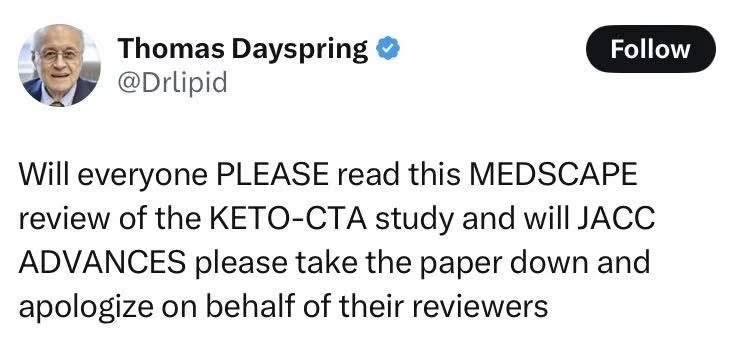
The Journal of the American College of Cardiology (JACC) is reporting possible issues with the integrity of the data/analyses published in the Keto-CTA study.
The journal has announced that they have opened a formal investigation into the matter.
The authors on this paper are Adrian Soto-Mota M, Nicholas G. Norwitz, Venkat S. Manubolu, April Kinninger, Thomas R. Wood, James Earls, David Feldman, and Matthew Budoff.
Some of the authors themselves seem to have been involved in requesting this investigation (see comments). It’s important to point out that no actual evidence of wrongdoing by anyone has been presented so far, to the best of my knowledge. But this is a very unusual step for a journal to take.
Quoted:
“The Editors of JACC: Advances wish to inform readers that concerns have been raised regarding the integrity of data and/or analyses presented in the paper mentioned above. These concerns are currently under confidential review in accordance with the Journal’s editorial policies and the Committee on Publication Ethics (COPE) guidelines. While this process is ongoing, the Editors believe it is important to alert readers to the existence of these concerns.”
Paper · JACC: Advances · 2026Expression of Concern: “Plaque Begets Plaque. ApoB Does Not: Longitudinal Data from The KETO-CTA Trial” [JACC: Advances, Volume 4, Issue 7, July 2025, Article 101686]jacc.org#ketoctaHD #ketoctasummaryHD #ketoHD #nicknorwitzHD #davefeldmanHD #lmhrHD