How does exercise affect the odds of healthy aging in the long term ?
Randomized controlled trials on exercise only go for relatively short periods of time.
To quantify the magnitude of the benefits in the long term, e.g. 20 years, we must look at prospective cohort studies.
One of the latest papers from the Harvard Nurses Study answers this question.
The results are good, but they hardly support the hyperbolized claims that many people make about exercise and aging.
The bottom line: Replacing one hour each day of sedentary behavior (like television watching) with moderate to high physical activity, increases odds of aging in a healthy way by about 30%. Replacing it with light physical activity increases odds by about 10%.
The benefits here are solid but modest. You do not see odds increasing by high amounts like 2x, 3x, 10x, etc. as some have claimed.
——
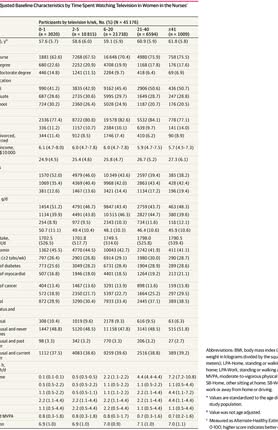
The portion of the 45,176 female participants in the Nurses Health Study aged 50 years or older and free of major chronic diseases in 1992 were prospectively followed for 20 years.
Healthy aging was defined as survival to at least age 70 years with maintenance of 4 health domains:
- no major chronic diseases,
- no impairment in subjective memory,
- no impairment in physical function,
- no loss of mental health.
Each increment of 2 hours per day in sitting watching television was associated with a 12% reduction in the odds of healthy aging.
In contrast, each increase of 2 hours per day in light physical activity at work was associated with a 6% increase in the odds of healthy aging.
Replacing 1 hour of sitting watching television with light physical activity at home increased odds of healthy aging by 8%.
Replacing it with light physical activity at work increased odds by 10%.
Replacing it by moderate to vigorous activity increased odds by 28%.
Paper · JAMA Network OpenJAMA Network Open articlejamanetwork.com