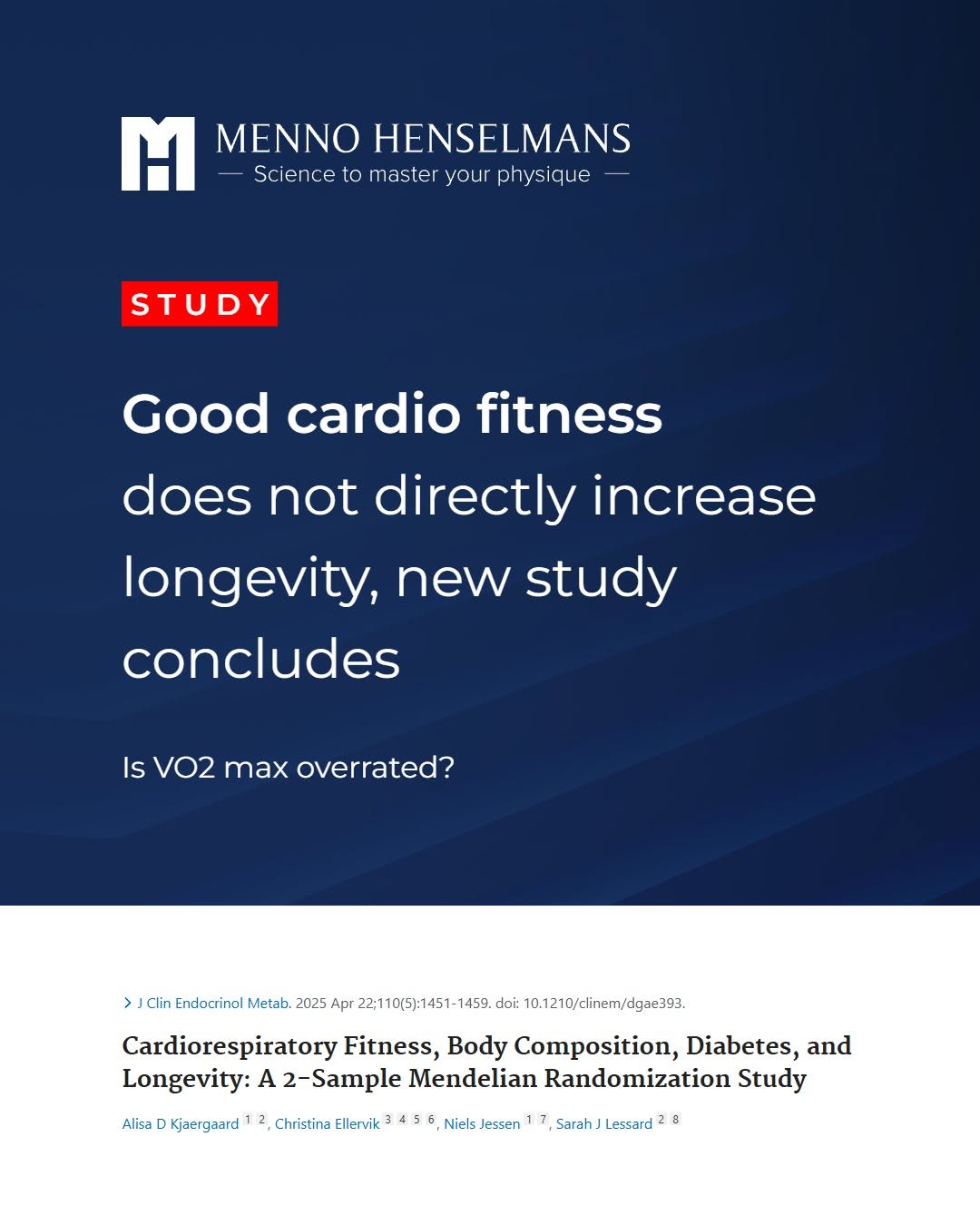
I have to agree with Chris on this one.
The claim that VO2-max causally promotes longevity is dubious. When you take the time to actually dig into the claim, you see how weak the evidence really is.
For example, Mendelian randomization shows absolutely no forward causality at all:
↪ Mendelian randomization finds no causal effect of VO2-max on longevity or type 2 diabetes
But you do see evidence of major causality in the reverse direction:
↪ Aging causes VO2max to decline, not the reverse
And this is just the tip of the iceberg…
There are holes in this claim everywhere that you look, as Chris explains.
He made this article available free for a week.
I suggest that everyone interested in this topic read it.
His whole point in this article is that the vast majority of studies have actually shown a correlation between treadmill performance and longevity, not between VO2-max and longevity.
People are falsely claiming that these same studies show VO2-max is correlated with longevity. This is just plain wrong, as he explains.
There are lots of other factors that go into a successful treadmill test besides just VO2-max.
For example, many of the observational studies examining the correlation between treadmill tests and lifespan used unhealthy volunteers. Poor treadmill performance often reflects underlying disease—such as chest pain or shortness of breath—rather than just low aerobic fitness. This has nothing to do with VO2-max.
As someone who rowed crew competitively in college and actually worried about ergometer tests (the rowing equivalent of treadmill tests), I can attest first hand that he is right about this, even in very healthy people. Your VO2-max is only one of many factors that predict your performance on an ergometer test (or treadmill test). This is well known in rowing. For example, mental toughness and ability to tolerate pain and discomfort play a major role. There is also a skill factor involved. You learn little tricks to make it feel easier as you get better at it. And lots of aspects of overall fitness contribute beyond just the raw ability to take oxygen from air and deliver it to muscle tissue.
Improving your overall fitness level, skill, and mental toughness as measured on an ergometer or treadmill test is a worthy health goal that probably does promote longevity to some extent, if not taken to extremes. On the other hand, biohacking your VO2-max for longevity is complete nonsense. Mendellian randomization shows no forward causality whatsoever. Studies show major reverse causality. And as Chris explains here, the observational studies constantly being cited to justify biohacking VO2-max don’t even show an association between VO2-max and longevity. They actually show an association between treadmill performance (general health, overall fitness, skill, mental toughness, etc.) and longevity.
Even this well-established association between treadmill performance and longevity probably suffers from a large degree of reverse causality. Twin studies suggest that the observational literature on exercise and mortality as a whole is fraught with reverse causality. For example:
↪ Finnish twin study suggests exercise's mortality benefit is partly reverse causality