People who score well on fitness tests live longer, on average, than people who score poorly. Nobody in the group disputes that. The disagreement is about what it means. Some popular longevity voices describe VO2 max as the single best marker of how long you will live and as a number to train directly. Louis Nervegna, one of the admins, argues that this goes well beyond the evidence56.
The posts in the archive therefore give a more careful answer than "raise your VO2 max." Cardiorespiratory fitness, meaning how well the lungs, heart, blood vessels and muscles work together during sustained effort, is strongly linked to survival. VO2 max is only one component of it. Fitness, body composition, muscle and physical activity all travel together, and the best evidence summarized here suggests that being lean, muscular and active matters, while VO2 max by itself may be a marker of that package rather than a lever45.
This article sets out the observational case, the skeptical case, what the posts say about improving fitness and muscle, and the downsides of pushing too far.
What VO2 max and cardiorespiratory fitness are
VO2 max is the maximum volume of oxygen the body can consume during peak exercise, usually expressed in milliliters of oxygen per kilogram of body weight per minute712. A related unit is the MET (metabolic equivalent of task). One MET equals 3.5 mL of oxygen per kg per minute, the oxygen use at rest; a post describing a meta-analysis lists about 3 METs for brisk walking and 6 or more for vigorous exercise such as fast treadmill running1.
Two points recur in the group's posts.
- VO2 max is a ratio. Because the formula divides oxygen consumption by body weight, VO2 max can rise through weight loss while oxygen consumption stays flat, and so it is not a pure measure of the heart's output. A post Louis endorsed makes this point12.
- Fitness is broader than VO2 max. Topol's argument, shared by Louis, is that cardiorespiratory fitness is a result of many variables that determine performance on a functional test, and VO2 max is only one of them5.
The observational case for fitness
Several posts present evidence that fitter people live longer.
- A meta-analysis (PMID 38599681) of 20.9 million observations found that each 1-MET increase in cardiorespiratory fitness was associated with 11-17% lower all-cause mortality, 18% lower heart failure incidence and up to 73% lower cardiovascular mortality. Louis noted that there is "lots of potential risk for reverse causality here, but some of the causality is almost certainly in the forward direction"1.
- A Cleveland Clinic cohort followed 122,007 adults for a median of about 8 years after a treadmill stress test. People slightly below average in fitness had about 41% higher risk of death than those slightly above average, and smokers had about the same added risk compared with nonsmokers. The retired neurosurgeon who summarized it stressed that the study was observational, that healthier people are more able to exercise, and that it looked at people sent for a stress test rather than the general public2.
- Louis shared a clip of sports cardiologist Andre La Gerche, summarized as: with the same coronary artery calcium (CAC) score, the person who exercises has a much lower heart attack risk over the next 20 to 25 years13. The post gives no numbers or study.
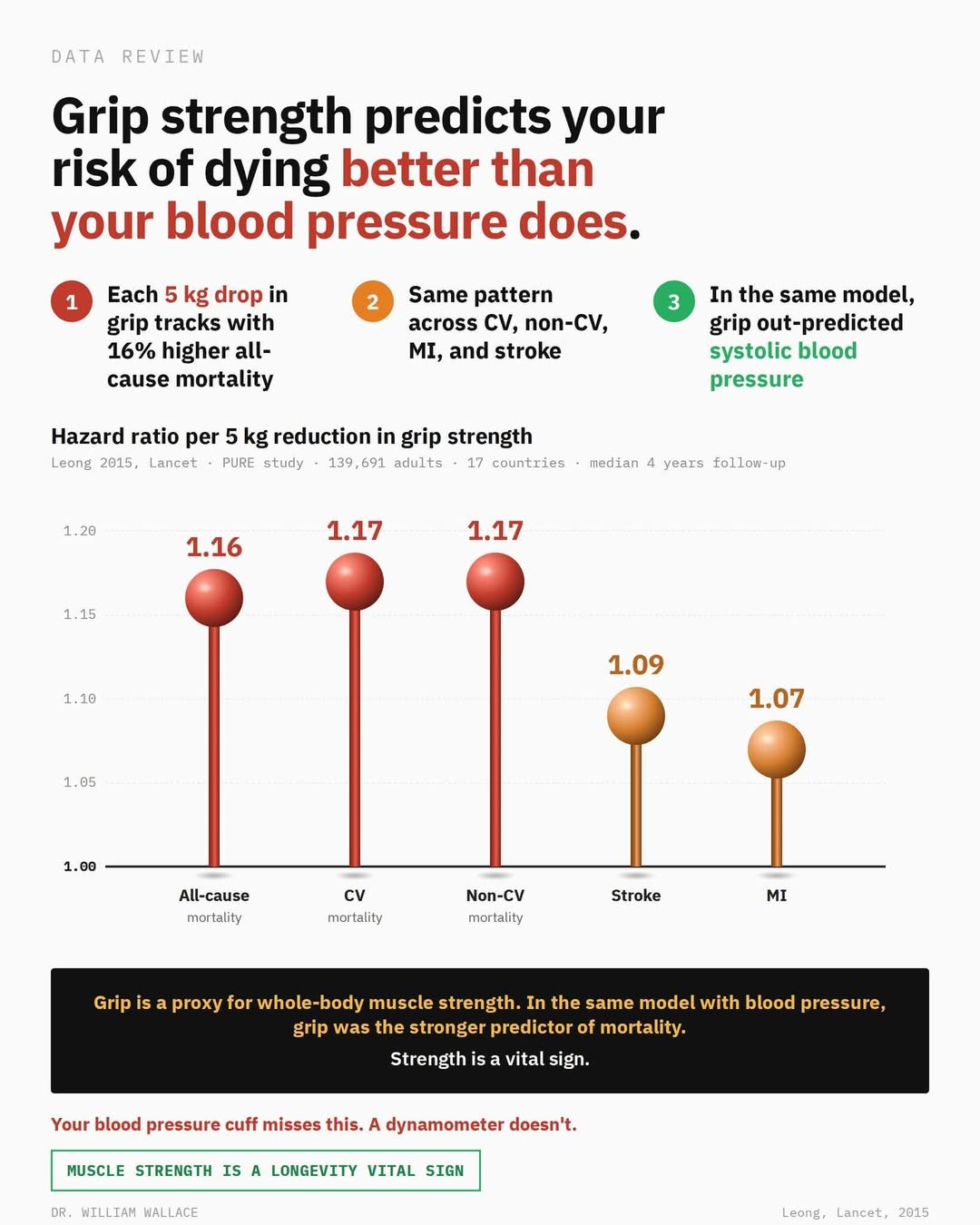
- In the Prospective Urban Rural Epidemiology (PURE) study of 139,691 adults in 17 countries, every 5 kg lower grip strength tracked with 16% higher all-cause mortality, and grip strength was a stronger predictor than systolic blood pressure10.
- A UK Biobank analysis of over 70,000 participants, quoted in Topol's article, concluded that improving both cardiorespiratory fitness and muscle strength, rather than either alone, may be the most effective behavioral strategy to reduce all-cause and cardiovascular mortality5.
The skeptical case: why VO2 max may be a marker, not a cause
Mendelian randomization
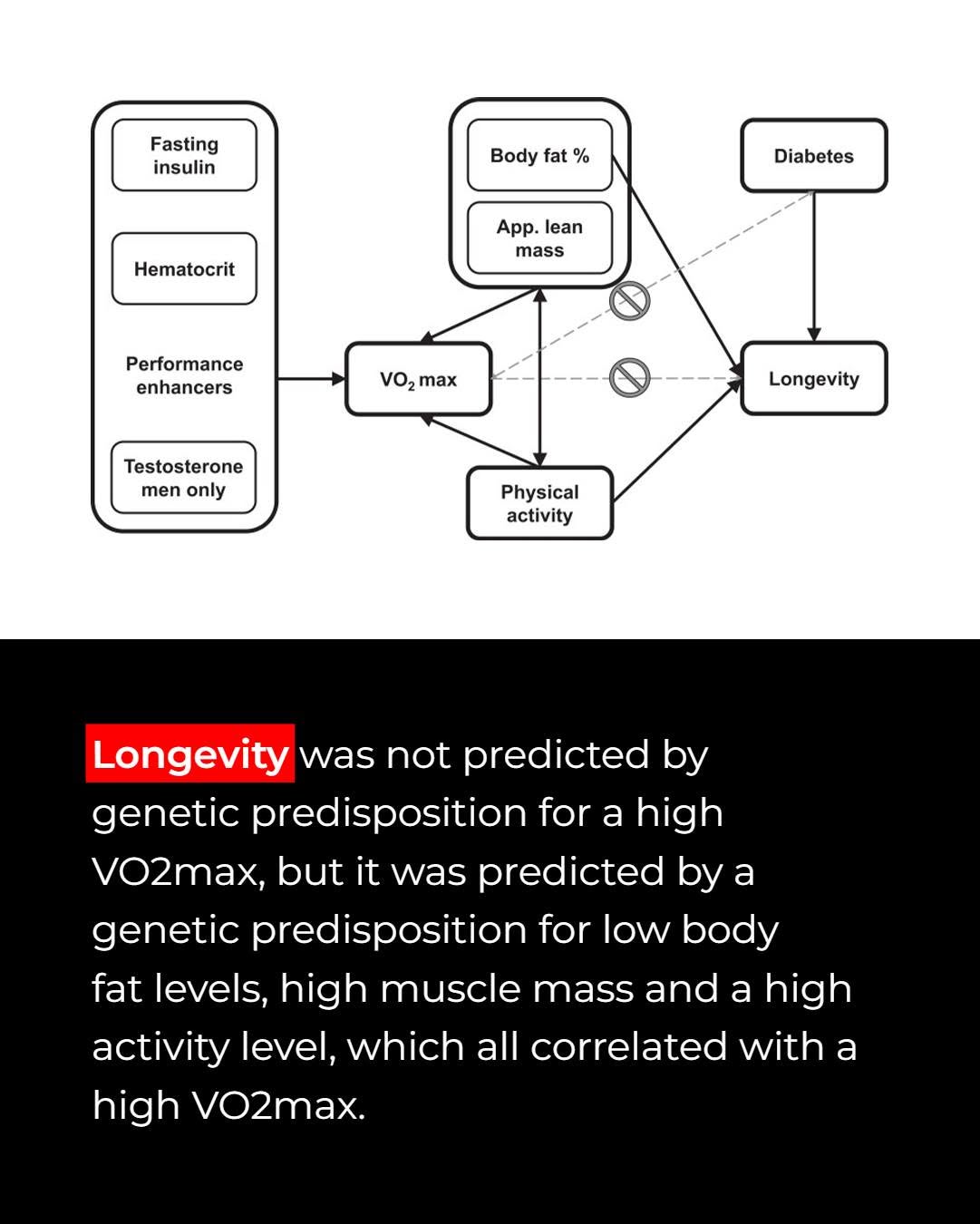
Mendelian randomization uses genetic variants that are semi-randomly distributed, and that raise a trait such as VO2 max, as a natural experiment to test whether the trait causes an outcome. A 2024 two-sample Mendelian randomization study in the Journal of Clinical Endocrinology & Metabolism analyzed about 70,000 people with cycling-test VO2 max, with longevity estimated from parental survival. Louis reports that34:
- Genetic predisposition to high VO2 max did not predict longevity or diabetes.
- Genetic predisposition to low body fat, high muscle mass and high activity did predict longevity.
- The study's own conclusion, as shared, is that VO2 max seems to be "a proxy for good health, not a causal driver of longevity," and the same applies to handgrip strength.
Louis reads this as showing that the observational link reflects reverse causality or confounding3. He also argues that aging itself causes VO2 max to fall, citing a 2005 Circulation longitudinal study in which the rate of decline in peak VO2 accelerated with each successive decade, especially in men, regardless of physical activity habits14. He states that he has seen no credible evidence that a declining VO2 max per se causes aging, while allowing that lack of exercise may accelerate aging14. These are Louis's interpretations of a single study design, which cannot settle the question on its own.
What the foundational studies measured
Three posts argue that the key studies did not measure VO2 max at all.
- Gregory Katz, in an article Louis shared, notes that the most-cited paper, a 2018 JAMA study showing that low cardiorespiratory fitness carried a mortality risk comparable to end-stage renal disease, used the Bruce protocol treadmill stress test in people referred for a stress test. Exercise time on that test reflects effort and is a proxy for VO2 max, and the participants were not a general healthy population6.
- Chris Masterjohn argues that most studies link treadmill performance, not measured VO2 max, to lifespan, and that poor performance often reflects underlying illness such as chest pain or shortness of breath. Louis adds from his own rowing experience that mental toughness and skill also shape ergometer results7.
- Topol's article, which Louis shared, makes the same point about "conflation" of cardiorespiratory fitness studies with VO2 max claims, and concludes there are no supportive data for the average person to measure VO2 max and make it the focus of training. He sees a possible place for serial measurement in elite athletes or in people with heart failure or pulmonary hypertension515.
Louis goes further than the other authors: he says to forget about causality, because for VO2 max specifically there is not even a proven association6. That is a stronger position than the Cleveland Clinic or meta-analysis findings above, which concern overall fitness, and the posts do not resolve the tension between them.
| Evidence | What was actually measured | What it found |
|---|---|---|
| Fitness meta-analysis (20.9 million observations) | Cardiorespiratory fitness in METs | 11–17% lower all-cause mortality per 1-MET gain; observational1 |
| Cleveland Clinic cohort (122,007 adults) | Treadmill stress-test performance in people sent for testing | About 41% higher mortality just below versus just above average fitness; observational2 |
| 2018 JAMA study | Exercise time on the Bruce treadmill protocol, a proxy for VO2 max | Low fitness carried mortality risk comparable to end-stage renal disease; referred patients, not a healthy population6 |
| Mendelian randomization (about 70,000 people) | Genetic predisposition to high cycling-test VO2 max | No link to longevity; genes for low body fat, more muscle and activity were linked34 |
Marker versus lever
Louis applies the same logic to grip strength. Grip predicts mortality as well as or better than blood pressure, but blood pressure is causal while grip strength is not. Treating blood pressure lowers risk, whereas doing handgrip exercises improves the test without lowering risk1016. He calls this a general lesson about proxies: "the moment that you try to artificially hack them, they lose their predictive value"10. Waist circumference is another example. In Whitehall II, waist size at age 65 predicted later disability better than nine other measures, including grip strength, walking speed, chair rises and BMI, and adding the others barely improved prediction1718.
How the posts suggest improving fitness
The 2-year trial in sedentary adults
The most discussed fitness study in the group is the randomized trial led by Dr. Benjamin Levine, published in Circulation in 2018 as Reversing the Cardiac Effects of Sedentary Aging in Middle Age19. As summarized in a post Louis shared8:
- 61 sedentary adults, average age 53, trained 4-5 sessions a week for 2 years.
- The program had two high-intensity interval sessions (4-minute intervals on a treadmill at 90-95% of maximum heart rate), two moderate endurance sessions of 60 minutes at 70-75%, and one strength session; the control group did low-intensity stretching, balance and strength work three times a week.
- VO2 max, baroreflex sensitivity and heart elasticity improved. Listed limitations were that participants were healthy and nutrition was not standardized.
Other posts describe the same program as "5-6 hours per week" or "about five hours," with hearts "more like a 30-year-old's"2021. Posts also differ on the Norwegian 4x4 details: four 4-minute efforts at about 80-90% of maximum heart rate with 4 minutes of active recovery, or about 85-95% with 3 minutes of recovery1920. Gokhan Can's summary of a Rhonda Patrick video says moderate exercise is ineffective for a significant share of people and vigorous intervals are a more reliable way to raise VO2 max. The post also links a 2023 study in well-trained women in which aerobic intervals raised VO2 max more than all-out sprint intervals, and the HERITAGE Family Study on how VO2 max responses to a standard program run in families19.
Louis, in contrast, regards much influencer enthusiasm for the 4x4 as resting on a "house of cards"6. The two views are not contradictory about the trial itself: the trial was randomized and showed improvements in fitness and heart structure, whereas the longevity claims attached to VO2 max are the contested part68.
Body composition and muscle
The Mendelian randomization result points to body fat, muscle mass and activity as the traits that tracked with longevity4. Several posts reflect that emphasis:
- Waist and visceral fat. Louis argues that visceral fat matters and that diet is the most effective way to reduce it17.
- Resistance training with weight loss. In a 16-week trial of 82 people with type 2 diabetes, fat-free mass changed by -2.7% with diet alone, -1.9% with moderate exercise and -0.2% with high exercise (six sessions a week), and body fat fell 3.5%, 6.3% and 8.0% respectively22.
- Strength plus fitness. Topol's article, quoting the UK Biobank analysis, favors improving both fitness and strength5.
Show data
| Body fat lost | Fat-free mass lost | |
|---|---|---|
| Diet only | 3.5% | 2.7% |
| Diet + moderate exercise (3 sessions a week) | 6.3% | 1.9% |
| Diet + high exercise (6 sessions a week) | 8.0% | 0.2% |
Muscle, strength and sarcopenia
Sarcopenia is the progressive loss of muscle strength, mass and function. A Circulation review shared by Louis says it is associated with faster progression of cardiovascular disease and higher risk of mortality, falls and reduced quality of life, with a bidirectional link to heart disease. Louis adds that regular resistance exercise is the best way to prevent it9. Another post says sarcopenia affects half of people over 8023.
- Inactivity versus aging. Research cited in a post suggests sedentary adults may lose up to 8% of their muscle per decade after 40, while a University of Pittsburgh MRI study of 40 athletes aged 40-81 who trained 4-5 times a week found muscle density in those in their 70s and 80s similar to those in their 40s. This is a cross-sectional comparison of dedicated athletes24.
- Resistance training is the lever. Louis calls it the only proven way to truly prevent sarcopenia, with other measures helping a little25. He says no drug has regulatory approval for sarcopenia and non-drug measures remain first-line, according to a review Gokhan shared26.
- Protein does not replace training. Louis cites a meta-analysis of 69 trials in which protein raised strength gains only modestly and only alongside resistance training (about 5% extra strength going from the RDA to 1.5 g/kg), and a meta-analysis of 36 trials in nonfrail adults over 65 that found no benefit of extra protein on grip, leg strength, walking speed or muscle mass272829. Luigi Fontana, in a post Louis shared, argues frailty in Western older adults reflects decades of overnutrition and inactivity, not low protein30. A 24-week trial of whey protein raised IGF-1 without improving muscle outcomes31. Louis notes that frail people may differ from the nonfrail groups studied28.
- Mechanisms (early-stage). Louis shares work suggesting chaperone-mediated autophagy declines with age in muscle, with exercise and fasting raising it, and that exercise lowers elevated basal mTOR in aging muscle, which he links to heart health because the heart is a muscle. Much of the cited work is in animals2332.
- Drugs under study. Louis also posts about statins, metformin and GLP-1 drugs in connection with muscle. These are hypotheses or small trials, including a small randomized trial of metformin during bed rest, a review on statins and sarcopenia and a trial in which 12 months of semaglutide cut lean mass about 5% while handgrip improved 4.5 kg. They should be read as emerging rather than established333435. In the STOMP trial of 420 healthy people, atorvastatin 80 mg for 6 months did not change strength, endurance or VO2 max across 14 measures, although muscle pain was about twice as common (9.4% vs 4.6%)36.
The downside of chasing fitness too far
Louis argues that intense exercise "has risks, as well as benefits," especially at high volume, and cites a 2026 Circulation analysis (Master@Heart) of wearable-measured training load and coronary atherosclerosis in middle-aged and older athletes. He says the net benefit of exercise remains large for the average person and calls influencer messaging about VO2 max a "panacea" story that the cardiology literature does not support11. He also cites American Heart Association and American College of Cardiology recognition that high-volume intense exercise can have downsides12. A shared story of a 39-year-old marathoner who kept exercising through chest tightness before a heart attack shows that fitness does not rule out heart disease37.
What this means for you
These points reflect the posts, not individual medical advice. People with heart disease, symptoms or medications should discuss exercise plans with their doctor.
- Think fitness, not a number. The admins argue that general cardiorespiratory fitness, strength and body composition matter, and that chasing a lab VO2 max is not supported for most people45.
- Combine endurance and strength work. Topol's article quotes UK Biobank data favoring both, and the 2-year Levine program included intervals, endurance and strength sessions58.
- Make resistance training a priority with age. Louis calls it the best prevention for sarcopenia925.
- Watch waist size. A tape measure was the strongest single predictor of late-life disability in Whitehall II17.
- Be cautious with extremes. Weigh benefits and risks, especially at high volumes and ages above 35-4011.
Frequently asked questions
Does a higher VO2 max make you live longer?
The group's evidence says people with higher fitness live longer, but the Mendelian randomization study found no causal link from VO2 max to longevity13. The studies most often cited may not have measured VO2 max56.
Is cardiorespiratory fitness the same as VO2 max?
No. VO2 max is one of many variables behind performance on a fitness test5.
Can exercise really reverse heart aging?
In the 2-year Levine trial, a program of intervals, endurance and strength work in sedentary 53-year-olds improved VO2 max and heart elasticity versus a control group, though participants were healthy8.
Is grip strength worth training?
Louis says it is a marker, not a cause, so training grip alone would not lower risk; building overall strength and muscle is a different matter1016.
Does fitness still help if you already have calcified plaque?
A shared clip says that at the same CAC score the person who exercises has much lower long-term heart attack risk, though the post gives no numbers13.