This post is copied fron the rapamycin group: facebook.com/share/p/1JvE56pXF3.
People here may find it interesting as well. The mTOR pathway promotes growth in the human body, including growth of muscle. However, its overactivation becomes pathological as we get older, which contributes to the pathogenesis of major diseases like CVD, and to the aging process itself. Inhibiting this pathway consistently extends lifespan in animal models, influding mammals like rodents.
The idea that exercise is beneficial to muscle because it raises mTOR is naive and oversimplified.
What exercise does to mTOR in muscle is more complex.
This includes muscle in the heart.
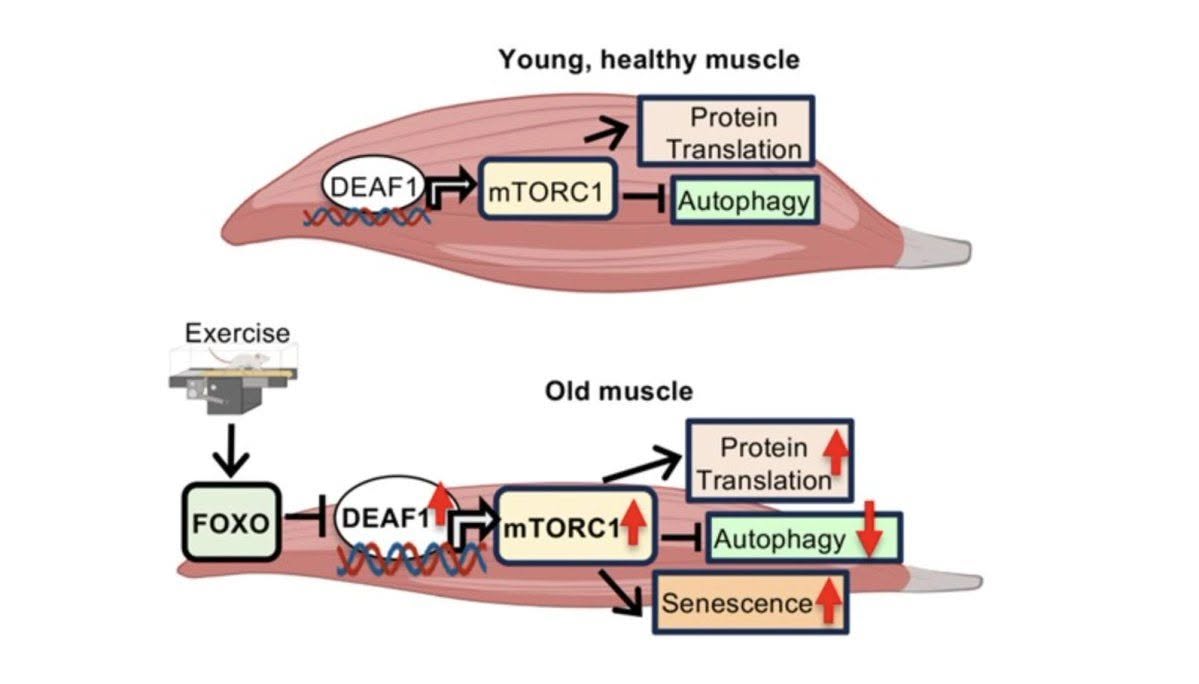
In the long term, exercise actually lowers basal levels of mTOR in the muscle of older people, and restores missing autophagy.
In the long term, exercise is a form of hormetic stress that lowers mTOR.
Link to full study (Choy et al, PNAS 2025):
Paper · Proc. Natl. Acad. Sci. U.S.A. · 2025Exercise suppresses DEAF1 to normalize mTORC1 activity and reverse muscle agingSkeletal muscle is essential for movement, respiration, and metabolism, with mTORC1 acting as a key regulator of protein synthesis and degradation. In aging muscle, mTORC1 becomes overactivated, contributing to sarcopenia, though the mechanisms remain unclear. Here, we identify DEAF1, a FOXO-regulated transcription factor, as a key upstream driver of mTORC1 in aged muscle. Elevated Deaf1 expression increases mTOR…pnas.orgOn the other hand, the activation of mTOR in muscle as a result of exercise is a short term adaptive repair process.
Any time tissue gets temporarily damaged (as happens with exercise) mTOR is activated in the short term to fix the damage. (For example, by turning on muscle protein synthesis.)
This short term repair process is adaptive in the sense that it strengthens the muscle over time to make future damage less likeky, e.g. hypertrophy.
It’s important to understand these differences between the short term verses long term effects that exercise has on mTOR in muscle.
We need a proper balance of anabolism and catabolism (e.g. autophagy) for our muscle to stay healthy as we age.
The aging process itself upsets this balance, and certain hormetic stressors like exercise, calorie restriction, fasting, etc. help to restore it. (The drug rapamycin, an mTOR inhibitor, likely does as well, when used properly at low doses.)
Quoted:
“Skeletal muscle is essential for movement, respiration, and metabolism, with mTORC1 acting as a key regulator of protein synthesis and degradation. In aging muscle, mTORC1 becomes overactivated, contributing to sarcopenia, though the mechanisms remain unclear. Here, we identify DEAF1, a FOXO-regulated transcription factor, as a key upstream driver of mTORC1 in aged muscle. Elevated Deaf1 expression increases mTOR transcription, leading to heightened mTORC1 activity, impaired proteostasis, and muscle senescence. Remarkably, exercise suppresses Deaf1 expression via FOXO activation, restoring mTORC1 balance and alleviating muscle aging. Conversely, FOXO inhibition or Deaf1 overexpression blocks exercise benefits on muscle health. These findings highlight DEAF1 as a critical link between FOXO and mTORC1 and suggest that targeting the FOXO–DEAF1–mTORC1 axis may offer therapeutic potential to preserve muscle function during aging.”