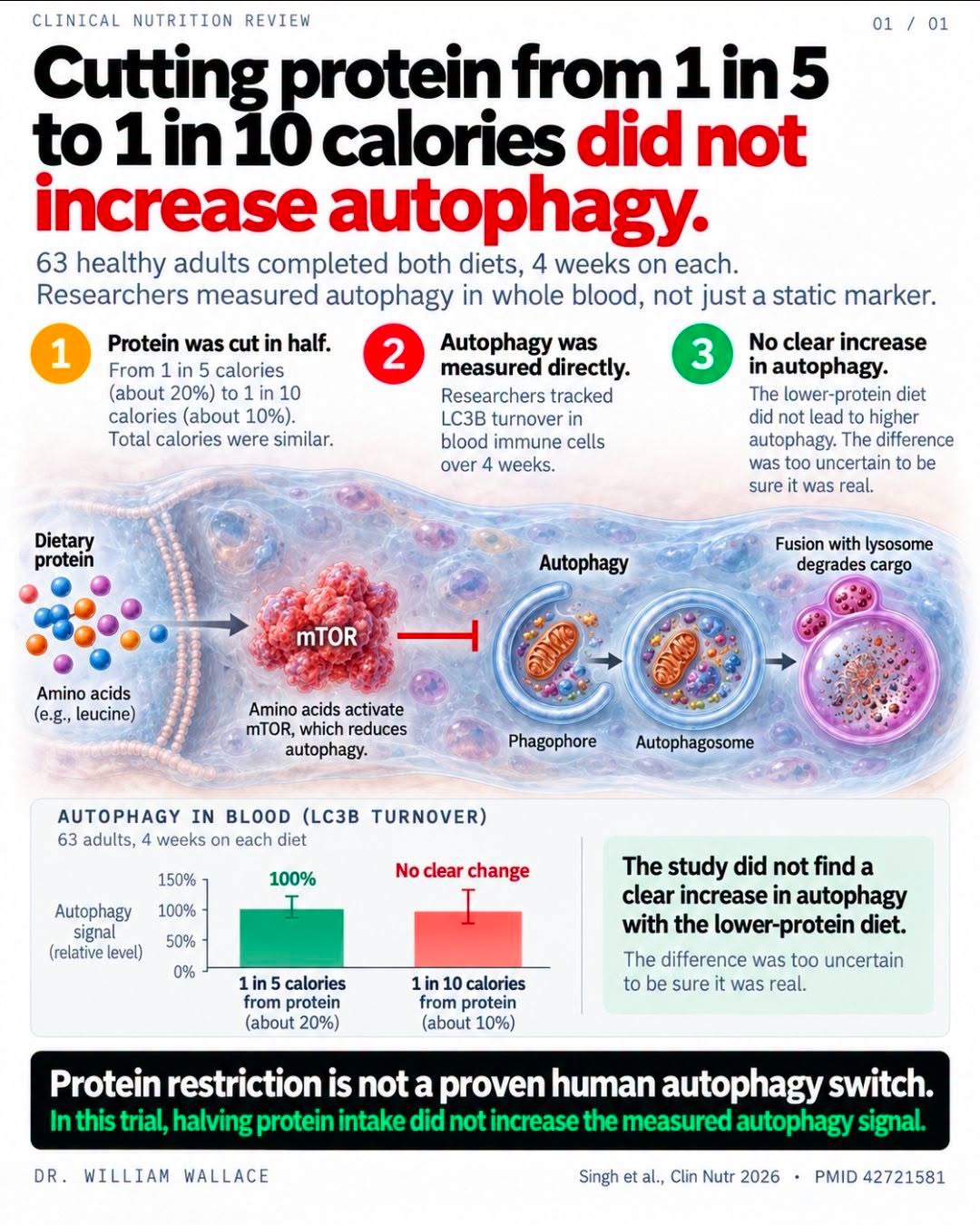
Cutting protein intake in half (from 20% to 10% of calories) did not significantly activate autophagy in human immune cells, over a 4 week trial period.
Moderate protein restriction alone, in the absence of fasting or caloric restriction, does not seem to increase basal levels of autophagy in circulating immune cells of healthy adults.
Link to journal paper (pre-print):
Paper · 2026Reduced dietary protein intake does not alter autophagy in human blood: a randomized crossover study in healthy adultsBackground & aims Autophagy activation is a promising strategy to counteract age-related cellular dysfunction. While preclinical studies suggest dietary protein restriction can induce autophagy via mTORC1 inhibition, direct human evidence using dynamic, flux-based measurements remains limited. The aim of this study was to determine whether a low protein diet could modulate autophagic flux in humans. Methods We…medrxiv.org
Quoted:
“We conducted a randomized crossover trial in which 74 healthy adults were randomized to receive two 4-week interventions of either average-protein (20% energy) or reduced-protein (10% energy) diets prescribed to maintain calculated energy balance, separated by a 4-week washout period. The primary outcome was autophagic flux measured in whole blood using a validated assay that preserves PBMCs in their physiological environment during lysosomal inhibition.”
“Moderate protein restriction does not increase basal autophagy in circulating immune cells of healthy adults, suggesting protein reduction alone, without caloric deficit, may be insufficient to activate autophagy in human blood.”
#autophagyHD #proteinHD #mtorHD
A common longevity claim is that lowering protein automatically “turns on” autophagy. A new human trial tested that assumption much more directly than most of the evidence behind it.
Researchers enrolled 63 healthy adults in a randomized crossover study. Each person completed two four-week diets: one providing about 20% of calories from protein and another providing about 10%. Total calorie intake was kept similar, allowing the researchers to isolate protein reduction rather than the effects of fasting or weight loss.
Importantly, they did not rely on a single static autophagy marker. They measured autophagic flux, which tracks how quickly cellular material is actually being processed through the autophagy pathway in circulating immune cells.
Cutting protein intake in half did not significantly increase that flux. The estimated difference favored neither diet clearly, and the confidence interval crossed zero.
That does not mean protein intake has no relationship with autophagy. Amino acids, particularly leucine, interact with mTOR signaling, and animal and cell studies provide strong mechanistic reasons to expect nutrient availability to influence the pathway. But mechanism is not the same as demonstrating that moderate protein restriction increases autophagy in humans.
There are also important boundaries. This study measured blood immune cells, not liver, skeletal muscle, or brain. It lasted four weeks per diet. And calories were maintained, so it tells us little about fasting or caloric restriction, where the biology may be different.
Simply cutting protein from about 20% to 10% of calories was not enough to produce a measurable increase in autophagic flux in this human study.
That makes “eat less protein to activate autophagy” a much less settled recommendation than it is often presented.
Reference:
Singh S, Fourrier C, Hein LK, et al. “Reduced dietary protein intake does not alter autophagy in human blood: A randomized crossover study in healthy adults.”