The short answer is that a ketogenic or very low-carb diet often raises LDL cholesterol, sometimes dramatically, and that being lean and metabolically healthy does not appear to cancel out the effect of that LDL on the arteries. The best direct test of this idea so far is the KETO-CTA study of "lean mass hyper-responders", which found measurable plaque growth over one year in people who already had plaque.12 The study was also heavily criticized, partly re-analysed and eventually retracted, so the details matter.34
That does not make every low-carb diet harmful. The group's posts describe real short-term benefits for weight, liver fat and blood sugar, and show that the answer depends on what you eat and how high your LDL goes.56 This article covers the numbers, where the evidence is solid or shaky, and what the admins suggest doing.
Key terms in plain language
- Ketogenic (keto) diet: a very low-carbohydrate, high-fat diet that pushes the body to burn fat and make ketones such as beta-hydroxybutyrate (BHB).11
- LDL-C and ApoB: two ways of measuring the cholesterol-carrying particles that enter artery walls. Nick Norwitz is paraphrased as saying ApoB is causal for atherosclerosis and necessary for it, though not necessarily sufficient.12
- Lean mass hyper-responder (LMHR): a lean, fit, metabolically healthy person (low triglycerides, high HDL) whose LDL-C rises very high on keto, often 190 mg/dL or more.3
- CAC and CTA: a coronary artery calcium (CAC) score measures calcified plaque. A CT angiogram (CTA) also shows soft, non-calcified plaque, which is the type KETO-CTA was designed to track.1314
- NCPV and PAV: non-calcified plaque volume (NCPV, in mm3) is the amount of soft plaque. Percent atheroma volume (PAV) is the share of the scanned vessel volume occupied by plaque, soft plus hard.1314
Why LDL rises on keto, and who is most affected
Population data show that low-carbohydrate high-fat (LCHF) eating tends to raise LDL. A cohort analysis in JACC: Advances found significantly higher LDL-C and ApoB in LCHF eaters than in people on a standard diet. Severe hypercholesterolemia (LDL-C above 5 mmol/L) was seen in 11.1% of LCHF versus 6.2% of standard-diet participants, and major adverse cardiovascular events over 11.8 years occurred in 9.8% versus 4.3% (adjusted hazard ratio 2.18, 95% CI 1.39 to 3.43). Those with a high LDL polygenic risk score had the highest LDL on LCHF.7 This is an observational association, so it cannot prove the diet caused the events.
Show data
| LCHF diet | Standard diet | |
|---|---|---|
| Severe hypercholesterolemia (LDL-C above 5 mmol/L) | 11.1% | 6.2% |
| Major adverse cardiovascular events | 9.8% | 4.3% |
For the extreme end, Louis Nervegna offers a hypothesis rather than a proven mechanism. In his view, a very lean person with almost no body fat who also removes carbohydrate and stays in ketosis can trick the body into acting as if it is starving. Circulating LDL then rises to deliver fat as fuel, leptin falls (which reduces LDL receptors and slows clearance), and thyroid and sex hormones fall. He links a 1999 Journal of Nutrition study in which fasting raised total cholesterol, LDL-C and ApoB in healthy non-obese people. He says it is more common with ApoE4 and when keto is combined with fasting and intense exercise.1516
Louis mentions LDL values of 500 or even 1,000 mg/dL in LMHRs, while KETO-CTA participants averaged about 254 mg/dL (a comparison chart reproduced in the group lists 237 mg/dL).11517
Not everyone on a low-carb diet responds the same way. Louis points out that lipid expert Tom Dayspring has followed a very low-carbohydrate (not keto) diet for years while keeping his LDL very low.18 Gokhan Can, who did keto on and off for about seven years, says he did not get sky-high LDL, still controls it with low-dose rosuvastatin, and avoids carnivore eating.19 A keto practitioner reshared by Gokhan reported that 15 years of keto lowered blood pressure, triglycerides, HbA1c, insulin and hsCRP but raised LDL and ApoB until he added ezetimibe.20
What KETO-CTA was and what it found
KETO-CTA was a one-year prospective cohort study of 100 lean, metabolically healthy people on keto with very high LDL (average about 254 mg/dL). They were active and health-conscious, most took "heart healthy" supplements, many fasted intermittently, and none had a diagnosis of heart disease.12 It was published in JACC: Advances in 2025 under the title "Plaque Begets Plaque, ApoB Does Not".14
Louis summarizes the headline results as follows:
- Total plaque volume rose by 0.8% on average after one year.1
- In people with a baseline CAC above 100, it rose by 2.4%, about three times the study average.12
- In people with a 10-year risk above 5% on the standard AHA calculator, it rose by 1.4%, about twice the average.1
- People with no plaque at baseline were unlikely to develop it within a year, no matter how high their LDL.12
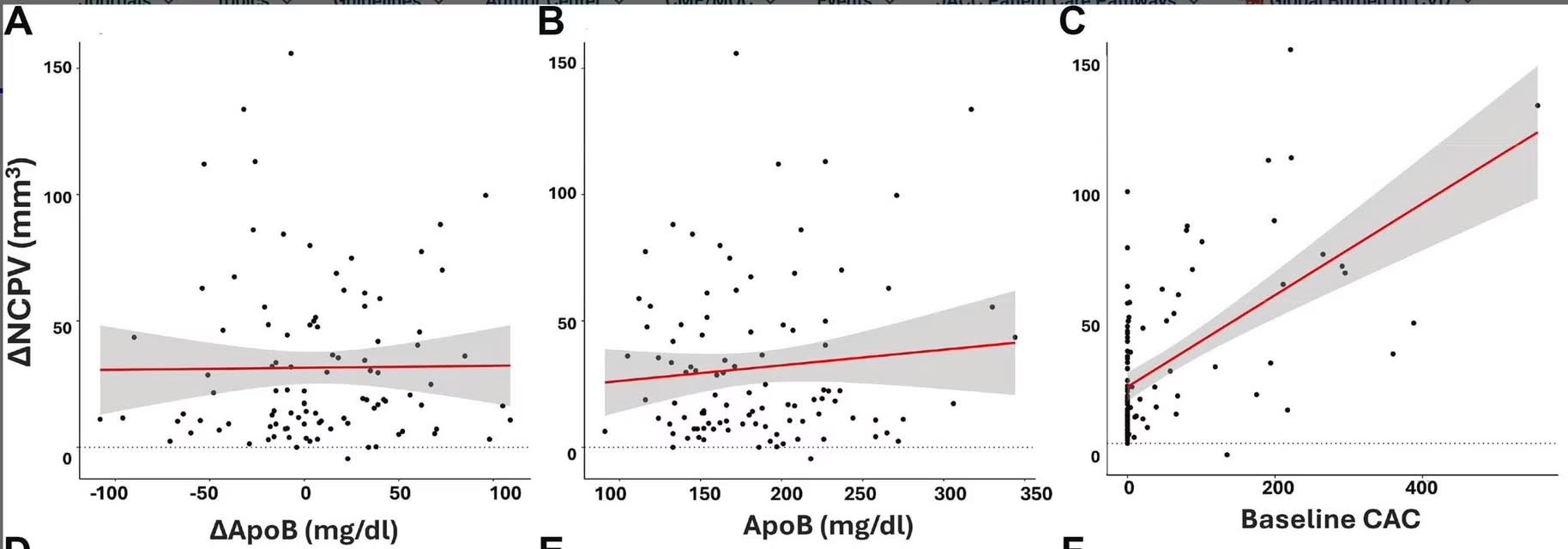
- Baseline plaque was strongly associated with progression, while ApoB was not, which is the basis of the paper's "plaque begets plaque" title.1
- In the individual-level figure, no participant showed regression of non-calcified plaque, and those who started with the most plaque progressed the most.213
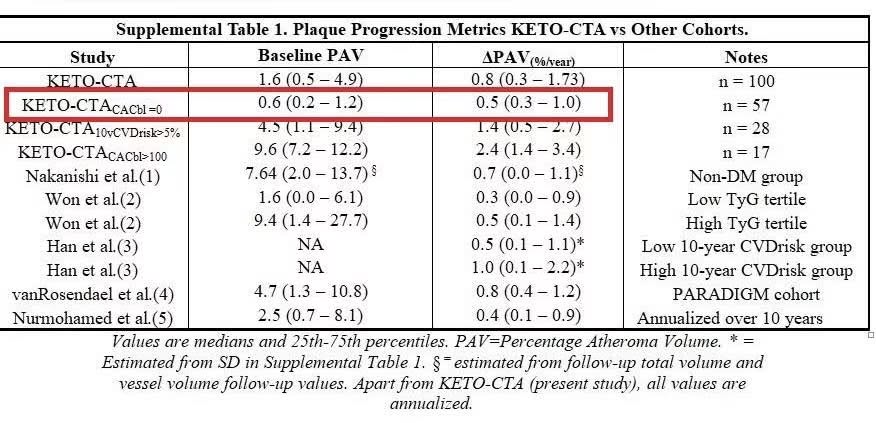
A table from the paper, as Louis reads it, shows PAV rising from 0.6% to 1.1% in people with CAC of zero, from 1.6% to 2.4% for the average participant, from 4.5% to 5.9% for the above-5%-risk group and from 9.6% to 12% for CAC above 100.14 Louis extrapolated those rates: people with CAC above 100 would cross the "severe plaque" line (PAV above 15%) in about 3 years, the average participant in about 17. He cautioned these straight-line projections are probably upper bounds.22
Show data
| Baseline | After one year | |
|---|---|---|
| Calcium score zero | 0.6% | 1.1% |
| Average participant | 1.6% | 2.4% |
| 10-year risk above 5% | 4.5% | 5.9% |
| Calcium score above 100 | 9.6% | 12% |
Gokhan makes a similar point from experience: group members who looked and felt excellent after years of keto or carnivore eating nevertheless had very early heart attacks, including a 95% blockage of the left anterior descending artery ("widowmaker") and a widowmaker heart attack at age 35.23 These are anecdotes, not controlled evidence.
How the plaque growth compares with other groups
The study had no control group, so the admins compared its numbers with other CT angiography cohorts. These cross-study comparisons are not randomized, a limitation critics raise.21
Nature-CT (standard diet, no medication). Louis highlights this as the closest comparison: a Budoff-led study from the same institute, with the same scanners and Cleerly software, a mean age of about 55, no diabetes and no lipid-lowering drugs. Over one year, NCPV rose 18.8 mm3 in the LMHR group versus 4.9 mm3 in Nature-CT, about 3.8 times faster. Budoff reportedly agreed it was a good comparison and planned a paper on it.1724 Later Louis acknowledged that Nature-CT's baseline plaque was a little lower (median 27.5 versus 44 mm3) but argued the difference was too small to invalidate the comparison.8
PARADIGM (serial CTA cohort). Quoting an analysis, Louis reports PARADIGM progression of about 3.2 mm3 per year in people without metabolic syndrome and about 5.6 mm3 per year with it, and only about 0.5 mm3 per year in properly statin-treated patients.2526 Nicola Guess made a similar estimate: about 13 mm3 over three years in PARADIGM's high-risk patients against about 20 mm3 in one year for the keto group, reading values off the paper's figure.27
Diabetes, SMARTool and PCSK9 comparisons. The quoted analysis places 18.8 mm3 per year near the roughly 17.4 mm3 per year seen in type 2 diabetes in a Budoff cohort, and nearly three times the 6.4 mm3 per year of SMARTool high-risk patients not on statins (1.0 mm3 per year on statins).26 In a separate Budoff study, higher-risk patients (53% hypertensive, 21% diabetic) whose LDL was lowered to about 30 mg/dL with the PCSK9 inhibitor Repatha mostly showed major plaque regression, while all the keto participants progressed or stayed neutral.13
DISCO-CT (statins plus DASH diet). In DISCO-CT, patients with non-obstructive coronary disease had plaque regression. The group cites a mean NCPV change of -21.3 mm3 with optimal medical therapy alone and -51.3 mm3 with added dietitian-led DASH diet advice, and elsewhere Louis plots -39.5 mm3 for DASH plus statins.828 Louis points out that DISCO-CT participants had nearly ten times more baseline plaque, yet regressed.8 The group describes DASH as very similar to a traditional Mediterranean diet.29
Colchicine. In another Budoff-led CT trial, 0.5 mg of colchicine daily reduced PAV by over 1% in a year versus placebo, which Louis contrasts with the 0.8% rise on keto. Budoff called it a small study.30
The controversy: primary outcome, re-analysis and retraction
The KETO-CTA paper was criticized almost from the day it appeared. The main concerns, as the group's posts describe them:
- Missing primary outcome. The registered primary outcome was the percent change in non-calcified plaque volume, but the paper's abstract and main text did not report it.2127 A letter to JACC says the lead author later shared a median rise of 18.8 mm3, roughly 43% above baseline.28 Gokhan has described it as a 50% rise in the median participant, which is his own rounding of the posted figure.31 People who reconstructed the paper's scatter plots reported a mean rise of 32.3 mm3, though that was a community reconstruction and not an official correction.32
- No control group, short follow-up and historical controls. Michael Albert notes that one year is brief compared with the 3 to 6 years of most plaque imaging studies and that cross-study comparisons ignore differences in baseline risk and imaging methods.21
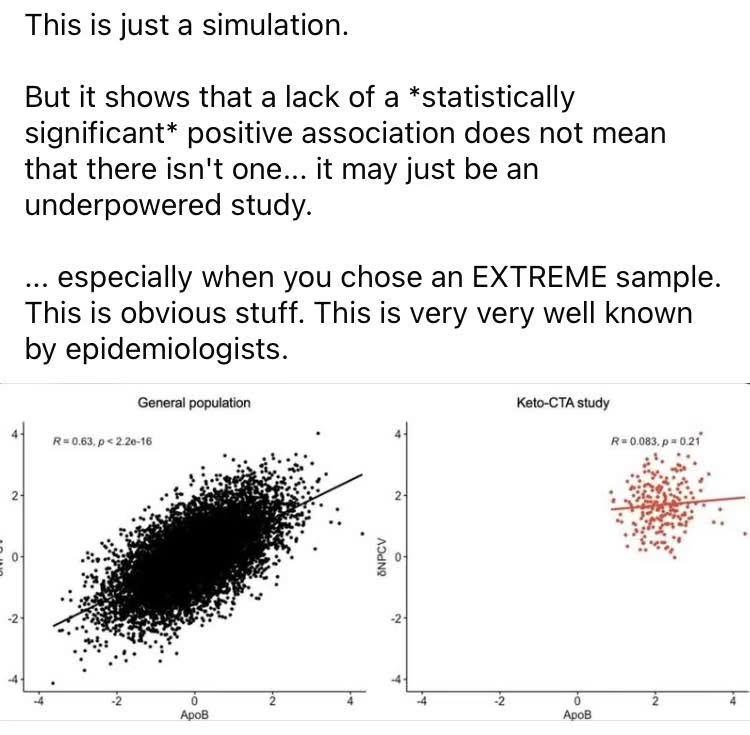
- The "ApoB does not matter" claim. John Mandrola's Medscape review is described as concluding that the data are nowhere near supporting the authors' claim that LDL is unrelated to atherosclerosis.3334 Louis shares an illustration suggesting that picking a small group from an extreme range of ApoB can make a real association look absent, a statistical explanation of why no ApoB link was seen.35
- Study design. Before results came out, Louis paraphrased Spencer Nadolsky, who helped write the original LMHR protocol, saying that enrolling only extremely healthy people, with no atherosclerosis, made detectable progression within a year unlikely, and that people with existing atherosclerosis would have been more informative.36
Budoff, the senior author, reportedly said in a video that the paper had major problems and that he was rewriting it, per Louis's summary of that video.3738 Louis at first argued the paper should stay published because the dataset was public and valuable and because the criticism targeted the write-up more than the methodology.33 In January 2026 JACC: Advances issued an Expression of Concern, announcing a confidential review of data integrity concerns under COPE guidelines. Louis notes that no evidence of wrongdoing had been presented and that some authors appear to have requested the review.4
By October 2026 Louis reports that the paper was retracted over concerns about the quality, blinding and reliability of the Cleerly automated plaque software. The investigators re-analysed the 200 scans with HeartFlow and QAngio. The fully blinded HeartFlow analysis gave a median NCPV rise of 5.5 mm3 and QAngio 5.6 mm3, compared with Cleerly's 18.8 mm3.3 Louis argues that this still matches the roughly 4.9 mm3 seen in Nature-CT's standard-diet group, and is as bad as people with untreated metabolic syndrome in PARADIGM (5.6 mm3 per year). He describes the change as moving from "horrible" to "just plain bad", while noting the re-analysis has not been peer reviewed.825
A fair reading is that the original large numbers (18.8 and 32.3 mm3) are now in doubt, the lower re-analysed numbers still show a rise in plaque in lean, healthy people, and there is still no control group. Gokhan also pointed readers to three detailed critiques (Kevin Klatt, Alex Leaf and Nicola Guess).32539 A quoted newsletter line he shared is blunter: people with sky-high LDL on low-carb diets should seriously consider lipid-lowering treatment.40
What else the group's posts say about keto
Possible benefits
Gokhan, who does keto for 3 to 12 months at a time, lists anti-inflammatory effects of BHB, appetite regulation and better insulin sensitivity, triglycerides and blood pressure.11 Stanford researchers described BHB-amino acids, new keto metabolites that suppress appetite, though the heart relevance is indirect.41 An 18-patient glioblastoma study reported 67% versus 8% three-year survival on keto, but Louis calls it tiny and the evidence mixed.42
A 2026 Cell Metabolism trial (Petersen et al.) fed 42 adults with obesity, prediabetes and fatty liver all their meals on keto (4% carbohydrate), Mediterranean (50%) or very-low-fat plant-forward (70%) diets until about 10% weight loss. All diets improved muscle insulin sensitivity and body composition, but liver fat fell 67% on keto versus 45% on the other two, and about half the keto group no longer met prediabetes criteria versus 29% on Mediterranean and 7% on plant-forward.543 Louis calls it a small study and wonders whether a Mediterranean-style keto diet would do even better.5
Weight loss and diabetes are less clear over time
- Louis notes that when calories are strictly matched in metabolic ward studies by Kevin Hall, low-carb diets did not produce more fat loss than normal-carb diets; appetite control is probably the main reason they work.44
- Gokhan cites a 2021 BMJ meta-analysis (23 trials) in which benefits at 6 months diminished by 12 months, and a 2020 meta-analysis (37 trials, 3,301 patients) in which the HbA1c advantage disappeared by 12 months and slightly reversed by 24 months. A 2-year trial comparing about 14% versus about 53% carbohydrate found identical weight loss (about 6.7 kg). His summary is that the benefit comes from adherence.45
- Louis stresses that a lower A1C on keto is not proof that diabetes has been cured. In his view only passing an oral glucose tolerance test shows that, and he describes liver and pancreas fat as the key.46 He also says very low-carb eaters rarely reach an A1C below 5 because of "physiological insulin resistance", the muscles sparing glucose, which is his own physiological reasoning rather than a trial result.47
- A 30-year Harvard cohort of over 200,000 people, as summarized in a video Gokhan shares, found that low-carb diets heavy in animal protein, saturated fat and refined carbohydrate such as white potatoes were linked to higher type 2 diabetes risk, while plant-based low-carb patterns (nuts, avocado, whole grains) were linked to lower risk.6
Other cautions raised in the group
- Methylglyoxal: a 2005 study of people on the Atkins diet found methylglyoxal, a glycation precursor, rose 1.67-fold by 14 to 28 days (2.12-fold in those in ketosis). Louis cautions that this measured markers, not outcomes.48
- Thyroid: Louis says prolonged very low-carb eating can lower T3 and T4 while TSH looks normal or low, and suggests gradually adding whole-food carbohydrates if full hypothyroidism is suspected. This is his mechanistic opinion without cited studies.4950
- Long-term unknowns: a long-term mouse study found keto protected against weight gain at first but later produced high cholesterol, fatty liver and impaired insulin secretion.51 Louis also argues that no long-lived population ate a carbohydrate-free diet, so the long-term heart effects are unknown.52
- Evidence quality: Louis calls an NHANES cross-sectional study suggesting keto might lower all-cause mortality hypothesis-generating at best.53
- A case report: a Circulation abstract described one LMHR patient whose coronary disease progressed rapidly after stopping a statin and starting keto; the authors advise caution for people with known coronary disease.54
Nuances and common misconceptions
- "If I look and feel great, my arteries must be fine." Gokhan's view is that appearance and energy do not rule out silent plaque, and that LDL and ApoB are the markers to follow.23
- "Good metabolic health protects against high LDL." Louis argues KETO-CTA tested this and found no protection in people with existing plaque, though people with zero plaque were unlikely to develop it within a year.155 Norwitz, as paraphrased, thinks the LMHR phenotype as a whole may carry different absolute risk and that the absolute benefit of lowering ApoB in LMHR is unknown.12
- "The study proved keto is deadly." It measured plaque on scans, not heart attacks, and its largest numbers have since been revised.13
- "The study proved keto is safe." It did not. Nadolsky's concern, as relayed by Louis, is that one year in extremely healthy people could not show harm even if it exists.36
- "Keto means carnivore." Gokhan suggests a nut-, fish- and olive-oil-heavy keto rather than a saturated-fat-heavy one.9 Louis shares a strict carnivore advocate's report of worsening cardiovascular health after 15 years, as anecdote not controlled evidence.56
What this means for you
These are points raised in the group, not individual medical advice. The admins recommend discussing them with your own doctor.
- Check your numbers on keto. Gokhan's advice is never to ignore LDL, and to consider cutting back on saturated fat in favor of nuts, fish and olive oil.9
- Consider imaging if you have been on keto with high LDL. Budoff, the study's principal investigator, recommends CT angiograms for his keto patients, and reportedly recommends a statin, low-dose aspirin and tight blood pressure control for those with significant plaque. He says the statin is aimed at the plaque, since statins slow progression even at low LDL.10 One keto practitioner chose a radiation-free carotid intima-media thickness test and still plans a CCTA.20
- Zero plaque is the best-case scenario. In KETO-CTA, people with no plaque at baseline were unlikely to develop it within a year, but the study could not say what happens over longer periods.114
- If you do low-carb, keep some carbohydrate and quality. Louis suggests including low-glycemic carbohydrates from non-starchy vegetables, legumes, berries, nuts, seeds and fermented dairy.52 Gokhan's own "Mediterranean plus low-carb" menu leans on vegetables, fish, eggs and nuts.57
- Watch for thyroid changes if you combine strict low-carb with heavy fasting or exercise.4950
- Treat single studies cautiously. The KETO-CTA saga shows how a headline number can change after re-analysis, and Louis has criticized influencers who he says misrepresent it.358
Frequently asked questions
Did KETO-CTA prove keto causes plaque?
No. It was a one-year cohort of 100 people with no control group, so it cannot isolate the effect of keto.121 What it does show is that lean, metabolically healthy people with very high LDL, especially those with baseline plaque, still had plaque growth.214 The original numbers were later questioned, and the paper retracted.3
Why was the KETO-CTA paper retracted?
Per Louis, the retraction followed concerns about the quality, blinding and reliability of the Cleerly plaque-analysis software.3 A January 2026 Expression of Concern had said data integrity concerns were under confidential review, and Louis notes no evidence of wrongdoing had been presented at that point.4
Is my LDL on keto a problem if my other numbers look great?
The admins suggest not assuming so. Louis argues good metabolic health did not protect people with existing plaque in KETO-CTA, while others (such as Norwitz as paraphrased) say the absolute risk in LMHRs is uncertain.1255 Because this is unresolved, the practical advice is to measure LDL and ApoB, consider imaging, and discuss it with a doctor.1023
Is keto better than a Mediterranean diet?
For liver fat in a small, tightly controlled trial, keto did better than both Mediterranean and low-fat plant-forward diets, though the Mediterranean diet also helped.543 For plaque, the admins point to DISCO-CT, where a DASH diet plus statins produced regression.829 When calories are matched, fat loss is similar.44
Do all very low-carb diets raise LDL?
Not in everyone. Dayspring's very low-carb diet comes with a very low LDL, and the LCHF cohort found the highest LDL in people with a high LDL polygenic risk score.718