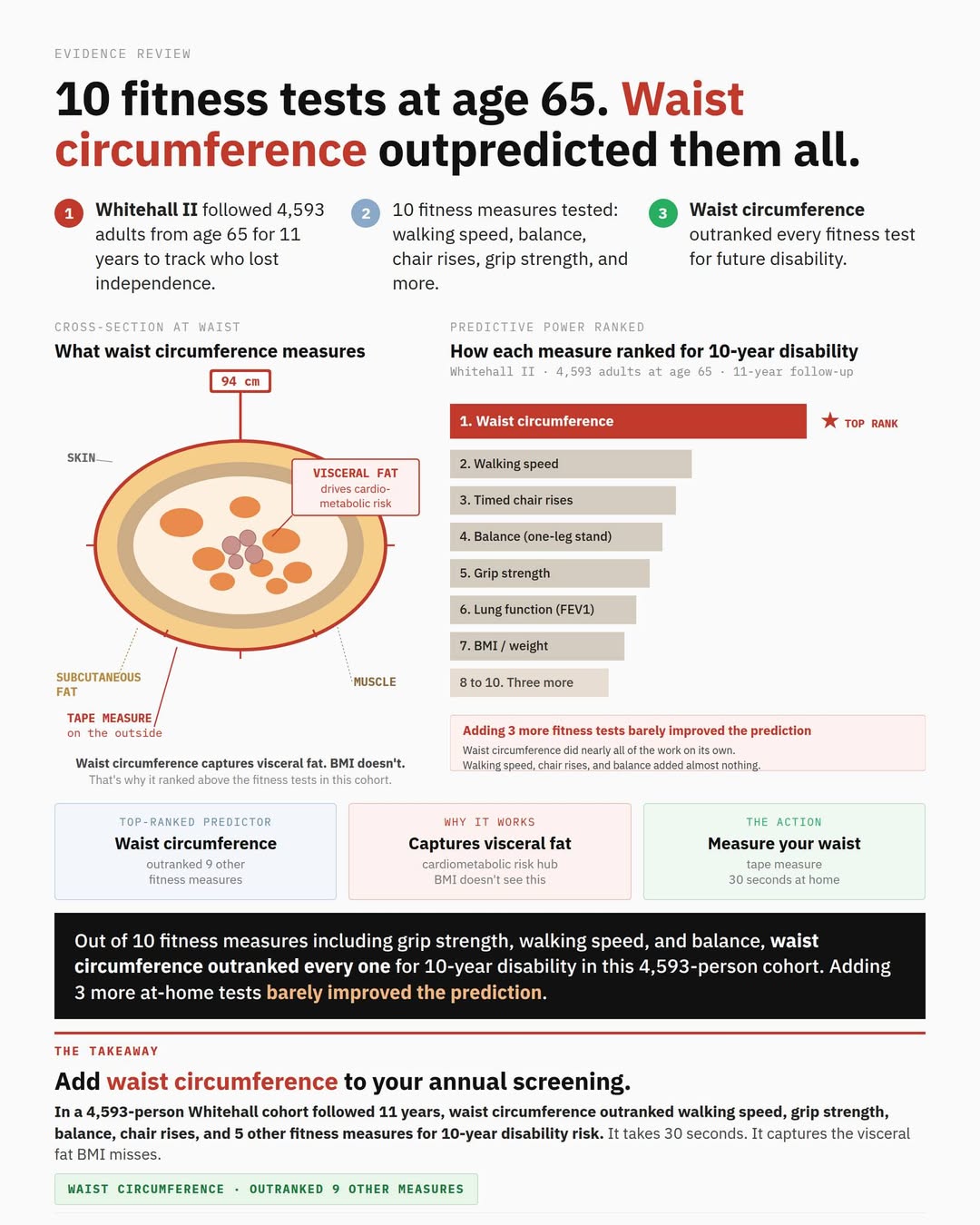
Waist circumference beats 10 other metrics commonly used in geriatrics for predicting risk of future disability in older people.
This includes grip strength, lung capacity, balance, walking speed, chair rises, and even BMI.
People at age 65 with the smallest waist circumference had the lowest risk of losing the ability to perform basic daily activities over the next 10+ years, e.g. dressing, bathing, standing, walking, toileting, feeding.
Adding the other metrics to waist circumference barely improved the prediction over waist alone. Waist circumference did almost all of the work on its own.
The message here is crystal clear:
Visceral fat is what really matters.
This is why diet is king. Nothing removes visceral fat more effectively than diet and nutrition.
All you need to do this test is a tape measure.
Link to full study:
Paper · GeroScience · 2026Identifying a fitness tool in early old-age to predict long-term risk of disability, severe disability, and mortalitylink.springer.com
#visceralfatHD #elderlyHD #waistcircumferenceHD
Walk into your next annual physical. They'll weigh you. They'll measure your height. They'll calculate your BMI. They probably won't measure your waist circumference. The Whitehall II cohort just published 11-year follow-up data demonstrating this is the wrong priority.
The Whitehall II study has followed UK civil servants for over three decades. In this latest analysis (Ben Hassen et al., GeroScience, 2026), researchers tracked 4,593 adults from a baseline age of 65 for a median of 11 years to identify who would lose the ability to perform basic daily activities: dressing, bathing, transferring, walking, toileting, feeding. They wanted to know which midlife test would best identify who would decline.
They tested 10 standard geriatric and fitness measures: walking speed, timed chair rises (how fast you can stand up from a chair five times), balance on one leg, grip strength, lung function (FEV1), BMI, and others. These are the measures geriatricians actually use in practice. They require a clinician, a stopwatch, sometimes a spirometer.
When the researchers ranked all 10 measures by predictive accuracy for 10-year disability, waist circumference came out on top. Higher than walking speed. Higher than grip strength. Higher than balance, chair rises, or lung function. The same pattern held for severe disability, defined as needing help with two or more daily activities.
The team then ran a machine learning analysis to find the smallest combination of measures that would maximize prediction. The final selected set: age, sex, waist circumference, walking speed, timed chair rises, and balance. For severe disability prediction, walking speed dropped out of the model entirely.
Here's the part that matters for practice. Adding walking speed, chair rises, and balance to waist circumference barely improved the prediction over waist alone. Waist circumference did almost all of the work on its own.
Why does this one measurement carry so much weight? Because waist circumference captures visceral adipose tissue, the metabolically active fat that wraps around your abdominal organs. Subcutaneous fat (the fat under your skin you can pinch) is mostly storage. Visceral fat is a different organ entirely. It secretes inflammatory cytokines including TNF-alpha and interleukin-6 that drive systemic insulin resistance. It promotes ectopic fat deposition in the liver, pancreas, and skeletal muscle. It disrupts adipokine signaling, lowering adiponectin and raising leptin in patterns that accelerate metabolic dysfunction. It correlates with atherosclerosis, type 2 diabetes, dementia, and frailty at higher rates than any other fat depot.
BMI cannot distinguish a person carrying weight as muscle from one carrying it as visceral fat. Two adults with identical BMIs can have radically different metabolic profiles. A 70-year-old man with a BMI of 27 and a 102 cm waist is metabolically a different person from a 70-year-old with the same BMI and an 88 cm waist. The first is at substantially higher cardiometabolic risk despite belonging to the same "weight class." Waist circumference captures part of this difference because it reflects where the fat actually lives.
This is not an argument to skip exercise or to deprioritize functional capacity. Walking speed, grip strength, and balance remain important markers of physical reserve. Training them matters for preserving independence and reducing fall risk. The Whitehall II finding is specifically about screening: when you have to pick one measurement to predict who will decline over the next decade, waist circumference outranked the entire fitness battery in this cohort.
What this looks like in practice. Add waist circumference to your annual physical or your own self-tracking. Measure at the level of your navel, tape parallel to the floor, after exhaling normally. Two minutes including writing it down. Track the trend year over year. A rising waist circumference with stable weight is the signal that body composition is shifting toward visceral fat accumulation, a metabolic warning that BMI will miss entirely.
The most informative aging marker in this 4,593-person cohort was a strip of plastic. The annual physical that skips it is missing the strongest individual predictor of the next decade of independence.
Ben Hassen et al., GeroScience, 2026
Whitehall II cohort, n = 4,593, median 11-year follow-up