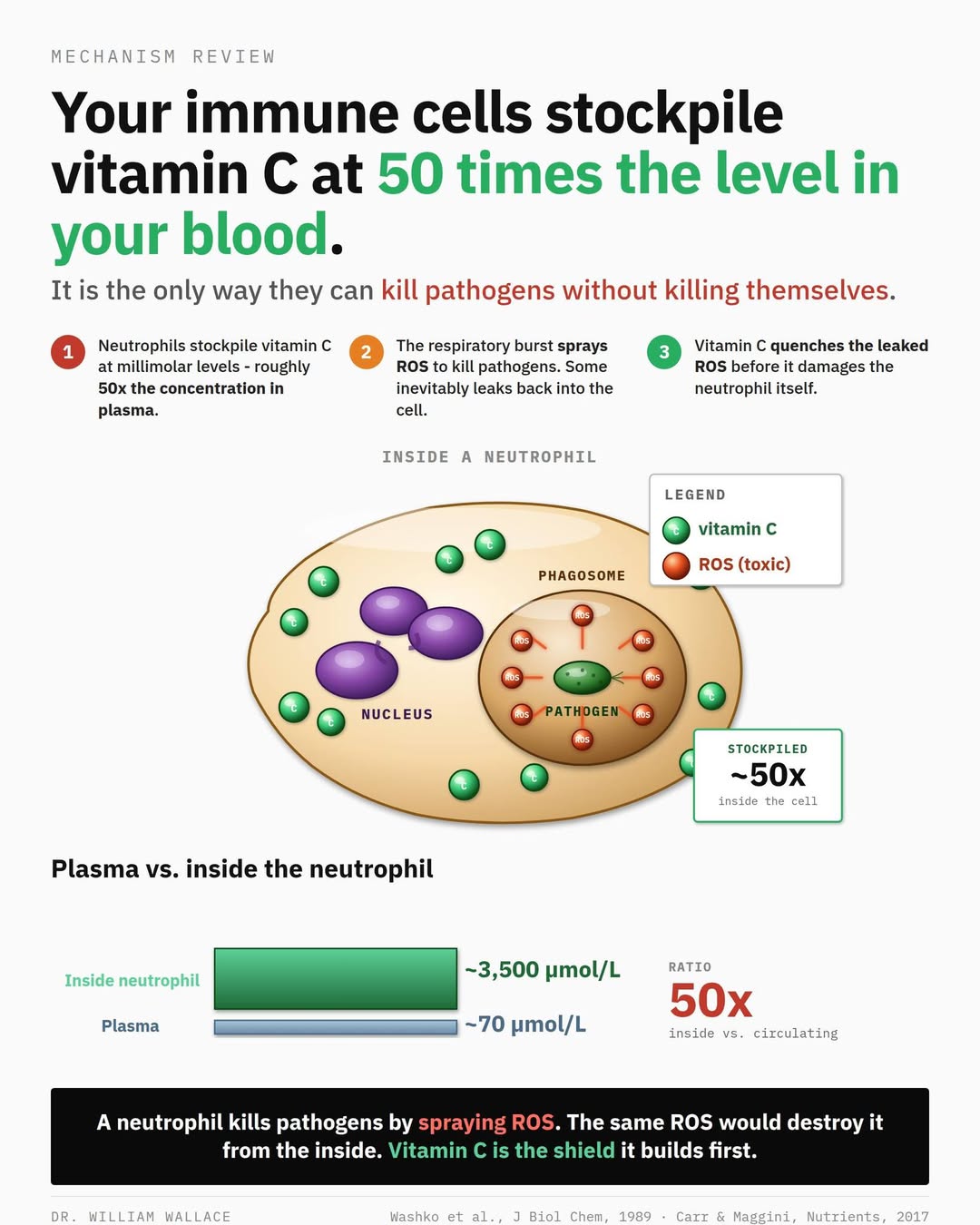
A nice explanation of why your neutrophils need vitamin C to fight infections.
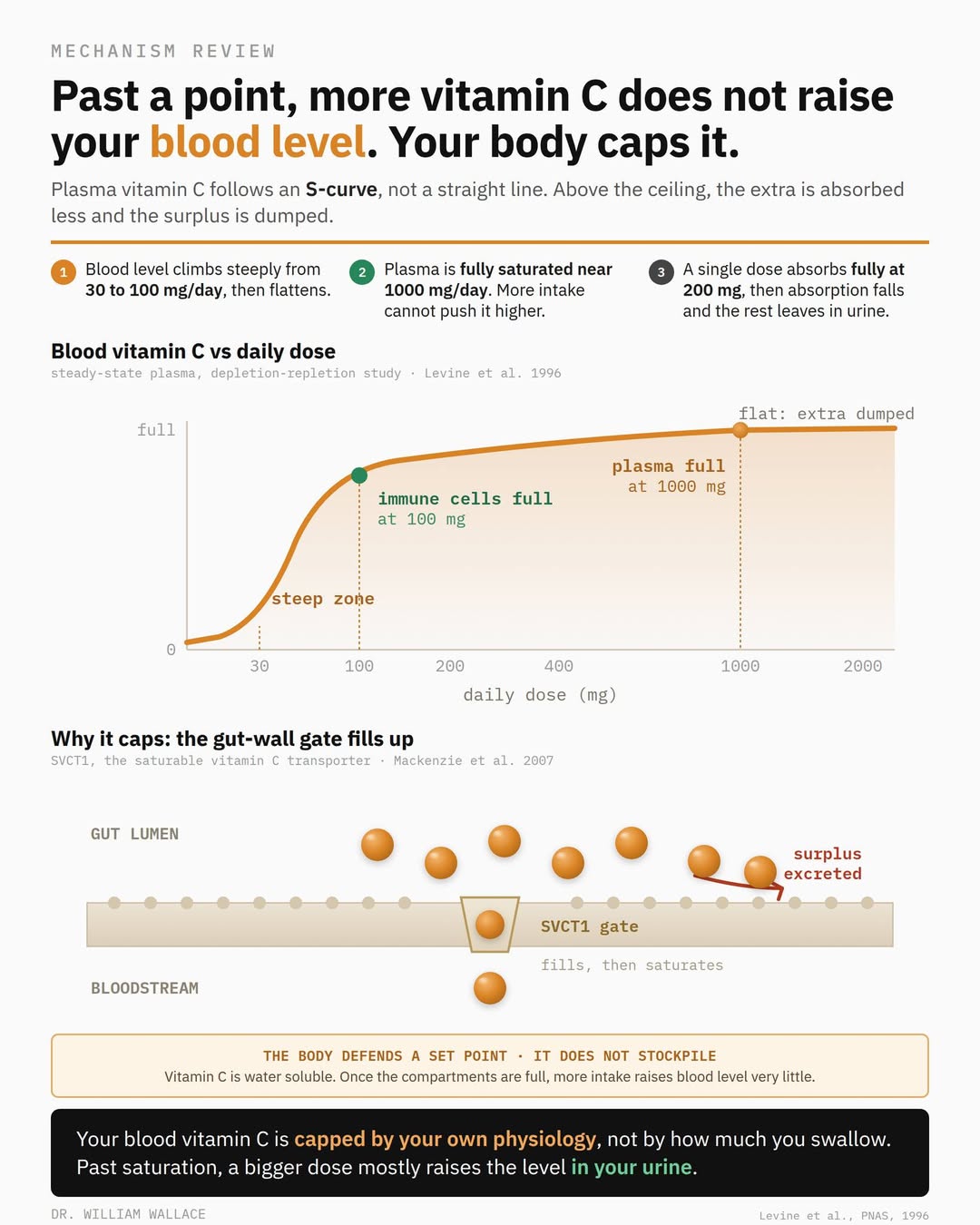
In a healthy person, neutrophil levels of vitamin C saturate at a dose of around 200mg, taken 2x per day.
The dose necessary to saturate neutrophils rises during infections.
#vitamincHD #neutrophilsHD #infectionHD
Vitamin C is famous as an antioxidant. That framing understates what it does inside your immune cells.
When a neutrophil hunts down a bacterium, it does not chew it apart. It engulfs the pathogen into a sealed compartment called a phagosome and detonates a respiratory burst inside, spraying reactive oxygen species like superoxide, hydrogen peroxide, and hypochlorous acid onto the trapped organism. This is essentially the chemistry of industrial bleach, used in a controlled space. It works. It also creates a problem.
ROS does not stay neatly contained. Some of it leaks back into the neutrophil itself. A cell that produces enough oxidant to kill a pathogen produces enough to kill itself. The neutrophil needs an internal antioxidant pool large enough to neutralize the leakage without shutting down the kill. Vitamin C is a major component of that pool.
Resting plasma vitamin C tops out around 70 micromolar at saturation. Inside neutrophils, the concentration sits in the millimolar range, roughly 50 times higher. This is not passive equilibrium. Neutrophils pump vitamin C across their membrane against a steep gradient using a sodium-dependent transporter called SVCT2, maintained at metabolic cost.
When neutrophils initiate a respiratory burst, their internal vitamin C drops sharply. Stankova 1975 and Winterbourn & Vissers 1983 documented this consumption during phagocytosis. The cell then needs to refill the reservoir. Repeated infection without dietary replenishment depletes the pool, and neutrophil function declines with it. Patients with severe infection routinely show plasma vitamin C well below healthy controls.
The practical question is dosing. Levine 1996 in PNAS measured this directly in seven healthy adults under controlled depletion-repletion. Neutrophils saturated at approximately 100 mg daily intake. Plasma saturated fully at 1000 mg daily. Single doses above 500 mg showed declining bioavailability with the excess excreted in urine. Above 400 mg daily, no measurable additional benefit appeared.
What this means: roughly 200 mg daily, split into two doses, keeps your neutrophil and plasma pools comfortably saturated. That is achievable from food alone. A red bell pepper, two kiwifruit, or an orange plus a cup of strawberries each put you in the range. The 1,000 mg pills do not get more vitamin C into your cells than the pepper does. They just produce more expensive urine.
Cellular vitamin C does not fall during infection because the immune system is broken. It falls because the system is working as designed and burning through its reserves to do it. Refilling the tank is one of the few interventions with mechanism, pharmacokinetics, and clinical context all aligned.
Washko et al., J Biol Chem, 1989
Levine et al., PNAS, 1996
Carr & Maggini, Nutrients, 2017