It is pretty well-established in animal models (and to some degree in humans) that high fructose intake causes fatty liver.
But in humans, high intake of whole fruit is repeatedly linked with lower risk of fatty liver. This is true in both randomized trials and prospective cohort studies.
The mechanism described in this post might partially explain why:
The fiber naturally bound to the fructose in whole fruit seems to protect the liver from the damaging effects of the fructose.
As a side note:
The high fructose content in sugar-sweetened beverages (like soda) has long been suspected as a major reason why these drinks seem to raise disease risk even more than other forms of refined carbohydrate. The fructose is delivered in highly absorbable liquid form, with zero protective fiber to help buffer the damaging effect on the liver.
#fructoseHD #fruitHD #fiberHD #inulinHD #fattyliverHD #liverfatHD #sugarsweetenedbeveragesHD #sodaHD
You have heard that fructose causes fatty liver. That part is true. What is less known is that your gut gets the first attempt at clearing it, and that step can be changed.
Fructose is broken down by your gut and your liver. In excess, the liver converts it into new fat, and over time that becomes fatty liver disease. The usual advice is to cut the sugar.
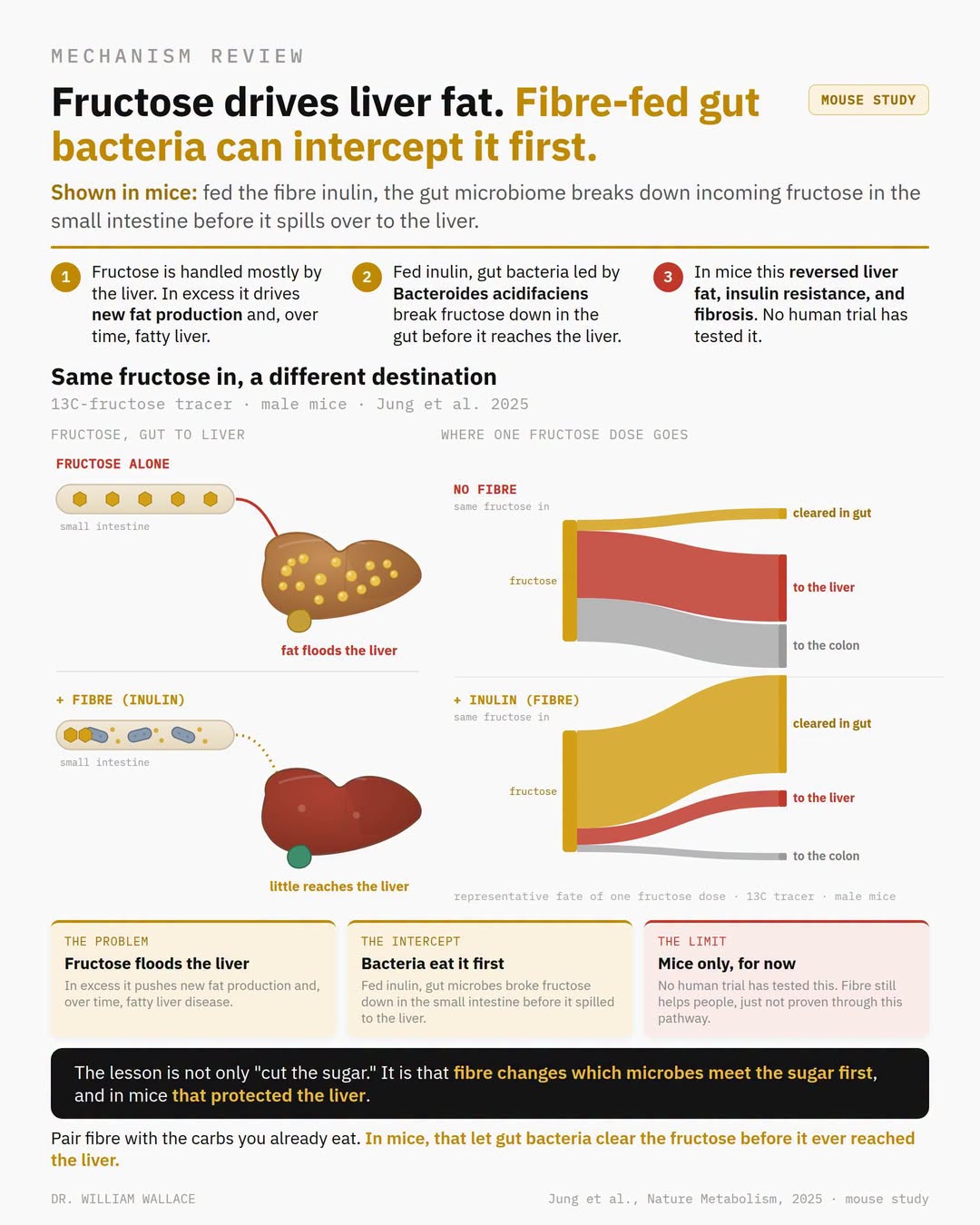
A 2025 study in mice found a second lever. Researchers fed the animals the fibre inulin and used a labeled tracer to follow where the fructose went.
The fibre did not change how much fructose reached the gut. It did not change how the mouse itself processed sugar. It changed the bacteria.
Fed inulin, the gut microbiome broke fructose down in the small intestine before it could spill over to the liver. Same fructose in, far less reaching the liver. A key species behind this was Bacteroides acidifaciens, and the effect transferred through the microbiome alone.
In these mice, the result was less liver fat, better insulin sensitivity, and reduced fibrosis.
This is a mouse study. No human trial has tested it. Fibre is good for people for many reasons, but this specific mechanism, gut bacteria intercepting fructose before the liver sees it, has not been shown in humans.
It changes how you think about the problem. Fatty liver is not only about how much sugar you eat. It is about which microbes meet that sugar first. The fibre is not feeding you. It is feeding the bacteria that clear your sugar.
Jung et al., Nature Metabolism, 2025