Psyllium husk is the most evidence-backed fiber supplement for lowering LDL cholesterol (LDL, the cholesterol carried in "bad cholesterol" particles that build up in artery walls). In the group's most-cited summary, about 10 g/day of psyllium lowered LDL by roughly 13 mg/dL on average across 28 randomized trials.1 A more recent analysis of 41 trials found a smaller average effect of about 9 mg/dL, so a realistic expectation is a modest, single-digit to low-teens drop rather than a dramatic one.2
Psyllium also appears to help with blood sugar, mainly in people whose blood sugar is already elevated. In type 2 diabetes it has been reported to lower fasting glucose and HbA1c (A1C, the three-month average of blood sugar), and the benefit seems to shrink as baseline glucose gets closer to normal.4
A key theme in the group is that "fiber" is not one thing. Whether a fiber lowers LDL depends on whether it forms a viscous gel, not on whether it is labeled "soluble." That is why the group's admins keep distinguishing psyllium and oat or barley beta-glucan from inulin, FOS and wheat bran.27 The sections below explain the mechanism, the numbers, the disagreements between sources, and the practical points that come up most often.
What psyllium is and how it lowers LDL
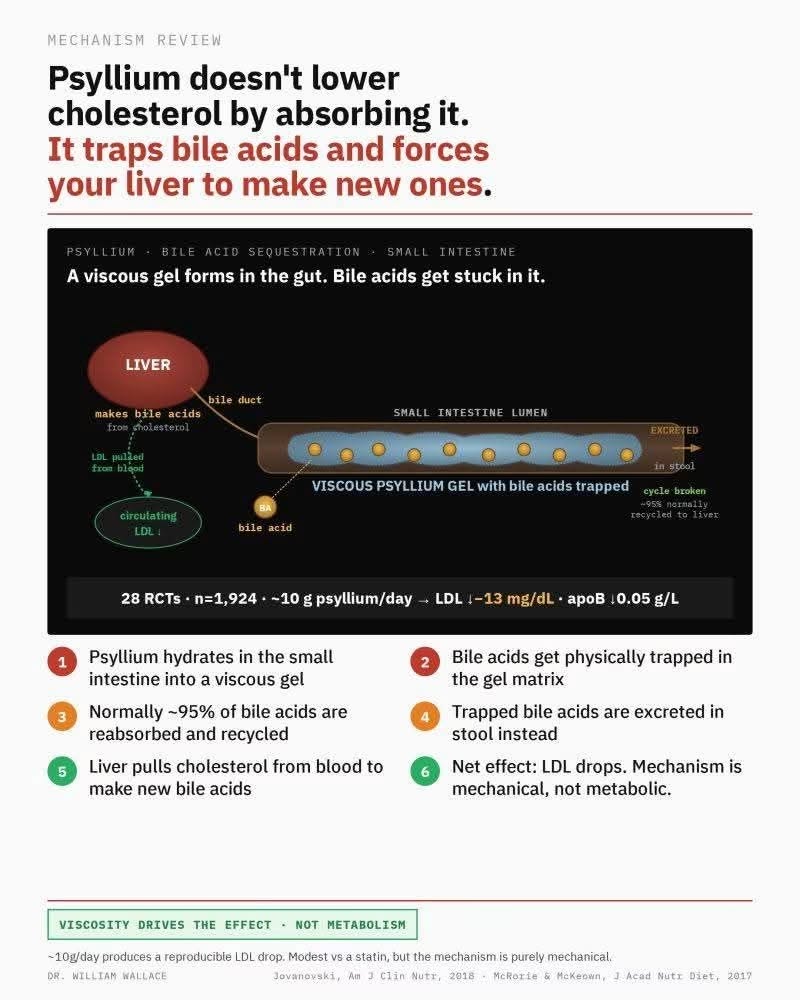
Psyllium is the seed husk of Plantago ovata. When it reaches the small intestine and hydrates, it forms a viscous gel.1 A widely shared explainer that Louis Nervegna reposted stresses that the mechanism is purely mechanical: psyllium does not absorb cholesterol and does not "scrub" the gut.18
The chain of events, as described in that explainer, runs as follows.
- The liver makes bile acids from cholesterol and releases them to help digest dietary fat. Normally about 95% of bile acids are reabsorbed in the ileum (the last part of the small intestine) and recycled back to the liver.12
- The pool cycles 4 to 12 times a day, losing about 5% on each pass. Recycling is efficient because making new bile acids is expensive, and the raw material is cholesterol.1
- The gel traps bile acids so more of them leave the body. The liver then has to make replacements. Loss of feedback signaling raises CYP7A1, the rate-limiting enzyme in bile acid synthesis, which draws down the liver's cholesterol pool.1
- As the liver's cholesterol runs low, SREBP-2 activates and LDL receptors are upregulated, so liver cells pull more LDL out of the blood. Serum LDL falls.18
The explainer notes this is the same principle used by prescription bile acid sequestrants.1 Louis's shorter version in another post: "to make new ones, your liver pulls LDL out of your blood."2
Why only some fibers work: the gel test
A recurring practical message is that the gel is the part that matters. Louis quotes a pharmacist's simple test: drop psyllium in water and it turns into a thick gel, while inulin dissolves clear.3 The same post advises that for an LDL goal one should choose a fiber that gels, namely psyllium or beta-glucan from oats and barley.3
A separate post lists the groupings explicitly.2
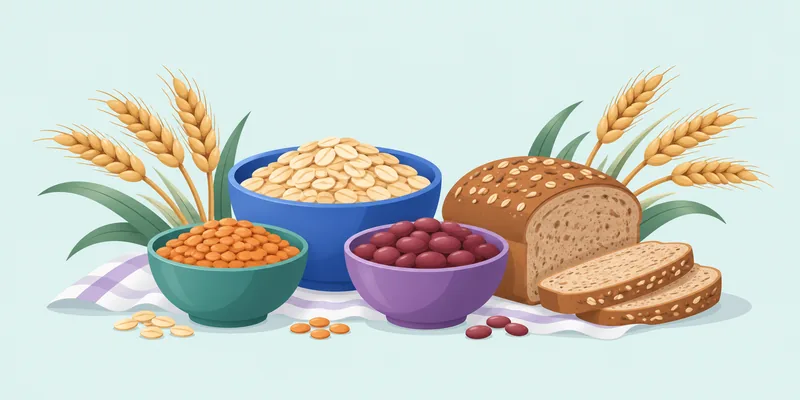
- Gel-forming: psyllium, oat and barley beta-glucan, raw guar gum.
- Not gel-forming: inulin, FOS (fructo-oligosaccharides) and wheat bran.
The same post adds a caveat: inulin-type fibers may lower LDL a little without forming a gel, but that evidence is described as very low certainty.2 Inulin is still presented as a perfectly good prebiotic (a fiber that feeds gut bacteria) for gut health; it simply is not a cholesterol tool.3
Soluble versus insoluble is an oversimplification
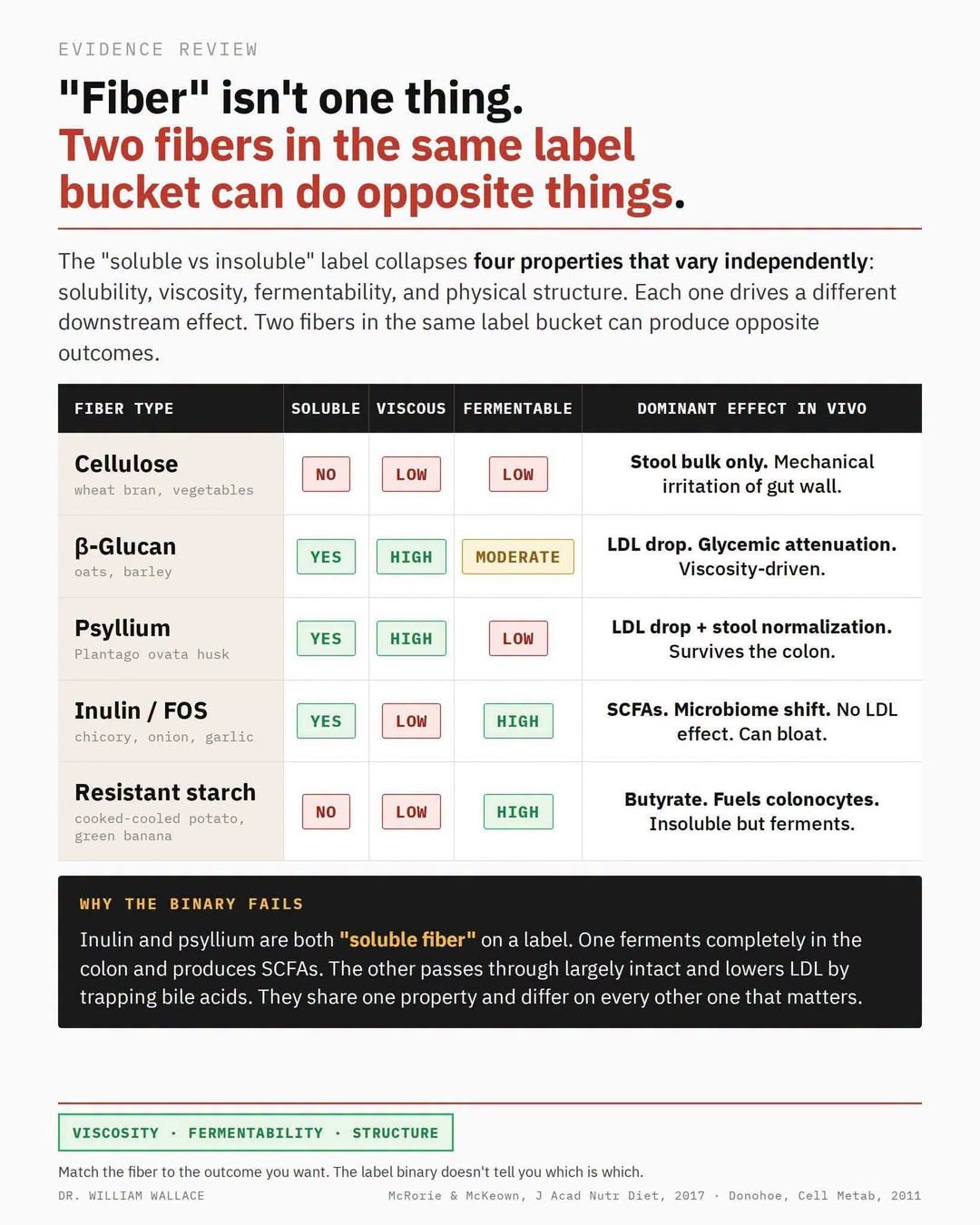
Another shared explainer reposted by Louis argues that the soluble/insoluble label hides four properties that vary independently: solubility, viscosity (gel formation), fermentability (whether colon bacteria eat it) and physical structure.7 Its examples are instructive.
- Cellulose (wheat bran, vegetables): insoluble, non-viscous, barely fermented. It bulks stool and speeds transit, with no metabolic effects.7
- Beta-glucan (oats, barley): soluble, highly viscous, moderately fermented. It lowers LDL through bile acid sequestration, and the FDA-approved oat health claim is built on this property.7
- Psyllium: soluble, highly viscous, poorly fermented, and it survives intact through the colon. It lowers LDL and normalizes stool, working for both constipation and diarrhea.7
- Inulin and FOS (chicory, onions, garlic): soluble but non-viscous and highly fermentable. Bifidobacteria use them to produce short-chain fatty acids. They have a minimal LDL effect and can cause bloating.7
The takeaway is that two fibers sitting in the same label bucket can do quite different things, which is why the group asks "does it gel?" rather than "is it soluble?"27
What the evidence shows
LDL and ApoB
The central number comes from the Jovanovski et al. meta-analysis (American Journal of Clinical Nutrition, 2018), which pooled 28 randomized trials with 1,924 participants. At a median dose of about 10.2 g of psyllium per day, LDL fell by about 13 mg/dL.12 A summary quoted by Louis lists the same study as also lowering ApoB (the protein on each atherogenic particle, so a count of those particles) by about 5 mg/dL.4
A 2025 meta-analysis of 41 trials (Gholami and Paknahad, Genes & Nutrition) found a smaller average LDL reduction, about 9 mg/dL.2 The posts do not explain why the estimates differ. A reasonable reading is that the true average effect is somewhere around 9 to 13 mg/dL, and that individual results vary. Louis himself describes the LDL effect elsewhere as "modest."9
Psyllium on top of a statin
One post quotes a pharmacist's reassurance that psyllium and cholesterol medication are compatible in a useful way: adding psyllium to a statin lowered LDL about as much as doubling the statin dose.5 The post does not name the underlying trial, so treat it as a reported finding rather than a precise, trial-tested figure.
Blood sugar
Two posts address glucose, and they differ in precision.
- A post quoting a longer breakdown cites a Gibb et al. meta-analysis (American Journal of Clinical Nutrition, 2015) of 35 randomized trials: HbA1c down about 0.97% in type 2 diabetes, and fasting glucose down about 37 mg/dL.4
- An earlier, shorter post by Louis states that psyllium lowers A1C by about 0.5% and blunts blood sugar spikes when taken with meals. The summary of that post notes that the shared item is no longer available and cites no source, so the 0.5% figure should be considered less well-supported than the 0.97% meta-analysis figure for people with diabetes.9
Importantly, the effect scales with baseline. The quoted breakdown says that if blood sugar is already fine, psyllium will not lower it further, and that in people whose HbA1c is creeping up (5.7-6.2%), taking psyllium before meals is among the better-evidenced low-cost options.4 The quoted author also reports his own HbA1c falling from 5.9 to 5.3 over eight months with psyllium as one contributor; this is a personal anecdote and cannot separate psyllium from other changes.4
Fiber as a whole-diet intervention
Fiber supplements are a small part of a larger story about dietary fiber. Gokhan Can's long summary cites the WHO-commissioned Reynolds et al. (2019) analysis of 185 prospective studies and 58 clinical trials. It reports that people eating 25-29 g/day of fiber had 15-30% lower all-cause mortality than low consumers, and 16-24% lower incidence of coronary heart disease, type 2 diabetes and colorectal cancer, with risk falling further for each additional 8 g/day.6
The same summary describes a 2025 NHANES analysis suggesting diminishing returns beyond about 30 g/day. In adults with metabolic syndrome, it identified an intake threshold of 22 g/day, and crossing it was associated with 20% lower all-cause mortality and 39% lower cardiovascular mortality.6 These are observational associations, so they do not prove that adding a supplement would produce the same results. The posts do not claim otherwise.
Nuances and common misconceptions
"All soluble fiber lowers cholesterol." Not so. Inulin and FOS are soluble but non-viscous, and the group's admins stress they have minimal or very-low-certainty LDL effects.27
"Psyllium works by absorbing cholesterol or cleaning the gut." The explainer the group reposted calls this a constant misrepresentation; the mechanism is mechanical trapping of bile acids.18
"Insoluble fiber does nothing." According to the shared explainer, cellulose still bulks stool and speeds transit, it just lacks the metabolic effects relevant to LDL.7
"A bigger effect should be expected." Psyllium's LDL effect is real but modest, in the range of roughly 9 to 13 mg/dL in the two meta-analyses.2 It is better seen as a low-cost supporting tool than a replacement for stronger LDL-lowering strategies. That framing is an interpretation of the numbers, not a statement made in the posts.
Inulin has other possible uses, but with limits. Louis shared a 2025 mouse study in which inulin shifted the gut microbiome so that fructose was broken down in the small intestine before it reached the liver, with less liver fat, better insulin sensitivity and reduced fibrosis in the mice. He notes this mechanism has not been tested in a human trial, and uses it only as a possible partial explanation for why whole fruit is linked to lower fatty-liver risk.10
What this means for you
This is education from the group, not medical advice. The group's admins recommend discussing any supplement with your doctor or pharmacist, especially if you take medications.
- If your goal is LDL, pick a gel-forming fiber: psyllium, or oat or barley beta-glucan, rather than inulin, FOS or wheat bran.23
- The meta-analysis dose behind the "about 13 mg/dL" figure was a median of about 10.2 g of psyllium per day.1
- Expect a modest effect, about 9 to 13 mg/dL on average, and recheck your lipids to see your own response. The author of one post, who says he carries two copies of APOE4, notes that LDL is a number he watches closely.2
- Take other medications about 2 hours apart from psyllium, because the gel can slow the absorption of some pills. Take particular care with thyroid medication and any drug with a narrow dosing window, and ask your pharmacist about your specific list.5
- If you are already on a statin, psyllium is reported to be complementary rather than conflicting.5
- For blood sugar, the benefit is largest when baseline glucose or HbA1c is elevated, and the quoted advice is to take psyllium before meals.49
- Keep inulin and FOS for what they are good for, such as feeding gut bacteria, and expect more fermentation and possibly bloating.37
- Do not forget food. Reynolds et al. linked 25-29 g/day of total fiber to lower mortality, so supplements are best viewed as an add-on to a fiber-rich diet.6
Frequently asked questions
How much does psyllium lower LDL?
On average, about 13 mg/dL at roughly 10 g/day in a meta-analysis of 28 randomized trials, and about 9 mg/dL in a 2025 meta-analysis of 41 trials.12
Does psyllium lower blood sugar in people without diabetes?
The quoted breakdown says the effect scales with baseline glucose and that psyllium will not lower blood sugar further when it is already fine. The large reported reductions (HbA1c about 0.97% and fasting glucose about 37 mg/dL) refer to type 2 diabetes.4 Louis separately states a roughly 0.5% A1C reduction, though that post has no cited source.9
Is inulin as good as psyllium for cholesterol?
No. Inulin does not form a gel, dissolves clear in water, and is described as a prebiotic that does not lower cholesterol; any LDL effect is of very low certainty.23
Can I take psyllium with my other pills?
The quoted pharmacist's rule is to separate psyllium from other medications by about 2 hours, with special care for thyroid drugs and narrow-window drugs. Confirm timing with your own pharmacist.5
Does psyllium work with a statin?
The post quoted by Louis reports that adding psyllium to a statin lowered LDL about as much as doubling the statin dose.5
Is psyllium only for cholesterol?
No. Beyond LDL and glucose, the shared explainer says psyllium normalizes stool, helping with both constipation and diarrhea.7