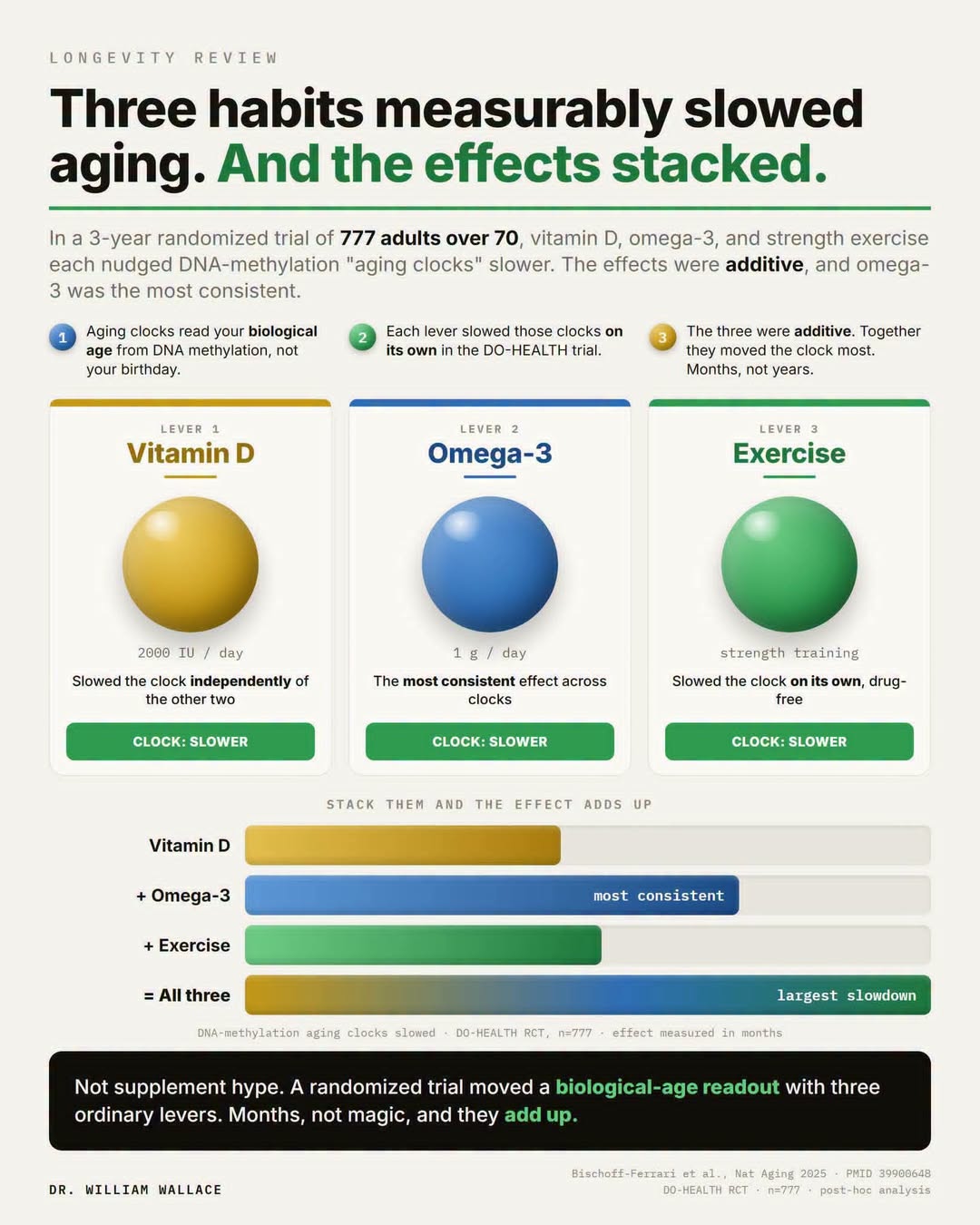
A three-year randomized trial moved a biological-age readout in older adults using three ordinary interventions, and the most reliable of them was fish oil. The trial was DO-HEALTH, and this particular result comes from a post-hoc analysis of 777 adults over age 70 who had been randomized to vitamin D at 2,000 IU per day, omega-3 at 1 gram per day, a home strength-exercise program, or combinations of the three, for three years. The outcome was not how people felt or how long they lived. It was the speed of their epigenetic aging, measured by DNA-methylation clocks.
These clocks deserve a word, because they are the entire basis of the claim. An aging clock estimates biological age from patterns of DNA methylation, chemical marks on the genome that shift in a fairly predictable way as a person ages. The newer generation of these clocks, including PhenoAge, GrimAge2, and DunedinPACE, were built to track health and mortality risk rather than just chronological age, and they are the tools this analysis used to ask whether any of the three interventions slowed the rate at which participants were biologically aging. The key thing to hold onto is that a methylation clock is a surrogate marker. It is a measurement of a biological process, not a measurement of disease, disability, or death.
Omega-3 was the standout. Taken on its own, 1 gram a day slowed three of the four clocks the analysis examined, PhenoAge, GrimAge2, and DunedinPACE, making it the most consistent single intervention in the trial. That is the cleanest finding in the dataset, and it is the one most worth carrying forward: of the three levers, the fish oil produced the broadest signal across independent measures of biological aging. Vitamin D and exercise did not show that same across-the-board effect alone. Their contribution showed up mainly when the interventions were combined.
The three interventions together produced an additive benefit on one specific clock, PhenoAge. That is the clock on which stacking vitamin D, omega-3, and exercise moved biological age more than any single one did. It is not the case that the effects stacked uniformly across every measure; the demonstrated additivity was on PhenoAge specifically, while omega-3 carried the consistency across clocks on its own. The combination did the most on the measure where addition was shown, which is a meaningful result and also a precise one that should not be inflated into a general claim that all three reliably compound on every readout.
The magnitudes were small: across the clocks, standardized effects ran from 0.16 to 0.32 units, which the authors translate to roughly 2.9 to 3.8 months of slowed biological aging over three years. Months, not years, on a surrogate marker. And the analysis was post-hoc, meaning these comparisons were specified after the trial's primary work was done, which lowers the evidentiary weight relative to a result the trial was originally designed to test. A slower methylation clock is a promising signal that these interventions touch the biology of aging, but it has not yet been shown to translate into fewer diseases, less disability, or longer life, and a post-hoc surrogate finding is a reason for measured interest rather than confident prescription. The defensible read is narrow and genuinely interesting: in a real randomized trial, three low-risk interventions each touched a biological-age readout, omega-3 most consistently, with additive benefit on one clock, and the entire effect was measured in months rather than years.
Bischoff-Ferrari et al., Nat Aging 2025
Belsky et al., eLife 2020
Lu et al., Aging 2019
Levine et al., Aging 2018