Fish oil is one of the most discussed supplements in the group, and the honest answer to "does it work?" depends on which product, which dose and which person. Taken together, the pooled randomized trials posted in the group point to a modest reduction in heart attack and coronary events from marine omega-3s (EPA and DHA).12 A purified, prescription form of EPA called icosapent ethyl (brand name Vascepa) has the strongest outcome data and a formal regulatory indication.3
The main caution is atrial fibrillation (AFib), an irregular heart rhythm. Higher doses appear to raise AFib risk, and the effect looks most relevant in people who already have high cardiovascular risk.4 Louis Nervegna, the group's admin who posts most of this material, adds the same warning to nearly every high-dose post: talk to your doctor before starting high doses of fish oil.56
This article walks through what omega-3s are, what the trials show, where the evidence is disputed or observational, and how group members approach dosing. It is a summary of what was posted, not medical advice.
What omega-3s are and what they actually do
The two long-chain marine omega-3 fatty acids are EPA (eicosapentaenoic acid) and DHA (docosahexaenoic acid). They become part of the phospholipid membranes that surround cells throughout the body, and DHA is especially concentrated in the brain and retina. ALA, the plant omega-3 found in flax and walnuts, is also essential, but humans convert only small amounts of it into EPA and DHA.8
One post pushes back on the idea that omega-3s are a generic "anti-inflammatory". Its argument is that the biology is more specific, and the clearest clinical effect is on triglycerides: at prescription doses of about 4 g/day, omega-3s typically lower elevated triglycerides by roughly 20-30%, with larger reductions possible when baseline levels are very high. That post stresses this is a pharmacologic dose and should not be confused with an ordinary fish-oil capsule or a serving of fish.8
Other measured effects are smaller:
- Blood pressure. A dose-response meta-analysis of 71 randomized trials found that 2-3 g/day of combined EPA and DHA lowered systolic pressure by about 2.6 mmHg and diastolic by about 1.6-1.8 mmHg on average, with larger effects in people with hypertension or elevated lipids.8
- Inflammation markers. In a meta-analysis of lipid-lowering therapies, fish oil lowered hsCRP (a blood marker of inflammation) by about 12.8%, compared with 17.3% for statins and 20% for bempedoic acid.9 The abstract quoted in that post says omega-3 fatty acids reduce CRP independently of LDL-C reductions.9
- Platelets. A review of functional foods notes that EPA and DHA reduce platelet aggregation, though results varied by dose and population.10
What the evidence shows for heart events
Pooled trials of EPA and DHA
The most-cited pooled analysis in the group is a 2021 meta-analysis and meta-regression published in Mayo Clinic Proceedings. It covered 40 randomized trials with 135,267 participants and reported:1
- Heart attack: relative risk 0.87 (95% CI 0.80 to 0.96), number needed to treat 272, rated high certainty.
- Coronary heart disease events: relative risk 0.90, number needed to treat 192, high certainty.
- Fatal heart attack: relative risk 0.65, number needed to treat 128, moderate certainty.
- Coronary heart disease mortality: relative risk 0.91, number needed to treat 431, low certainty.
- Overall cardiovascular events (a broad composite): relative risk 0.95 (0.90 to 1.00), which was not statistically significant.
Show data
| Relative risk (log scale) | 95% CI | |
|---|---|---|
| Heart attack | 0.87 | 0.80–0.96 |
| Coronary heart disease events | 0.90 | 0.84–0.97 |
| Fatal heart attack | 0.65 | 0.46–0.91 |
| Coronary heart disease death | 0.91 | 0.85–0.98 |
| Broad cardiovascular events composite | 0.95 | 0.90–1.00 |
The authors found the effect was dose-dependent for heart attack and cardiovascular events, with each additional 1 g/day associated with a 9% lower risk of heart attack, and suggested 1,000-2,000 mg/day of combined EPA and DHA.1 Louis called the 35% reduction in fatal heart attacks "especially impressive" compared with other interventions, and also added a warning that several trials showed a small increase in AFib at high doses.1
A separate JACC systematic review of 884 trials across 27 micronutrients (883,627 participants) found a similar signal for omega-3: cardiovascular mortality relative risk 0.93, heart attack 0.85 and coronary events 0.86. The same review found no effect of vitamin C, D, E or selenium on cardiovascular disease or type 2 diabetes, and an increase in mortality with beta-carotene.2
VITAL
The Harvard Gazette profile of JoAnn Manson, quoted in the group, describes the VITAL randomized trial of about 25,000 men and women aged 50 and older. It reported in 2018 that fish-oil omega-3s were associated with a 28% reduction in heart attack, and about 40% among people who reported minimal fish in their diet.11 This was a post quoting a news profile rather than the paper, so the group's summary does not give confidence intervals.
REDUCE-IT and icosapent ethyl
Icosapent ethyl is a highly purified ethyl ester of EPA. A post summarizing its FDA status says the agency continues to approve it to reduce cardiovascular risk, citing REDUCE-IT, which showed a 25% relative risk reduction in major adverse cardiovascular events. The label extension dates to December 2019.3 The indication is as an add-on to maximally tolerated statin therapy in adults with triglycerides of 150 mg/dL or more and either established cardiovascular disease, or diabetes plus two or more additional risk factors.3 An earlier post and the Harvard Health text it quoted describe the drug as lowering heart attack and stroke risk by 26% in people at high risk;5 the two figures differ slightly in the posts, so it is safest to say "roughly a quarter".
Louis emphasizes that Vascepa is high-dose EPA from fish oil, and that it is FDA-approved to lower cardiovascular risk, not just to lower triglycerides.5 Studies presented at the 2025 American College of Cardiology meeting were described as strengthening the case that purified EPA lowers heart attack and stroke risk even in patients already at an appropriately low LDL target, especially if triglycerides remain elevated.12
Plaque: EVAPORATE
The EVAPORATE trial (published in the European Heart Journal in 2020) enrolled 80 people with coronary artery disease, most of whom had diabetes and were on a statin, with triglycerides of 135 to 499 mg/dL. Half were randomized to 4 g/day of icosapent ethyl and half to placebo. After 18 months, imaging showed less unstable plaque and lower total plaque volume with the drug.5 A summary by group member Daniel Chong puts the reduction in vulnerable plaque at 17%,13 and Gokhan Can's ranking of plaque-regression strategies rates high-dose EPA as "likely helpful", noting that EVAPORATE showed markedly greater regression over 18 months and that another trial, CHERRY, also found greater regression with EPA.14
Louis includes high-dose EPA on his list of at least six strategies that have reversed plaque in randomized trials, alongside major weight loss, a Mediterranean or DASH diet, LDL-lowering drugs, colchicine and exercise.15 Other posts in the group repeat this list.1617 It is worth keeping the scale in mind: EVAPORATE was a small trial, and participants all had elevated triglycerides at the start.5
A member case report was shared as an illustration, not as evidence. A group member described a soft plaque with 70% stenosis in the left anterior descending artery that was no longer visible on a repeat coronary CT angiogram after roughly six to seven months on 6 g/day of over-the-counter EPA with a baby aspirin and no statin.6 The member himself wrote that he does not recommend others copy this without medical supervision because high-dose EPA can be dangerous for some, citing AFib and bleeding risks.6
Atrial fibrillation: the main safety question
The group does not downplay this. Louis wrote that the AFib risk from high doses "is real and should be taken seriously".4 The numbers he shared:
- A 2021 meta-analysis of seven randomized trials (81,210 participants), published in Circulation, found omega-3 supplementation raised AFib risk by 25% overall. Doses above 1 g/day were associated with a 49% higher risk, and each additional gram per day raised the hazard by 11%.4
- A 2026 updated meta-analysis of 35 trials (114,592 people) in Circulation: Arrhythmia and Electrophysiology concluded that high-dose EPA/DHA is associated with increased AFib in people at high cardiovascular risk, while low-dose EPA/DHA did not appear to raise AFib risk even in high-risk populations. Louis notes there was no increased risk from higher doses in people not at high cardiovascular risk.4
- The FDA-label summary for icosapent ethyl reports AFib or flutter requiring hospitalization in 5.3% versus 3.9% of participants, and bleeding in 11.8% versus 9.9%.3
Show data
| Icosapent ethyl | Placebo | |
|---|---|---|
| Atrial fibrillation or flutter needing hospital care | 5.3% | 3.9% |
| Bleeding events | 11.8% | 9.9% |
The shared explainer proposes that omega-3s integrate into cardiac cell membranes and change ion-channel behaviour.4 A video by fatty acid researcher Bill Harris was shared with the comment that whether fish oil causes or prevents AFib "is complicated" and may depend on dose and risk level.18
Bleeding has a longer-term perspective too. A 21-year Danish cohort of 54,546 adults aged 50 to 65 measured EPA and DHA in fat tissue and found that people with the highest EPA had a 36% lower risk of bleeding stroke; DHA was neutral and ALA was linked to a 32% higher risk, which the post says needs confirmation. The same post says pooled analysis of 11 randomized trials with more than 120,000 people found no increased brain bleeding, apart from a small added risk with high-dose prescription EPA. It is observational, so it cannot prove cause.19
Nuances, controversies and common misconceptions
Was the REDUCE-IT placebo a problem?
REDUCE-IT used mineral oil as the placebo, and some cardiologists argued the placebo may have mildly inflated the drug's apparent benefit. The post on FDA status says the agency concluded the efficacy was statistically and clinically significant, and that by its analysis a harmful placebo effect could account for at most a 2-5% relative risk difference.3
EPA alone, DHA, or both?
Gokhan describes aiming for 3 g EPA, 1 g DHA and 4.9 g total omega-3 per day by combining mixed EPA-DHA capsules with pure EPA, and notes that EPA appears to be the main contributor to vascular health but DHA may also help.20 The plaque case report above used EPA alone, with the member explicitly avoiding DHA.6 The group's trial results involve different products: icosapent ethyl in REDUCE-IT and EVAPORATE is pure EPA, while the 40-trial meta-analysis pooled EPA and DHA together.15 There is no head-to-head comparison in these posts.
The omega-3 index and "like smoking" claims
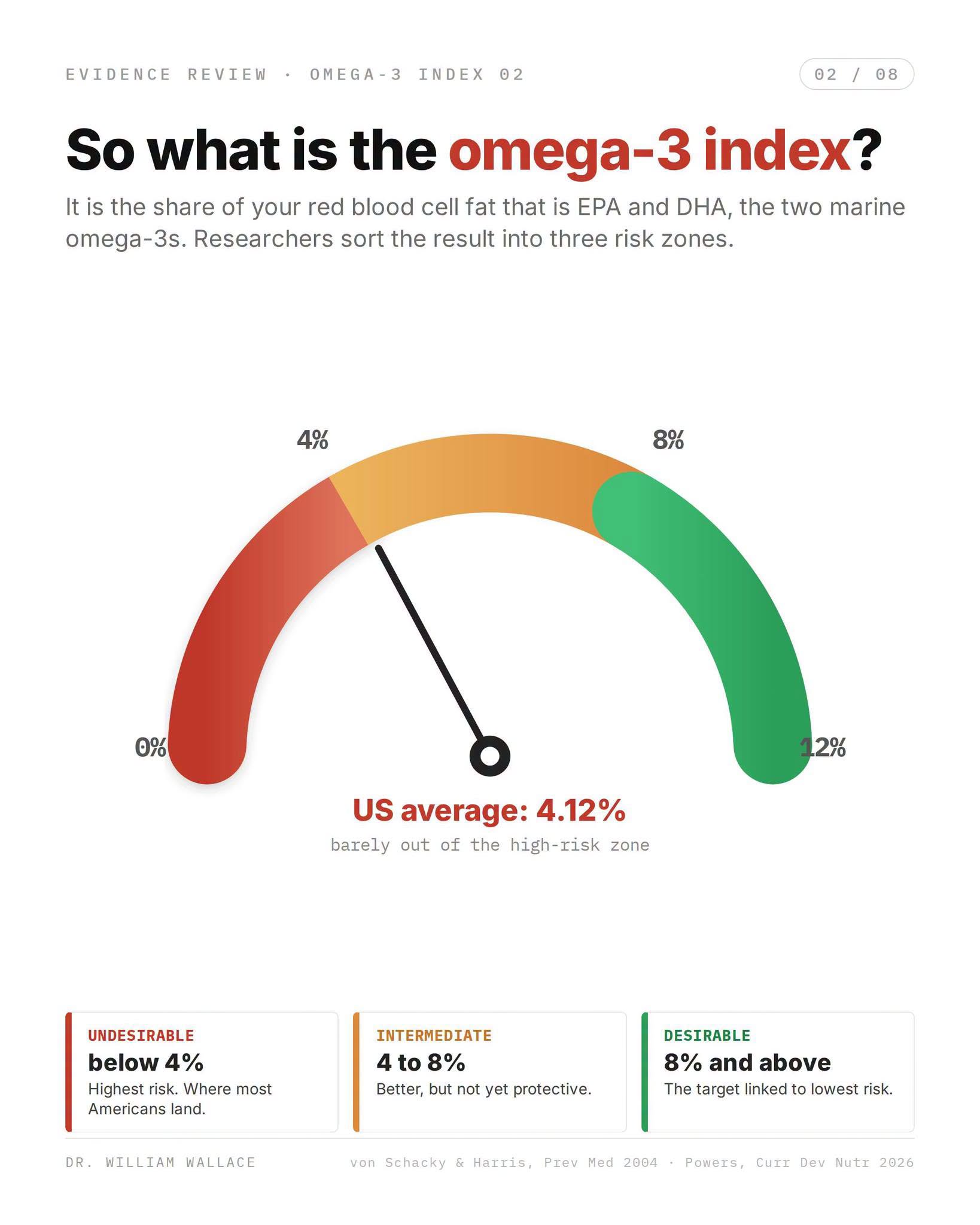
The omega-3 index is the share of red blood cell membranes made up of EPA and DHA. A set of posts relays claims, from FoundMyFitness and others, that an index below 4% carries a mortality risk comparable to smoking, and that about 2 g/day of EPA plus DHA raises the index from 4% to 8%, associated with roughly five more years of life expectancy.212223 A Rhonda Patrick keynote summary adds that an 8% versus 4% index was associated with 90% lower risk of sudden cardiac death.24 Louis labels this research as mostly observational, "but compelling", with some of it from the Framingham Heart Study.22
A later post cites NHANES data putting the US average index at 4.12%, with fewer than 1 in 50 reaching 8%. People in the highest fifth of the index had lower all-cause mortality in a 2,500-person cohort and a 42,466-person pooled analysis, and in Framingham the index predicted death better than cholesterol. The post itself says these are associations, not proof that raising the index saves lives.7 The same post says the dose needed to reach 8% from a 4% start is about 2,000 mg/day, and about 1,100 mg from 6%.7 A video from a company that sells the index test argues it may predict risk better than cholesterol; the post gives no numbers and the source has a commercial interest.25 Targets also vary among individuals: Peter Attia reportedly aims for a red-cell EPA+DHA level near 12% using about 2 g EPA and 1.5 g DHA daily, a personal regimen rather than evidence.26
Oxidized fish oil
Many people worry that rancid or oxidized capsules do harm. Louis shared Bill Harris's argument that this is likely not harmful, and that oxidized oil may be slightly less effective.27 He describes a human trial in which fish oil was deliberately super-oxidized and fed for 7 weeks, with no difference in oxidation, peroxidation or inflammation markers, nor in glucose, lipids or liver enzymes versus non-oxidized oil.28 Another post says randomized trials show oxidized fish oil does not worsen these markers.29
Omega-3s and the brain: mixed results
- DHA in APOE4 carriers. The PREVENT-E4 trial gave 2,000 mg/day DHA for two years to 365 adults aged 55 to 80 who rarely ate fish (47% APOE4 carriers). There was no difference in cognition or hippocampal volume on MRI. DHA reached spinal fluid equally in APOE4 carriers and non-carriers.30 Louis stresses that the trial was small, short and designed mainly to test brain penetration, so cognitive results are exploratory, and that APOE4 carriers with the highest DHA-to-arachidonic-acid ratio declined less.3031
- Observational signals can mislead. An observational ADNI study reported faster cognitive decline in fish oil users. Hussein Yassine, a USC neurologist, argues reverse causation is the likeliest explanation, as people who notice early memory problems start supplements.32
- Plant omega-3 trial. A Rutgers trial is testing ALA in APOE4 carriers with mild cognitive impairment, on the rationale that ALA enters the brain more easily in these carriers.33
Vegans and omega-3
Joel Fuhrman argues that vegans converting plant ALA poorly may have an omega-3 index below 4% and should use algae-based DHA and EPA to reach 6-9%, but the post comes from a promotional blog without cited studies.34
Aging, cancer and other findings
Louis has shared several other results, which are interesting but mostly use surrogate or secondary outcomes:
- In the 3-year DO-HEALTH trial of 2,147 adults aged 70 or older, 1 g/day of omega-3 slowed three epigenetic aging clocks by about three months, with nearly four months when combined with vitamin D and exercise. The trial also reported 10% fewer falls and 13% fewer infections with omega-3.35 A follow-up post hoc analysis in 777 adults found omega-3 slowed three of four methylation clocks, which are surrogate markers.36
- The combination of vitamin D3 2,000 IU/day, omega-3 1 g/day and home exercise was associated with a 61% reduction in invasive cancer (4 cases versus 12 on placebo, number needed to treat 35), a small number of events.3738
- In VITAL, omega-3 at 1 g/day showed no effect on leukocyte telomere length.39
- A 2022 meta-analysis of eight trials found 1-2 g/day reduced premenstrual syndrome severity, though heterogeneity was noted.40
- A 2025 review of 33 systematic studies found little evidence that omega-3 supplements improve lean mass, strength or physical function,41 though a small 8-week krill oil trial during alternate-day fasting reported less fat-free mass loss (-0.2 kg versus -1.2 kg).42
What this means for you
These points reflect what the group's posts say; they are not individual medical advice.
- Know your category. The strongest outcome evidence for a single product belongs to prescription icosapent ethyl, at 4 g/day, in people on statins with elevated triglycerides and established disease or diabetes.35
- Lower doses have the best-supported balance. The 40-trial meta-analysis suggested 1,000-2,000 mg/day of EPA plus DHA,1 and the 2026 AFib update found no AFib increase at low doses even in high-risk people.4
- Higher doses call for medical conversation. The group's admins consistently recommend talking to a doctor before starting high-dose fish oil, especially for anyone at higher risk of AFib.15
- Consider bleeding and other medicines. Bleeding events were somewhat more common on icosapent ethyl,3 and the member case report mentions both AFib and bleeding as risks.6
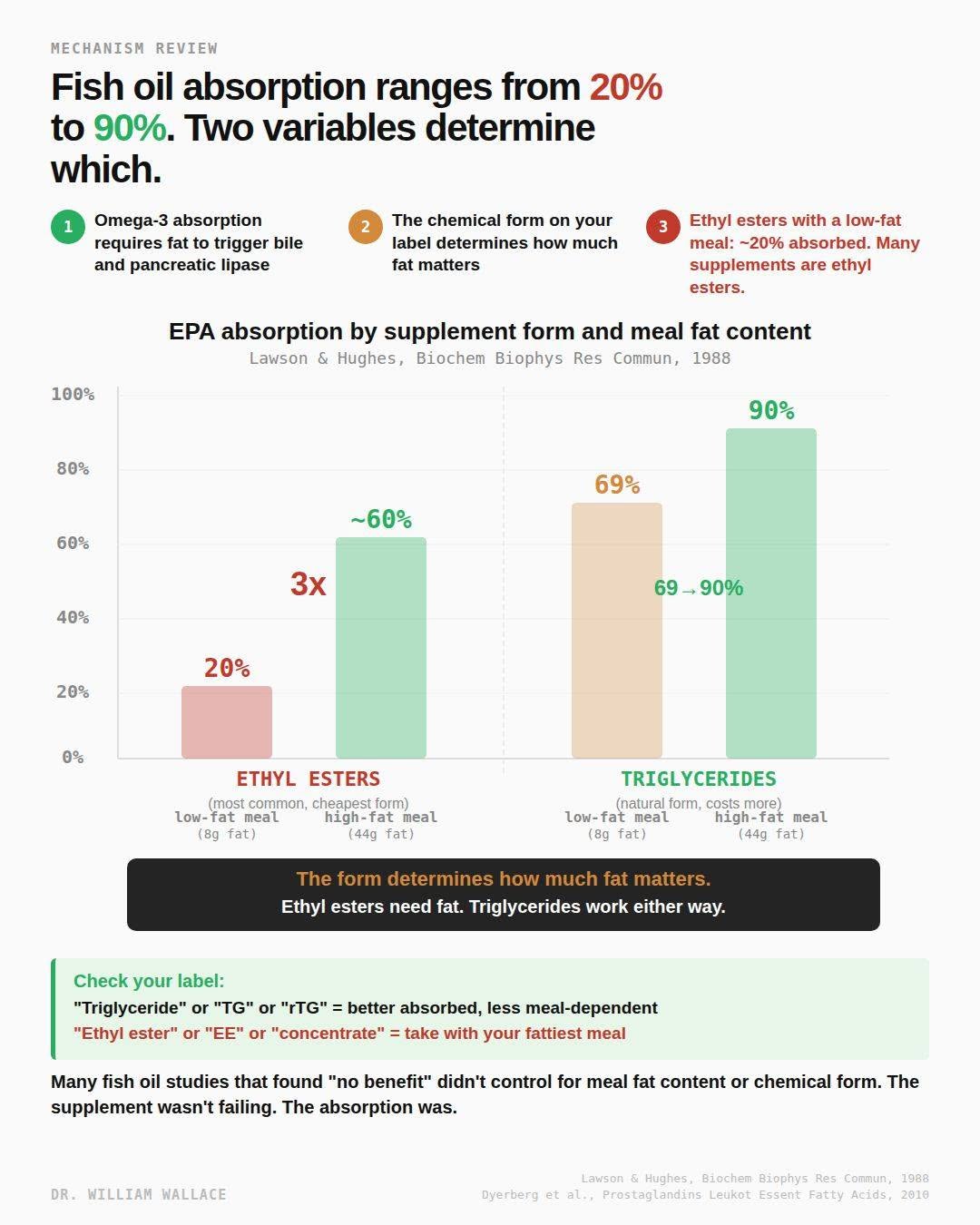
- Take it with a fat-containing meal. Louis shared Lawson and Hughes (1988): ethyl-ester EPA was absorbed at about 20% with a low-fat meal (8 g) and about 60% with a high-fat meal (44 g), while triglyceride-form fish oil was already around 69% absorbed with a low-fat meal.43
- Food counts too. The 2025 ACC scientific statement on inflammation emphasizes lifestyle measures, including two to three meals per week of fatty fish high in EPA and DHA, alongside exercise and a Mediterranean or DASH diet.44
- Treat omega-3 as one layer, not a replacement. Plaque-regression summaries rank statins, PCSK9 inhibitors and ezetimibe as having the strongest evidence, with high-dose EPA below them.14
Frequently asked questions
Does ordinary fish oil prevent heart attacks?
Pooled analyses of randomized trials suggest a modest reduction: heart attack risk fell 13% and fatal heart attack 35% in one meta-analysis, though overall cardiovascular events were not significantly reduced.1 Another large review reported a heart attack relative risk of 0.85.2
Is over-the-counter EPA the same as Vascepa?
Vascepa is a highly purified EPA ethyl ester used in REDUCE-IT.3 The posts do not compare it head-to-head with supplements, and the member case report used over-the-counter EPA at 6 g/day, which is not a trial result.6
How high a dose raises AFib risk?
In the 2021 meta-analysis, doses above 1 g/day were linked to a 49% higher AFib risk and each additional gram per day to an 11% higher hazard. The 2026 update found the increase in high-risk people at higher doses but not at low doses.4
Does fish oil lower triglycerides and blood pressure?
At about 4 g/day, omega-3s lower elevated triglycerides by roughly 20-30%. A 2-3 g/day dose lowers systolic blood pressure by only about 2.6 mmHg on average.8
Is oxidized fish oil dangerous?
Group posts relay trial evidence that deliberately super-oxidized fish oil did not worsen oxidation, inflammation, lipid or liver markers over 7 weeks, and that it may be only slightly less effective.2728