“Key takeaway: Ceramide is the molecule that makes insulin resistance worse than elevated blood sugar can explain alone. Reducing dietary saturated fat, increasing olive oil and omega-3s, and resistance training all reduce ceramide through three different mechanisms simultaneously.”
Edit—
Revised key takeaway from Gemini AI, which corrects some technical inaccuracies and overstatements in the post:
(See fact check in the comments.)
Ceramide is a primary lipotoxic driver of cellular insulin resistance, helping explain why excess saturated fat impairs metabolic health even before elevated blood sugar appears. Reducing dietary saturated fat directly cuts off the substrate needed for ceramide synthesis, while incorporating olive oil and omega-3s helps suppress ceramide synthesis pathways and inflammation. Concurrently, resistance exercise activates AMPK to burn off lipid precursors, clearing ceramide through complementary metabolic pathways.
#ceramidesHD
Ceramide is the convergent molecular driver of insulin resistance across skeletal muscle, liver, and cardiac tissue - a sphingolipid whose accumulation inside cells simultaneously blocks insulin signaling at two independent points in the cascade, producing complete insulin resistance regardless of how much insulin is present in the bloodstream. Understanding what ceramide is, how it accumulates, and what reduces it reveals the most actionable molecular target in dietary management of insulin resistance.
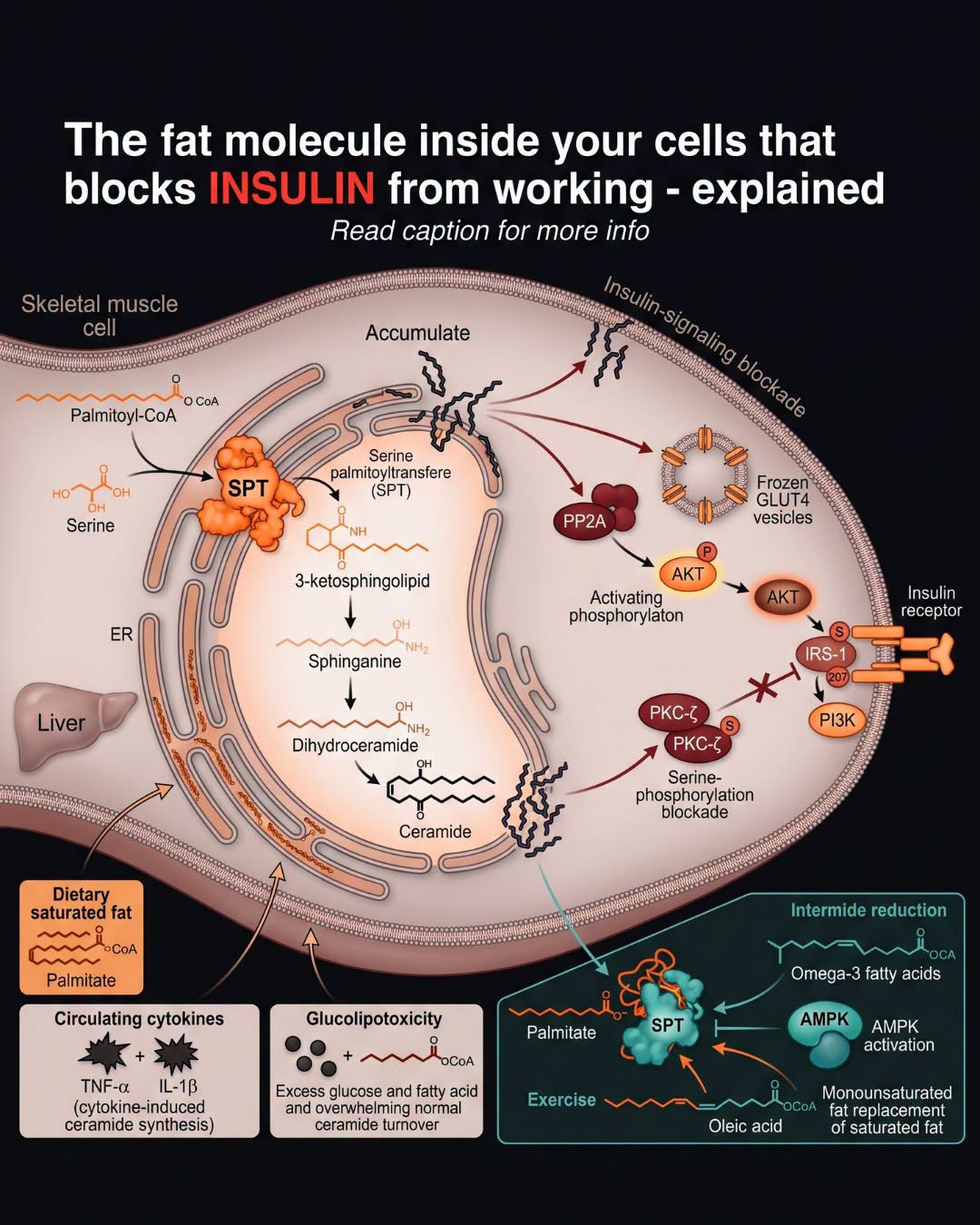
Ceramide is a sphingolipid - a fat molecule built from a sphingosine backbone with a fatty acid attached - that serves normal physiological roles in cell membrane structure, apoptosis regulation, and stress response signaling. Its pathological role in insulin resistance emerges when it accumulates in excess inside metabolically active cells - a state driven by three converging inputs: chronic dietary saturated fat excess providing palmitate as the primary substrate for de novo ceramide synthesis, inflammatory cytokines (TNF-alpha, IL-1beta) from expanded adipose tissue directly activating the ceramide synthesis enzyme complex, and glucolipotoxicity from chronic hyperglycemia combined with excess fatty acids overwhelming normal ceramide turnover.
The de novo synthesis pathway begins with palmitoyl-CoA - the activated form of palmitate, the 16-carbon saturated fatty acid predominant in animal fat and tropical oils - combining with serine through the enzyme serine palmitoyltransferase (SPT) on the endoplasmic reticulum membrane. Progressive enzymatic steps convert this initial product through sphinganine and dihydroceramide to the final ceramide structure.
Ceramide then simultaneously blocks insulin signaling at two independent molecular points. First - it activates protein phosphatase 2A, which directly dephosphorylates and inactivates AKT (the central kinase of the insulin signaling cascade) regardless of how strongly insulin has activated the upstream receptor and IRS-1. AKT inactivation blocks GLUT4 translocation, blocking glucose entry into the cell. Second - ceramide activates PKC-zeta which serine-phosphorylates IRS-1 at serine 307, placing an inhibitory block upstream of PI3K and AKT. Two simultaneous blockades at two different points in the same cascade produce complete insulin signaling failure that cannot be overcome by increasing insulin concentration.
The dietary interventions that most specifically reduce ceramide: replacement of dietary saturated fat with monounsaturated fat (olive oil, avocado) reduces the palmitoyl-CoA substrate supply to SPT, directly reducing de novo ceramide synthesis rate. Omega-3 fatty acids compete with palmitate for SPT substrate binding, reducing ceramide production while simultaneously producing the pro-resolving mediators that reduce TNF-alpha and IL-1beta - addressing the cytokine-induced ceramide synthesis simultaneously. Resistance exercise activates AMPK which enhances ceramide clearance through ceramide kinase activation.
Key takeaway: Ceramide is the molecule that makes insulin resistance worse than elevated blood sugar can explain alone. Reducing dietary saturated fat, increasing olive oil and omega-3s, and resistance training all reduce ceramide through three different mechanisms simultaneously.
Save this post - share it with someone you love. Heart emoji
📌 RESOURCES
Ceramide and Insulin Resistance: pubmed.ncbi.nlm.nih.gov - search "ceramide insulin resistance PP2A AKT IRS-1 skeletal muscle"
Dietary Fat and Ceramide: pubmed.ncbi.nlm.nih.gov - search "saturated fat palmitate ceramide insulin signaling"
American Diabetes Association - Lipotoxicity: diabetesjournals.org/diabetes
#Diabetes #Type2Diabetes #BloodSugar #InsulinResistance #DiabetesAwareness