Brown adipose tissue - the metabolically active fat that produces heat by consuming glucose and fatty acids rather than storing them - is one of the most therapeutically significant tissues in Type 2 diabetes management that most patients have never heard of. It is structurally and functionally the opposite of the white adipose tissue that drives insulin resistance, and activating it produces blood glucose reduction through a completely insulin-independent pathway that works even in severely insulin-resistant tissue.
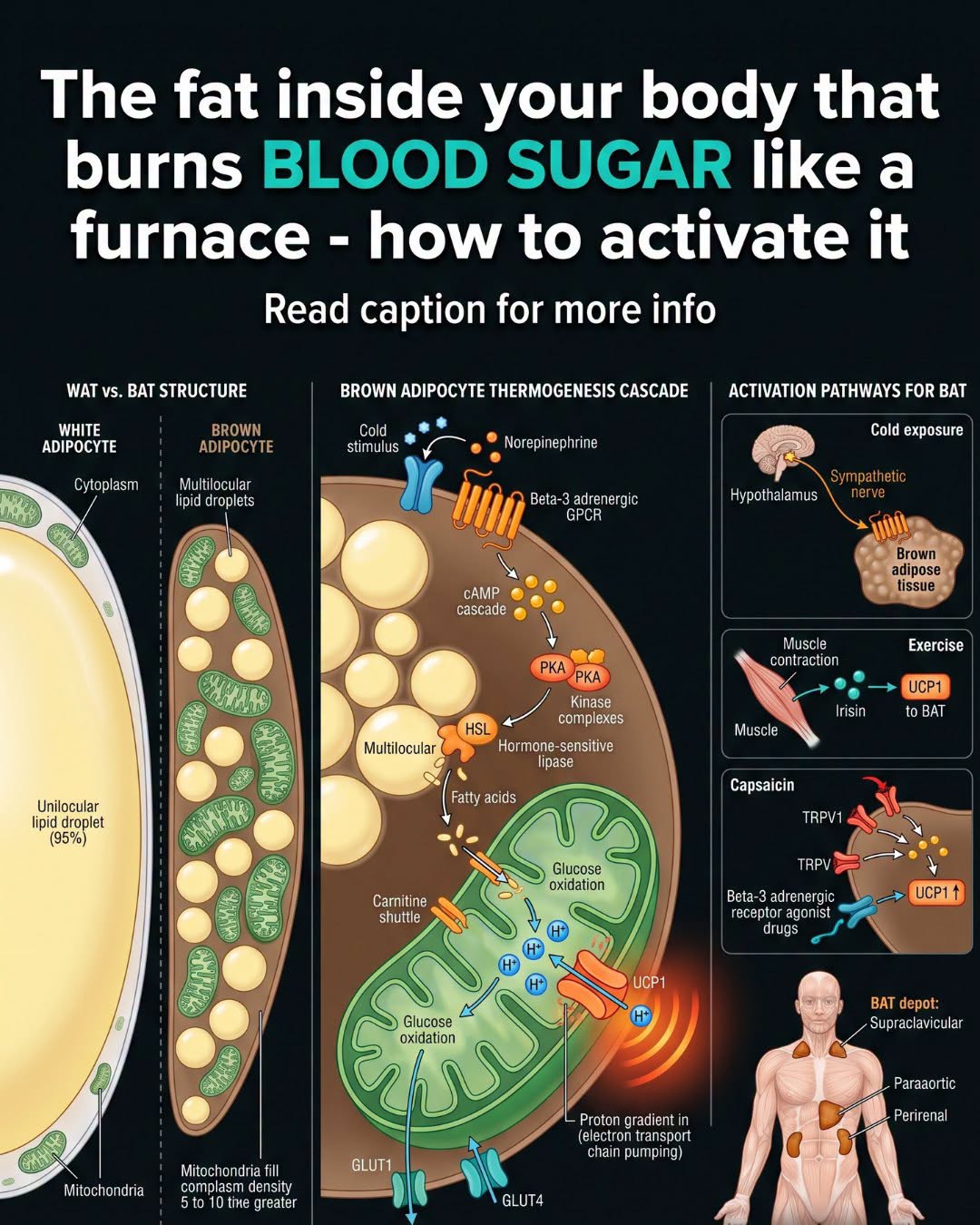
The fundamental distinction between white and brown adipose tissue is mitochondrial. White adipocytes are storage cells - their interior dominated by a single enormous lipid droplet with minimal mitochondria around its perimeter, designed for passive energy storage. Brown adipocytes are energy-consuming cells - their interior filled with multiple small lipid droplets surrounded by the densest mitochondrial population of any cell type in the body, designed for continuous thermogenic fat and glucose oxidation.
The thermogenic mechanism operates through uncoupling protein 1 - UCP1 - a proton channel embedded in the inner mitochondrial membrane of brown adipocytes. The electron transport chain normally pumps protons across the inner mitochondrial membrane to create a gradient that drives ATP production through ATP synthase. UCP1 provides an alternative proton pathway that short-circuits this process - dissipating the proton gradient as heat rather than capturing it as ATP. This "uncoupled" respiration produces no ATP but consumes continuous quantities of fatty acids and glucose as fuel - making activated brown adipose tissue a continuous, insulin-independent glucose disposal system.
Brown adipose tissue in adult humans is located primarily in the supraclavicular region, around the aorta, and in perirenal depots - with total BAT mass varying significantly between individuals and correlating inversely with insulin resistance. Research using PET-CT scanning has confirmed that individuals with higher BAT activity show significantly better insulin sensitivity and lower fasting blood glucose than matched controls, independently of overall adipose mass.
The four most evidence-backed BAT activation strategies available without pharmaceutical intervention: cold exposure (cold showers, cold room sleeping) stimulating the sympathetic-norepinephrine-beta-3 adrenergic receptor cascade. Exercise producing irisin from contracting muscle which activates UCP1 expression in brown adipocytes. Capsaicin from chilli peppers binding TRPV1 receptors on brown adipocytes and activating the same cascade as norepinephrine. Adequate sleep in cool temperatures combining both cold and sleep-related growth hormone signals that promote BAT activity.
Key takeaway: Brown adipose tissue burns glucose and fat simultaneously through a completely insulin-independent mechanism. Cold, exercise, capsaicin, and cool-room sleep activate it. Every spicy meal and every cold shower is talking to this tissue directly.
Save this post - share it with someone you love. Heart emoji
📌 RESOURCES
Brown Adipose Tissue and Insulin Sensitivity: pubmed.ncbi.nlm.nih.gov - search "brown adipose tissue UCP1 glucose metabolism insulin sensitivity Type 2 diabetes"
American Diabetes Association - Non-Shivering Thermogenesis: diabetesjournals.org/diabetes
Capsaicin and BAT Activation: pubmed.ncbi.nlm.nih.gov - search "capsaicin TRPV1 brown adipose tissue thermogenesis"
#Diabetes #Type2Diabetes #BloodSugar #InsulinResistance #DiabetesAwareness